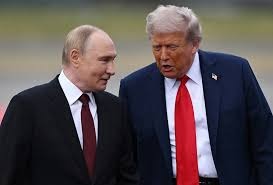
Trump-Putin summit ends without material changes

The Trump–Putin summit in Alaska ended without progress on a ceasefire, underscoring the entrenched positions of both leaders. While Trump hailed the meeting as a success, little substance emerged beyond vague promises of future talks. Putin, however, gained symbolic victories—international recognition and time to advance Russia’s offensive in Ukraine. With Zelensky absent, peace remains distant and fragile. Europe now faces the task of pressuring both Washington and Moscow to sustain support for Kyiv and keep prospects for a fair settlement alive.


Read MoreTrump-Putin summit ends without material changes

The Trump–Putin Summit and its implications for Sustainable Development

The Trump–Putin summit in Anchorage underscored shifting geopolitical dynamics with far-reaching consequences for sustainable development. While dominated by the Russia–Ukraine war, its implications extend to energy security, climate goals, food supply chains, and global cooperation. Agreements hinting at fossil fuel dependency, U.S. security guarantees to Ukraine, and weakened multilateralism risk slowing progress on the SDGs. With disruptions to trade, aid, and decarbonization, the summit highlights the need for vigilant international advocacy for sustainability, inclusivity, and cooperative governance.

Read MoreThe Trump–Putin Summit and its implications for Sustainable Development

Strategic Partner or Dominant Power? Rethinking U.S. Influence on NATO’s Consensus Model

For decades, intergovernmental military alliance NATO has held up its consensus-based decision-making as proof of its democratic values. A system where every member has an equal voice and consensus dictates agreement through unity. Yet, as the dominant military and financial contributor, the influence of the United States has always been apparent. In 2025, does that influence increasingly override collaborative negotiation?

Read MoreStrategic Partner or Dominant Power? Rethinking U.S. Influence on NATO’s Consensus Model

Are African Economies Prepared for a Global Trade Reordering Driven by U.S. -China Decoupling?

As the U.S.–China economic decoupling redefines global trade, Africa faces a critical inflection point. The continent must either seize emerging supply chain opportunities or risk deeper marginalisation. This dispatch lays out a strategic readiness agenda—from industrial zoning to smart trade defence—aimed at positioning Africa within the evolving global trade order.

Read MoreAre African Economies Prepared for a Global Trade Reordering Driven by U.S. -China Decoupling?

The Last Days of the Nation-State: How Corporations Are Building the Next Global Order 

As governments falter under the weight of debt, disruption, and declining legitimacy, corporations are quietly stepping in—not just to influence the global order, but to construct a new one altogether. From private satellite constellations to platform-enforced speech, a corporate architecture of power is emerging with little democratic oversight. This dispatch traces the end of traditional sovereignty and the rise of algorithmic governance—and asks whether the public still governs the public sphere.

Read MoreThe Last Days of the Nation-State: How Corporations Are Building the Next Global Order 

From Presence to Power: Can Africa Redraw the Map of Global Governance?

Africa is no longer absent from global governance—it’s increasingly present, from BRICS to the G20. But visibility without influence is a hollow victory. Despite symbolic gains, real power remains elusive, scattered by internal disunity and institutional limits. To shape the world order, Africa must build leverage, not just presence—through coherence, strategic diplomacy, and reform from within. The seat at the table is not the prize; what Africa does with it is.

Read MoreFrom Presence to Power: Can Africa Redraw the Map of Global Governance?

Privatizing Sovereignty? The Strategic Risks of Governance Vacuums in Fragile States

As state power declines in fragile regions, governance is increasingly shifting to non-state actors—militant groups, corporations, and private investors. From Gaza to tech-run cities, sovereignty is no longer exclusive to nations. This brief examines the rise of private governance, its geopolitical drivers, and the risks it poses to legitimacy, stability, and diplomacy. The future of power may lie not in parliaments, but in boardrooms, algorithms, and fortified zones.

Read MorePrivatizing Sovereignty? The Strategic Risks of Governance Vacuums in Fragile States

Panic in Washington: US Lawmakers Admit They’ve Lost Strategic Control in Africa

Africa is no longer passively awaiting Western aid, it is actively reshaping global power structures. As U.S. influence recedes due to policy neglect and strategic confusion, countries like China, Russia, and Türkiye have filled the void with investments and diplomatic engagement. African leaders are rejecting paternalism, insisting on equal partnerships and sovereign respect. The United States, once a dominant presence, now watches from the sidelines, adrift while the continent forges a multipolar future on its own terms.

Read MorePanic in Washington: US Lawmakers Admit They’ve Lost Strategic Control in Africa

Economic Deals and Syria Sanctions Lift- The Implications of Trump’s Middle East Tour

During a four-day tour of Saudi Arabia, Qatar, and the UAE, U.S. President Donald Trump secured historic economic and defense deals, including a $600 billion investment pact with Saudi Arabia and a $1.4 trillion AI agreement with the UAE. In a surprise move, Trump also announced the lifting of U.S. sanctions on Syria, signaling a potential diplomatic reset and opening the door to regional economic investment and reconstruction.

Read MoreEconomic Deals and Syria Sanctions Lift- The Implications of Trump’s Middle East Tour

US-Syria Relations – How the Lifting of Sanctions can Lead to Opportunities for Rapprochement

The recent U.S. decision to lift sanctions on Syria has sparked cautious hope for a new chapter in U.S.-Syria relations. With a new Syrian president in place, there's a chance to rebuild diplomatic and economic ties. While the move offers opportunities for recovery and cooperation, it comes with tough conditions. Could this be the start of lasting peace and partnership, or just a temporary shift in a complex region?

Read MoreUS-Syria Relations – How the Lifting of Sanctions can Lead to Opportunities for Rapprochement