AI in 2025: The Good, the Bad, and the Ugly

By 2025, artificial intelligence has shifted from disruptive innovation to strategic infrastructure. It is boosting productivity, accelerating scientific discovery, and expanding access to knowledge, while simultaneously intensifying labour disruption, market concentration, and governance gaps. More troublingly, AI is eroding trust in information, enabling surveillance, and compressing decision-making in ways that strain democratic and security systems. AI is no longer a neutral tool; it is a force multiplier whose impact depends less on capability and more on the strength of institutions that govern it.
Read MoreAI in 2025: The Good, the Bad, and the Ugly

2026 Geopolitics: Power Without Dominance

Geopolitics in 2026 is defined by power without dominance. Major states retain significant military and economic capacity, yet lack the ability to impose durable outcomes unilaterally. Strategic competition has shifted toward chokepoints in technology, energy, and finance, while unresolved conflicts are increasingly managed rather than resolved. Fiscal constraints, alliance recalibration, and regional power assertion are reshaping global behaviour, producing a fragmented international system marked by calibrated escalation, persistent friction, and heightened strategic uncertainty.

Read More2026 Geopolitics: Power Without Dominance

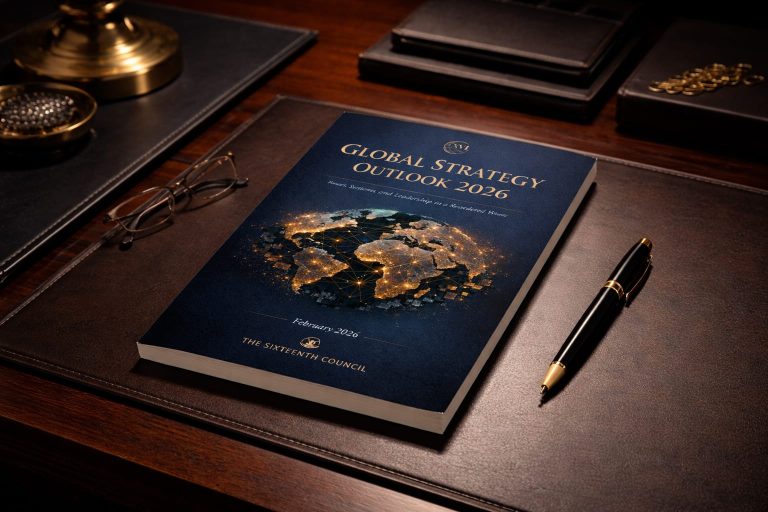
The Sixteenth Council to Release Global Strategy Outlook 2026 in February 2026

Global Strategy Outlook 2026 examines a world moving beyond emergency management into a decisive phase of structural redesign. As geopolitical fragmentation deepens, economies rewire, technology becomes a core arena of power, and institutional trust erodes, reactive leadership is no longer sufficient. The report offers a strategic framework for governments, executives, and institutions seeking resilience, legitimacy, and long-term performance in a volatile decade. The future will reward foresight, system-building, and disciplined strategic choice across global, regional, and sectoral decision-making environments worldwide.

Read MoreThe Sixteenth Council to Release Global Strategy Outlook 2026 in February 2026

Global Trade in 2025: From Efficiency to Power

By 2025, global trade stopped pretending to be neutral. Efficiency gave way to resilience, markets to strategy, and institutions to power. Shipping routes, carbon rules, currencies, and data flows became tools of statecraft rather than technical details. Trade did not collapse; it realigned around security and political trust. The era of frictionless globalization ended quietly, replaced by a world where who you trade with now matters as much as what you trade.

Read MoreGlobal Trade in 2025: From Efficiency to Power

What Trump Really Wants in Venezuela and How it Affects India?

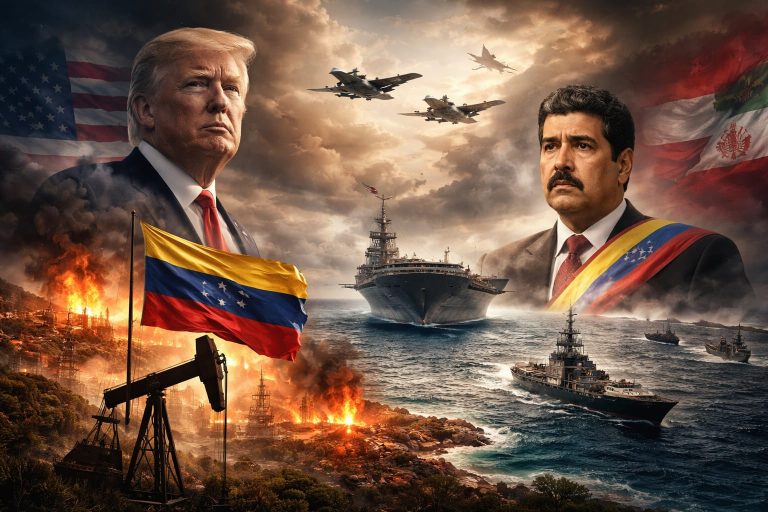
Trump’s Venezuela strategy is less about democracy and more about power: oil leverage, geopolitical signaling, and dismantling rival influence from Russia, China, and Iran. By framing pressure on Caracas as a war on drugs, Washington creates legal and political cover for escalation. For India, the fallout is tangible—sanctions disrupt crude supplies, stall ONGC Videsh investments, and expose the fragility of energy planning in a sanctions-driven world. Geopolitics, not markets, now dictates access.

Read MoreWhat Trump Really Wants in Venezuela and How it Affects India?

Electoral Uncertainty in Latin America

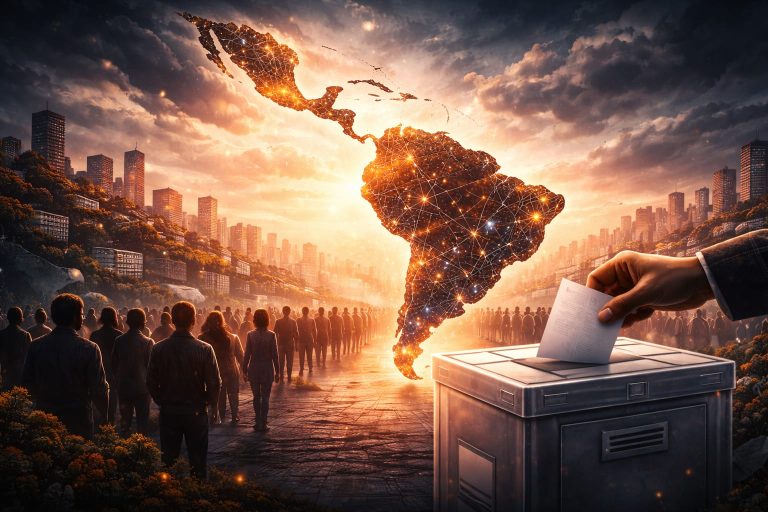
Latin America is entering a period of heightened electoral uncertainty as a dense cycle of elections from late 2025 to 2026 reshapes the region’s political trajectory. Voter fatigue, economic pressures, and dissatisfaction with inequality are fuelling a potential shift away from left-leaning governments toward more centrist or market-oriented leadership. While this transition may unlock reform and investment opportunities, it also heightens risks of policy volatility, social unrest, and intensified geopolitical competition between global powers.

Read MoreElectoral Uncertainty in Latin America

Global Order Under Strain: The Major Foreign-Policy Shocks of 2025

2025 exposed a global order under strain, defined less by decisive realignments than by accumulating shocks. U.S.–China economic confrontation became visibly symmetric, conflict mediation in Ukraine and the Middle East lost credibility, and regional actors assumed security roles once held by global powers. Trade routes, supply chains, and deterrence norms all proved fragile. The year underscored a central reality: major powers retain ambition, but their ability to enforce outcomes is increasingly constrained, producing a more volatile and contested international system.

Read MoreGlobal Order Under Strain: The Major Foreign-Policy Shocks of 2025

Economies to Watch in 2026

The global economy entering 2026 is no longer governed primarily by growth cycles, but by strategic stress. Fiscal exhaustion in advanced economies, geopolitical fragmentation, energy realism, and uneven technological diffusion are reshaping economic outcomes. The most consequential economies in 2026 will not be those expanding fastest, but those sitting at critical inflection points—capable of transmitting shock, absorbing volatility, or redefining alignment. Economics has become an instrument of power, constraint, and contest.

Read MoreEconomies to Watch in 2026

A brief analysis of Labour’s first year in government – A story of economic struggle and foreign policy success

Labour’s first year in government has been defined by domestic economic strain alongside notable foreign policy achievements. While gradual tax rises and budget reforms have stabilised markets and supported modest growth, rising unemployment, inflation and welfare controversies have damaged public confidence. Social policy decisions have pleased few voters, leaving space for rival parties. In contrast, Labour’s strengthened ties with the US and EU, continued support for Ukraine, and pragmatic diplomacy mark a rare area of clear success for the government.

Read MoreA brief analysis of Labour’s first year in government – A story of economic struggle and foreign policy success

A Continent Under Pressure: Europe’s Battle for Sustainable Food Security

Europe’s food security is entering a new era of vulnerability as climate change, rising production costs, geopolitical shocks, and widening inequalities disrupt every stage of the food chain. While food availability remains strong, affordability and access are deteriorating for millions. With climate-driven losses mounting and supply chains increasingly exposed to external risks, Europe must shift from reactive crisis management toward a resilience model built on climate adaptation, supply-chain diversification, stronger food-safety governance, and targeted support for vulnerable consumers.

Read MoreA Continent Under Pressure: Europe’s Battle for Sustainable Food Security