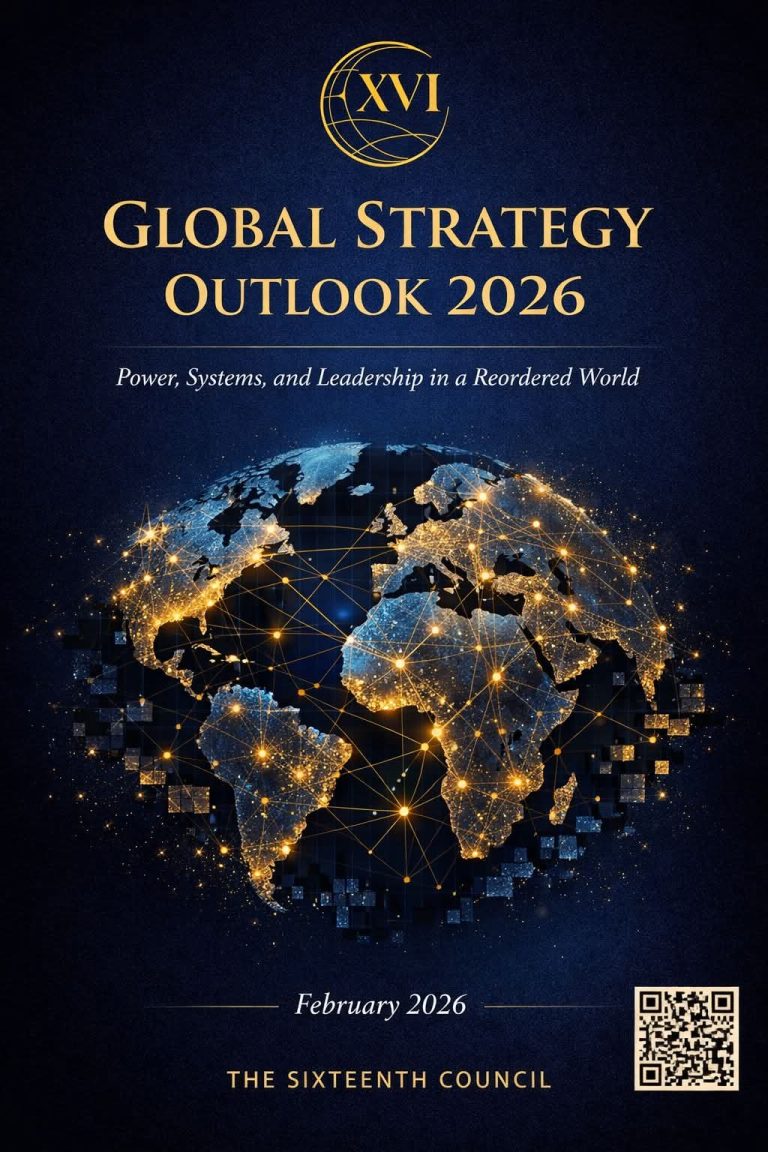
The Sixteenth Council to Release Global Strategy Outlook 2026 in February 2026
Global Strategy Outlook 2026 examines a world moving beyond emergency management into a decisive phase of structural redesign. As geopolitical fragmentation deepens, economies rewire, technology becomes a core arena of power, and institutional trust erodes, reactive leadership is no longer sufficient. The report offers a strategic framework for governments, executives, and institutions seeking resilience, legitimacy, and long-term performance in a volatile decade. The future will reward foresight, system-building, and disciplined strategic choice across global, regional, and sectoral decision-making environments worldwide.

London | 25th December 2025 — The Sixteenth Council has announced the forthcoming release of its flagship report, Global Strategy Outlook 2026, scheduled for publication in February 2026. The report provides a comprehensive strategic assessment of the forces reshaping global power, governance, and economic performance as the international system enters a new cycle between 2026 and 2030.
After more than half a decade marked by overlapping crises—ranging from geopolitical conflict and economic volatility to institutional strain and technological disruption—the report argues that the global environment is shifting away from constant emergency response toward a period defined by structural redesign, systemic reorganization, and long-term strategic choice. In this context, the report cautions that leaders who remain trapped in reactive crisis management will increasingly lose strategic advantage.
Global Strategy Outlook 2026 asserts that the next phase of global leadership will reward those capable of building resilient systems, adapting institutions, and exercising strategic foresight across political, economic, and technological domains. The report emphasises that resilience is not accidental but must be deliberately designed into governance frameworks, markets, and organisational structures.
The Outlook identifies five fundamental shifts shaping global outcomes over the remainder of the decade: intensifying geopolitical fragmentation and bloc competition; the re-wiring of globalisation as supply chains and industrial capacity reconfigure; the rise of technology—particularly artificial intelligence—as a central arena of power and systemic risk; increasing environmental volatility with direct economic and infrastructure consequences; and a widespread erosion of public trust in institutions driven by weak service delivery, corruption, and large-scale misinformation.
In response, the report sets out a Ten-Point Global Leadership Agenda for 2026–2030, offering a strategic framework for stabilising a fragmenting global order, rebuilding institutional trust, strengthening collective security and crisis prevention, designing sustainable growth models focused on productivity rather than debt, governing AI and emerging technologies responsibly, enhancing environmental resilience and resource security, rebuilding global health and biosecurity capacity, securing critical supply chains and infrastructure, preparing labour markets for technological disruption, and protecting and governing the global commons.
Global Strategy Outlook 2026 is intended for senior decision-makers across government, business, finance, and international institutions, and will be supported by executive briefings and strategic insights following release.
📘 Release Date: February 2026
🔔 Subscriptions are now open on our website for early access, executive briefings, and priority insights ahead of public release