
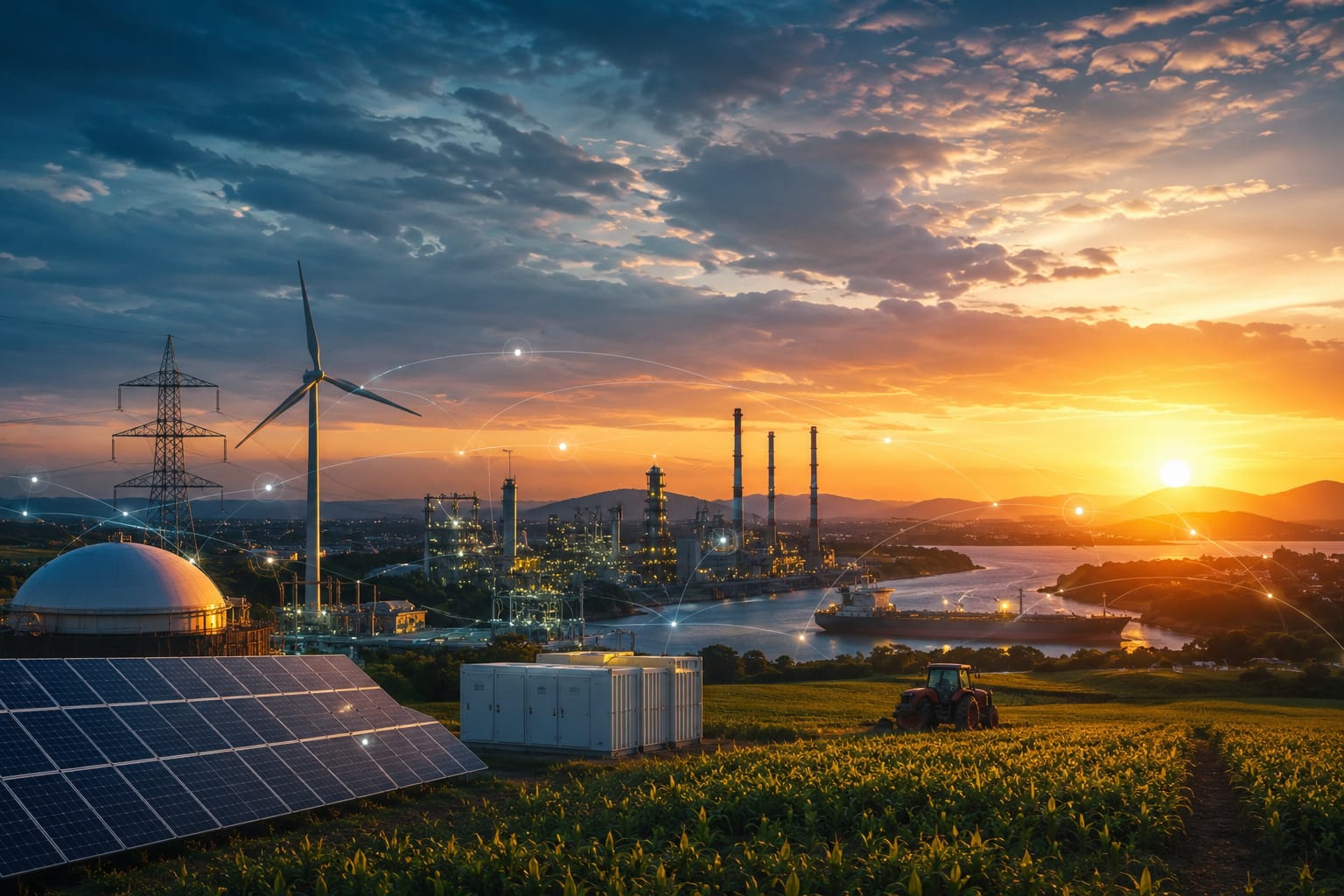
Energy, Food, and Power: The New Geopolitics of Global Markets
Dr. Silvana Sosa Clavijo examines how energy, artificial intelligence, food systems, and geopolitics are reshaping the global economy. As electricity replaces oil as the strategic foundation of growth, nations face new pressures linked to AI-driven energy demand, supply-chain vulnerabilities, and geopolitical instability. The article argues that energy security, food security, and technological competitiveness are now deeply interconnected. It concludes that future global influence will depend on resilient electricity systems, strategic infrastructure, agricultural stability, and control of critical supply chains.

Introduction
The global economy is entering a new era in which energy, technology, food systems, and geopolitics are becoming increasingly interconnected. The transformation currently taking place in global energy markets is not simply a transition toward cleaner energy sources; it represents a structural reconfiguration of economic power, industrial competitiveness, and international security. Electrification, artificial intelligence, geopolitical fragmentation, and supply-chain vulnerabilities are reshaping the foundations of global markets and altering the balance of strategic influence among nations.
For more than a century, oil and gas dominated the architecture of economic growth and geopolitical power. Today, however, electricity has emerged as the new strategic axis of development. According to the International Energy Agency (IEA), global electricity demand is growing significantly faster than overall energy demand, driven by digitalization, electric mobility, industrial electrification, and the rapid expansion of artificial intelligence infrastructure.
At the same time, geopolitical tensions in the Middle East, the war in Ukraine, disruptions in global supply chains, and competition over critical minerals are redefining energy security strategies worldwide. These developments are also contributing to rising food prices and inflationary pressures, demonstrating that energy security and food security can no longer be treated as separate policy domains.
The emerging global order is therefore increasingly shaped by the interaction between energy systems, technological transformation, agricultural resilience, and geopolitical competition. Understanding these dynamics is essential for governments, businesses, and international organizations seeking to navigate an increasingly unstable and interconnected world.
1. The rise of the “Age of Electricity”
One of the most important structural changes in the global economy is the accelerated electrification of economic activity. Historically, economic growth was closely associated with fossil fuel consumption, particularly oil. However, the rise of electric mobility, renewable energy systems, digital infrastructure, and electrified industrial production is transforming this relationship.
The IEA’s Electricity 2026 Report projects that electricity demand will grow at more than twice the pace of overall energy demand through the end of the decade. This growth is being driven not only by climate policies, but also by oil price volatility, industrial modernization, urbanization, and technological expansion.
A particularly symbolic development is the rapid growth of solar energy. According to the IEA Global Energy Review 2026, solar photovoltaic power became the largest contributor to global energy demand growth in 2025. This milestone reflects both the declining cost of renewable technologies and the strategic importance of electricity infrastructure in modern economies.
As a result, energy security is increasingly being redefined. In the twentieth century, strategic power depended largely on access to oil and gas reserves. In the twenty-first century, it increasingly depends on electricity generation capacity, grid resilience, battery storage, and access to critical minerals such as lithium, cobalt, and rare earth elements.
Countries capable of modernizing electricity infrastructure and securing supply chains for clean technologies are likely to gain major economic and geopolitical advantages in the coming decades.
2. Artificial intelligence and the new energy demand shock
Artificial intelligence is rapidly becoming one of the most important drivers of global electricity demand. Although AI is generally understood as a technological revolution, it is equally an energy revolution because of the enormous computational power required by data centres and digital infrastructure.
The expansion of hyperscale data centres is creating unprecedented pressure on electricity systems, particularly in North America, Europe, and parts of Asia. Research published through ArXiv indicates that concentrated siting of AI data centres drives regional power-system stress which suggests that AI-related electricity consumption could more than double by 2030, significantly increasing stress on regional grids.
These pressures are already visible. The North American Electric Reliability Corporation (NERC) has warned that rapidly changing electricity loads associated with data centres may threaten grid stability and increase blackout risks. Governments and utility companies are therefore accelerating investments in transmission systems, battery storage, smart grids, and alternative energy generation.
The AI-energy nexus is also reshaping global investment patterns. Large-scale capital is simultaneously flowing into renewable energy, nuclear power, gas infrastructure, and storage technologies to support growing digital demand. Technological leadership is increasingly inseparable from energy capacity.
This transformation highlights a broader reality: the future digital economy will depend fundamentally on reliable and resilient energy systems. Countries unable to expand electricity infrastructure may face constraints not only on industrial growth, but also on technological competitiveness.
3. Geopolitics, energy security, and food prices
Despite the expansion of renewable energy, geopolitics continues to exert powerful influence over global energy markets. Conflicts in the Middle East, the war in Ukraine, and tensions surrounding shipping corridors and critical minerals have reinforced the strategic importance of energy security.
Recent instability involving Iran and Qatar has exposed the vulnerability of liquefied natural gas (LNG) markets and increased concerns regarding global supply disruptions. According to Reuters, IEA says that Middle East tensions are already tightening medium-term gas supply expectations and contributing to higher transportation and storage costs.
These developments are not limited to energy markets alone. Modern agriculture is deeply dependent on energy systems through fuel, fertilizers, irrigation, refrigeration, and transportation. Natural gas is a key input in fertilizer production, meaning that increases in gas prices rapidly translate into higher agricultural costs and rising food prices.
The FAO Food Price Index has shown renewed increases in global food prices, driven partly by higher energy costs and stronger biofuel demand. Similarly, the World Bank Commodity Markets Outlook 2026 warns that prolonged geopolitical instability could intensify inflationary pressures across both energy and food markets.
The relationship between energy and food systems has therefore become increasingly structural. Higher oil prices increase transportation costs across global supply chains, while higher fertilizer prices reduce agricultural productivity and increase food insecurity in vulnerable regions.
This energy-food nexus has major geopolitical implications. Food inflation contributes to social instability, migration pressures, fiscal stress, and political unrest, particularly in developing economies where households spend a larger proportion of income on food and energy.
Consequently, the transformation of global energy markets must also be understood as a challenge of human security. Energy transitions that fail to preserve affordability and agricultural resilience may generate broader economic and political instability.
4. The hybrid energy transition
One of the clearest lessons emerging from current market developments is that the global energy transition will likely be hybrid rather than linear. Earlier expectations that renewable energy would rapidly replace fossil fuels are increasingly giving way to more pragmatic and diversified approaches.
Renewable energy capacity continues expanding rapidly, especially in solar and wind power. However, intermittency challenges require complementary investments in storage systems, transmission infrastructure, backup generation, and grid modernization. According to the IEA Global Energy Review 2026, battery storage has become one of the fastest-growing sectors in global energy markets.
At the same time, natural gas remains strategically important as a stabilizing fuel for electricity systems, while nuclear energy is regaining attention as a reliable low-carbon energy source.
Governments are therefore increasingly prioritizing resilience, affordability, and energy security alongside decarbonization objectives. The transition is becoming less ideological and more operationally pragmatic.
The future energy system will likely combine renewables, fossil fuels, storage technologies, nuclear energy, and digital infrastructure within increasingly interconnected networks. Managing this complexity will become one of the defining economic and geopolitical challenges of the twenty-first century.
Conclusion
The transformation of global energy markets is reshaping not only energy systems, but also the foundations of economic power, technological competitiveness, food security, and geopolitical stability. Electrification, artificial intelligence, geopolitical fragmentation, and climate pressures are accelerating the emergence of a new global order characterized by interconnected systemic risks.
Electricity is progressively replacing oil as the strategic foundation of economic development. Artificial intelligence is becoming a major source of energy demand. Geopolitical instability continues to influence energy and food markets simultaneously, while governments increasingly recognize infrastructure resilience as a matter of national security.
Perhaps the most important conclusion is that energy transitions can no longer be analysed exclusively through environmental or technological perspectives. They must also be understood in relation to inflation, agricultural resilience, social stability, and geopolitical competition.
The future global balance of power will therefore depend not only on access to hydrocarbons, but also on the ability to secure resilient electricity systems, technological infrastructure, food security, and strategic supply chains in an increasingly interconnected world.
Dr. Silvana Sosa Clavijo is Research Fellow for the Europe Program of The Sixteenth Council
Changing Latin America’s Security Architecture: What It Means for India