
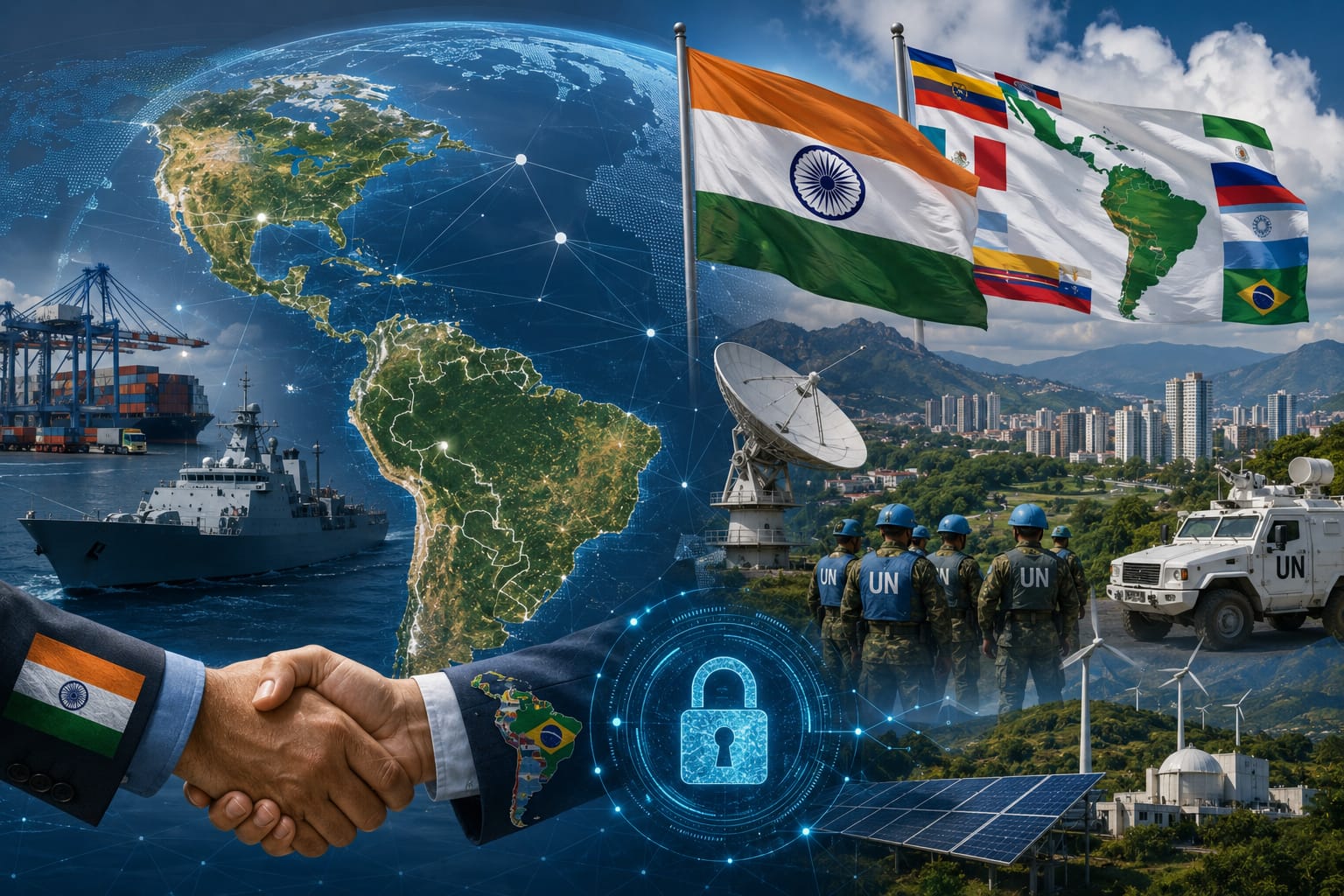
Changing Latin America’s Security Architecture: What It Means for India
Latin America’s evolving security architecture is being reshaped by geopolitical competition, organised crime, climate risks, migration, and digital threats. As regional powers seek greater autonomy in a multipolar world, India faces new strategic, economic, and diplomatic opportunities across the region. This report explores how India can strengthen defence cooperation, secure critical supply chains, expand technological partnerships, and deepen multilateral engagement with Latin America while navigating rising Chinese influence, political fragmentation, and emerging non-traditional security threats in an increasingly interconnected global order.

Introduction
The global security situation has changed significantly over the past few months, and Latin America is no different. There have been significant changes in the region’s security architecture, the combination of institutions, alliances, conventions, and policies that shape how it handles security. A number of internal and external variables, including political realignments, transnational crime, economic integration, the rise of great-power competition, and the evolution of multilateralism, are shaping these shifts. India is becoming a more powerful country globally, and its economic and diplomatic interests in Latin America are growing. These changes are crucial for India. This report examines why the security situation in Latin America is evolving and what it means for India, focusing on the strategic, economic, and diplomatic aspects.
I. Latin America’s Security Architecture: A Brief History
The security framework of Latin America has been influenced by three primary factors: the legacy of colonialism, the impact of the US, and intra-regional rivalries. During the Cold War, the US and the Soviet Union fought over ideas in the region. The US took the lead through the Monroe Doctrine, military interventions, and assistance for allied regimes. Security was largely militarised, and national militaries had a significant say in how the country was run.
After the Cold War, democracy and free markets spread across the continent, changing how people thought about security. The Organisation of American States (OAS) and newer groups like MERCOSUR and UNASUR became places where people could talk and work out their differences. There was increasing focus on human security, development, and non-traditional risks, such as drug trafficking, organised crime, and environmental problems.
II. Contemporary Reasons for Changes in Latin America’s Security Architecture
- Internal Factors
The reasons why Latin America’s security architecture is changing are complicated. They come from a mix of internal and external factors. Since the 1990s, the region has undergone major political change, marked by the collapse of military dictatorships and the growth of democratic institutions. This change has given civilians greater control over security personnel and enabled security to be handled in more open and evolving ways. Indigenous rights activism and social movements have been very important in pressuring governments to implement security measures that prioritise social inclusion and address the underlying causes of insecurity. But the rise of populist governments on both the left and the right in recent years has destabilised regional security cooperation, often undermining its consistency and efficiency.
Transnational organised crime and violence are another big problem that keeps coming up within the country. Latin America still has a lot of problems with drug cartels, especially in Mexico and Colombia. There are other networks that deal in people trafficking and gun smuggling. Governments have had to militarise police forces and come up with new ways to keep people safe because of gang wars and violence in cities, especially in Brazil and Central America. These non-state entities weaken the state’s power and make it harder for regions to work together to address security challenges.
Socioeconomic disparity and migration make the security situation even worse. Persistent inequality leads to crime and social unrest. Political and economic instability, as in Venezuela, especially after the US invasion, has led many people to move to other parts of the region. Because of this, security responses are increasingly focused on humanitarian issues and the management of migratory movements, in addition to traditional policing and border security. These internal forces have complicated Latin America’s security problems.
- External Factors
The external factors transforming Latin America’s security architecture are equally important. One of the most important factors is the great game between the US, China and Russia and the rise of a multipolar order. The US has long been the most powerful country in Latin America in terms of security and politics. However, in recent years, its strength has been challenged by the growing presence of other global powers, especially China and, to a lesser extent, Russia. Countries in Latin America are seeking more international partners to reduce their reliance on the US and gain greater freedom to make security decisions aligned with their national interests.
China’s expanding presence in Latin America is a defining feature of the present. China is becoming one of the most important trading partners and investors. It pays for large infrastructure, mining, and energy projects, such as those linked to the Belt and Road Initiative. China has expanded its involvement in the region through arms sales, transfers of security technologies, and high-level diplomatic engagements, all of which have significant consequences for the region’s security.
At the same time, the rise and strengthening of regional organisations such as CELAC, ALBA, and the Pacific Alliance signal a trend toward regionalism and multilateralism in security matters. These groups have set up new places for security talks that sometimes go around the old US-led ones. But political instability and ideological differences among member states sometimes undermine these groups’ effectiveness, especially in Venezuela, Brazil, and Argentina. Regionalism can lead to more localised and responsive security measures, but it also has significant problems because there is no agreement or unity within the region.
C. Non-Traditional Security Threats
Non-traditional security risks are increasingly affecting Latin America’s security system. Climate change and environmental insecurity are two of the most important problems on this list. Problems such as deforestation in the Amazon, frequent natural disasters, and resource scarcity are harmful to peace and security in the region. As these environmental concerns worsen, more and more people are realising that regional collaboration is needed, especially in disaster response and environmental protection, to address shared weaknesses.
Simultaneously, the swift digitalisation of Latin American businesses and cultures has rendered the region vulnerable to new risks, especially in cybersecurity. Cyberattacks and information warfare are becoming more common, which is a big threat to national security, economic stability, and even democracy. But even as people become more aware of and worried about cybersecurity, national and regional governments still don’t have the tools they need to address these digital dangers. These non-traditional security problems are now at the top of regional policy agendas. To address them, countries need to be more resilient at home and work more closely with other countries.
III. Important Fragments of the Changing Security Architecture
The changing security architecture of Latin America has several important elements that show how it is adapting to new challenges and rethinking old ways of doing things. First, there has been a move toward hybrid security models that combine traditional state-centred defence systems with a focus on non-traditional threats, including organised crime, public health, and environmental disasters. This strategy acknowledges that regional security cannot be managed solely through military or police interventions, and that collaborative initiatives across multiple societal sectors are required.
Another important part is security sector reform. Many nations are working to modernise their police and military services, teach human rights, and make security institutions more open. These changes frequently lead more people from civil society to take part in discussions on security policy. This helps make sure that security plans are more open to and responsive to the demands of different communities. The area has also embraced what is sometimes called a “variable geometry” of cooperation, meaning it prefers informal coalitions and issue-based alliances over formal treaties. This flexible strategy enables countries to address unique security challenges, including anti-drug operations and disaster response, more effectively and in a timely manner.
Lastly, Latin America’s security situation is getting more attention from outside countries. The area is becoming more open to foreign investment, technology sharing, and joint security work. China and, more recently, India are the most notable examples. Latin America is ready to work with a wide range of partners because the current international system is multipolar, and the region seeks solutions that best address its own security challenges.
IV. Consequences & Effects for India
India’s ties with Latin America have increased steadily since the start of the 21st century. Even though the two regions are far apart and haven’t interacted much in the past, they now have more commerce, diplomatic, and people-to-people ties. India faces both opportunities and challenges due to the changing security situation in Latin America.
A. Strategic Effects
The evolving security situation in Latin America presents both challenges and new opportunities for India. For example, Latin America accounted for about 8% of the world’s homicides in 2025, with organized crime and drug trafficking continuing to pose significant security threats across the region. At the same time, India has greater opportunities to move diplomatically and strategically as the region becomes more independent and its international partnerships become more varied. The trade volume between India and Latin America reached approximately $62 billion in 2025, highlighting robust economic engagement that can support security cooperation. India may now expand its geostrategic presence in areas once controlled by other major powers, as the regional order shifts. One sign of this expanding involvement is that India has sent over 1,200 troops to Latin America for United Nations peacekeeping missions, including the one in Haiti, thereby strengthening security ties between the two regions. Also, the changing dynamics make it possible for naval cooperation to grow, including joint exercises, anti-piracy efforts, and maritime security measures in the South Atlantic. These changes suggest that India may play a greater role in shaping the region’s security, safeguarding its own interests, and building defence relationships that benefit both sides.
India also needs to consider how to address China’s expanding influence in Latin America. China is now the largest trading partner for several Latin American countries, with China-Latin America trade surpassing $520 billion in 2025, and Chinese investments exceeding $155 billion since 2005, mainly in infrastructure, energy, and mining. If India doesn’t do something about it, China’s quick growth in the region’s economy and diplomacy could push Indian interests to the side. India may offset this by leveraging its capabilities in technology, pharmaceuticals, information technology, and capacity building to become a viable alternative partner—sectors where India’s exports to Latin America grew by over 25% in 2025. It can also use its reputation as a responsible global actor and its democratic credentials to do this. India can further improve its strategic standing in the region by participating in strategic talks and defence exchanges with key Latin American countries such as Brazil, Mexico, and Argentina. For example, India’s bilateral trade with Brazil reached $18.6 billion in 2025, and with Mexico, $5.1 billion, indicating a foundation for deeper engagement. These actions would not only help India secure its own interests but also help make the region’s international order more balanced and multipolar.
B. Effects on the Economy and Technology
India’s economy and technology will be greatly affected by the changes in Latin America’s security architecture. As Indian businesses invest more and more in areas like agriculture, medicines, and information technology, they are also more and more at risk from organised crime and political instability. These concerns can interfere with commerce and make it harder for Indian citizens to stay secure. This is why it is so important to establish robust consular protection and crisis response systems to safeguard the interests of the growing Indian diaspora in Latin America.
Additionally, Latin America is a major supplier of energy resources, including oil from Venezuela and Brazil, as well as significant minerals such as lithium, copper, and gold, which are necessary for India’s economic growth and technological progress. But these supply chains remain at risk of security problems, whether from the collapse of a state or from the activities of actors outside the state. To reduce these risks, India must improve its government-to-government frameworks and private-sector risk management practices so that these resources remain available.
India has significant potential to help Latin America strengthen its cybersecurity and digital governance capabilities, which are becoming increasingly vital as the region goes digital. India can create win-win situations by working together in space technology, e-governance, and financial technology (fintech). This would help Latin America become more technologically advanced and offer new ways for the two regions to work together and expand their economies.
C. Engagements in Diplomacy and Multilateralism
India has greater opportunities to engage in diplomacy and multilateral relations in Latin America due to changes in the region’s security situation. One major way is through regional groups. India is already an observer in the Pacific Alliance and CARICOM. India may participate in more security talks and policy discussions by leveraging this status to its advantage. This will give India more power and help it create networks of trust across the region. India’s reputation as a responsible and helpful partner is further strengthened by practical engagement, such as participating in disaster relief exercises, offering health cooperation (as shown during the COVID-19 pandemic through vaccine diplomacy), and contributing to UN peacekeeping missions.
Also, Latin America’s evolving security architecture aligns with India’s overall foreign policy focus on South-South cooperation, multipolarity, and the improvement of global governance institutions. India and Latin American countries can work more closely together on global problems such as climate change, trade, and security threats through multilateral institutions like the G20 and the United Nations. These diplomatic efforts help India and make the world a fairer and more open place for everyone.
D. Risks and Challenges
India is seeking to become more involved in Latin America, but the region’s evolving security architecture presents both opportunities and challenges. The security situation is complicated by weak institutions and divided regional politics, which can make it harder for India to build partnerships or implement initiatives. India is also always at risk of being drawn into local conflicts or caught in the middle of great-power rivalry, especially as the US and China compete for supremacy in the region.
Another factor is that India needs to invest more in resources and capabilities to match big players in Latin America, including the US and China. The US remains the largest foreign investor in Latin America with over $870 billion in investments, while China’s investments have crossed $155 billion since 2005, especially in infrastructure and energy. India’s diplomatic and military footprint is expanding, with defence exports reaching $3.1 billion in 2024–25, including indigenous equipment like the BrahMos missile and Akash air defence systems. To match the scale of competitors, India needs a deliberate strategy that focuses on expanding military ties and increasing its defence exports to Latin America, which currently remain limited. Lastly, India needs to stay on the lookout for non-traditional security threats, including pandemics, cybercrime, and climate change-driven disasters. For instance, Latin America suffered economic losses of over $32 billion from climate-related disasters in 2025, and cybercrime cost the region nearly $10 billion in the same year, both of which could directly or indirectly affect India’s interests.
V. Recommendations
India should adopt a proactive, multi-pronged strategy to address the evolving security situation in Latin America. First, it is important to strengthen security talks between two or more countries by making regular meetings with major Latin American countries part of the process and by becoming more involved in regional organisations and international forums. This kind of involvement will build confidence, make it easier to share information, and give people a heads-up about new risks.
Another priority is to increase collaboration in defence and security. India can consider conducting joint military exercises, port calls by its navy, and defence technology transfers with some Latin American countries. Sharing best practices in areas like disaster management, cyber defence, and counter-narcotics will make both sides stronger and more resilient. India needs to improve its economic diplomacy and risk-reduction approaches. This involves helping Indian businesses identify and address security issues, as well as setting up robust systems for sharing information and responding to crises to keep the Indian diaspora in the area safe.
To develop long-term relationships, it will be important to encourage capacity building and the sharing of expertise. India can help Latin American countries address both traditional and non-traditional security challenges by providing training, scholarships, and technical expertise in areas such as security sector reform, digital governance, and emergency response. Lastly, India should use its soft power to create development partnerships by strengthening people-to-people linkages through cultural and educational exchanges. Working together on projects in sustainable development, public health, and climate resilience will not only improve India’s reputation as a responsible actor but also lay the groundwork for long-term cooperation in these areas.
Conclusion
The changing security architecture of Latin America results from both global trends, such as multipolarity, the rise of non-traditional threats, and new ways of interacting with the world, as well as the region’s own historical, political, and economic problems. India has a clear chance to move beyond traditional ways of working together as these changes happen. It may broaden its position beyond commerce and diplomacy to include security, technology, and development cooperation. India’s active participation can help Latin America in becoming more stable, strong, and prosperous, while also helping India achieve its strategic and economic goals worldwide. As Latin America seeks greater freedom and variety in its international partnerships, India’s democratic credentials, technological know-how, and experience in handling complex security situations could be highly valuable. India can become a trusted and important partner for Latin American countries by investing in regular diplomatic talks, collaboration on defence and security, ways to reduce economic risk, and programs to improve capability. India’s desire to work together on important global problems such as climate change, cybersecurity, and public health demonstrates its commitment to shared ideals and progress for all.
India must be aware of the challenges that come with this potential in the region, including political fragmentation, rivalry among major powers, and new threats such as pandemics and cybercrime. To be successful, India needs to focus on building long-lasting connections, prioritising important relationships, and being ready to adapt to a rapidly changing regional situation. In the end, the future of Indo-Latin American relations will depend on more than just trade. It will also depend on building strong, mutually beneficial security and development partnerships that can navigate the unpredictability of a complex, interwoven world.
Prof Punit Gaur is a senior fellow at the Sixteenth Council Asia Program
Energy, Food, and Power: The New Geopolitics of Global Markets