China, Taiwan, and the Pacific Question: Influence Before Invasion
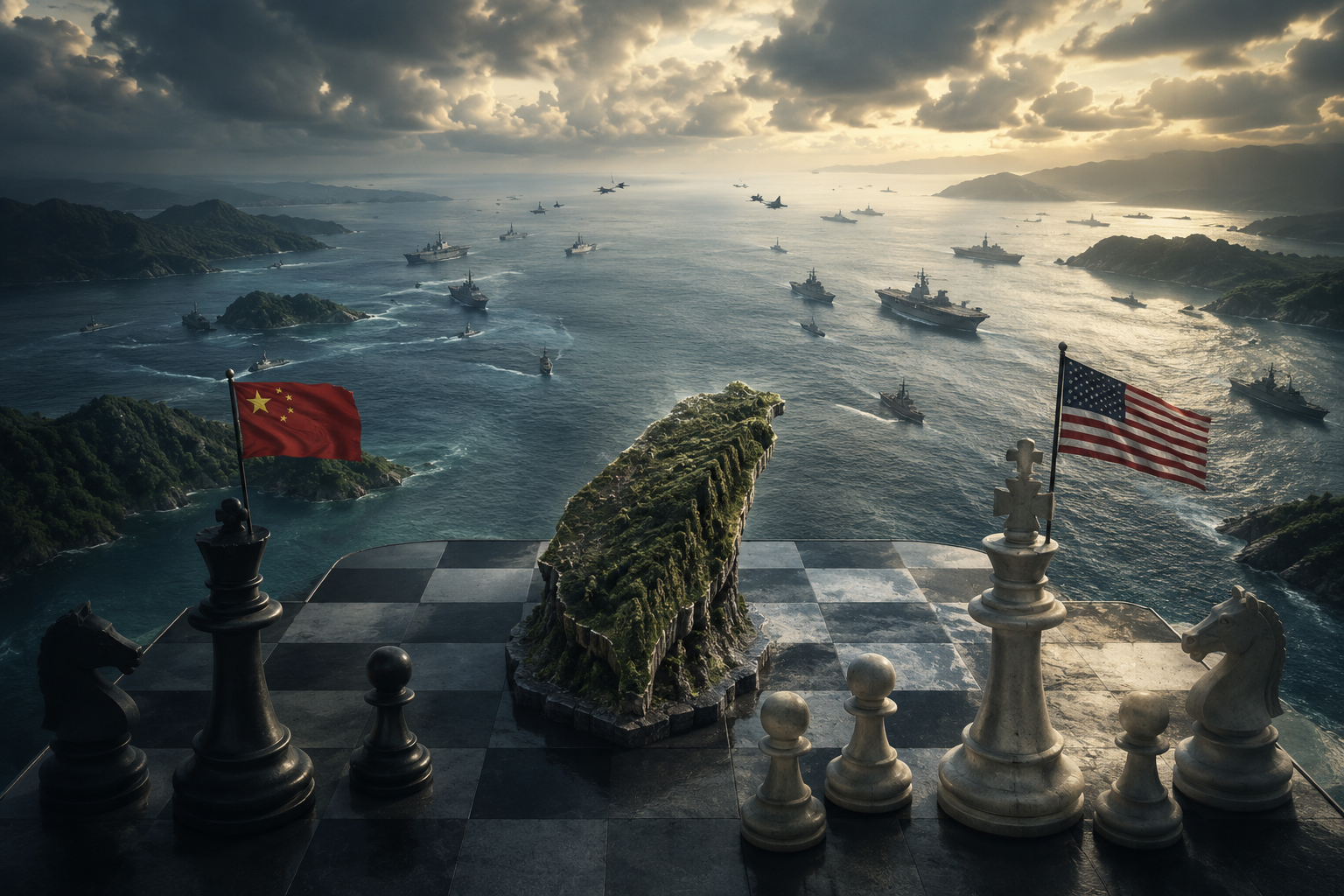
China’s long-term Pacific strategy may increasingly depend less on invading Taiwan and more on reshaping the strategic environment around it. President Trump’s recent Beijing visit underscored a growing geopolitical reality: Beijing is pursuing influence, alliance fragmentation, economic leverage, and naval expansion as alternative pathways to Pacific access. While Taiwan remains the decisive geographic prize in the First Island Chain, China appears focused on weakening resistance gradually rather than triggering a catastrophic conflict that could destabilize its economy and the wider global order.

Strategic Overview
President Trump’s recent visit to Beijing has renewed scrutiny over the central strategic question shaping the Indo-Pacific balance: can China secure reliable access to the Pacific without forcibly taking Taiwan?
For Beijing, Taiwan is not merely a territorial or nationalist issue. It is the geographic anchor of the First Island Chain — the network of U.S.-aligned territories and maritime positions stretching from Japan through Taiwan to the Philippines that constrains Chinese naval projection into the wider Pacific. Control of Taiwan would significantly alter the military geometry of Asia, granting China freer submarine deployment, expanded naval maneuverability, and enhanced leverage over regional sea lanes.
Yet the political, economic, and military costs of an invasion remain extraordinarily high. As a result, China increasingly appears to be pursuing an alternative pathway: strategic access through diplomacy, economic dependency, technological reach, and gradual erosion of U.S. alliance cohesion rather than outright military conquest.
Trump’s Beijing engagements highlighted this evolving contest. While trade, technology, and economic stabilization dominated public messaging, Taiwan remained the silent center of gravity beneath the discussions. Beijing’s objective may no longer be immediate reunification by force, but rather the creation of conditions under which Taiwan becomes strategically isolated and U.S. commitments grow politically uncertain.
Operational Context
Military Positioning: China continues accelerating its transition into a true blue-water naval power through carrier expansion, nuclear submarine modernization, anti-access/area denial systems, and long-range missile capabilities. These developments reduce — but do not eliminate — dependence on territorial control of Taiwan.
Diplomatic Strategy: Beijing is simultaneously deepening influence across Southeast Asia and the Pacific through infrastructure financing, port development, trade integration, and security partnerships. Rather than breaking the island chain militarily, China is probing whether it can politically soften or neutralize it over time.
Economic Constraints: A direct conflict over Taiwan would threaten China’s export economy, disrupt critical semiconductor supply chains, trigger sanctions, and risk capital flight at a moment of slowing domestic growth. This strengthens the incentive for strategic patience over kinetic escalation.
U.S. Signaling: Trump’s visit introduced renewed ambiguity into Washington’s posture. By avoiding highly confrontational rhetoric while emphasizing economic engagement, the administration signaled openness to stabilizing relations even amid strategic rivalry. For allies in Tokyo, Manila, and Taipei, ambiguity itself becomes a strategic variable.
Geopolitical Tensions
Alliance Credibility: The durability of the U.S. alliance network remains central to containing Chinese expansion beyond the First Island Chain. Any perception of weakening American resolve could alter regional calculations and accelerate hedging behavior among Asian states.
Strategic Geography: Taiwan’s importance stems less from ideology than from geography. Whoever shapes the maritime space surrounding Taiwan gains leverage over critical trade routes, naval mobility, and the balance of power across the Western Pacific.
Technology and Supply Chains: Taiwan’s semiconductor dominance adds an economic dimension to the strategic equation. Conflict risks catastrophic disruption to global technology markets, making the island simultaneously a military flashpoint and an economic nerve center.
Narrative Competition: Beijing frames reunification as historical inevitability and national restoration. Washington frames Taiwan as central to preserving regional balance and deterrence credibility. Both narratives increasingly shape domestic politics as much as foreign policy.
Strategic Outlook
Baseline: China is likely to continue prioritizing a long-term strategy of strategic encirclement, political pressure, economic integration, and military deterrence rather than near-term invasion. Beijing appears to recognize that influence may achieve what force could jeopardize.
What to Watch (next 2–6 weeks):
- U.S.–China Follow-On Engagements: Any new economic or security understandings emerging quietly after Trump’s Beijing meetings.
- Taiwan Election and Defense Signaling: Movements in Taipei regarding procurement, reserve mobilization, and diplomatic outreach.
- Regional Alliance Activity: Increased coordination among the U.S., Japan, Australia, and the Philippines as indicators of concern over shifting Chinese influence.
- PLA Naval Operations: Expanded Chinese exercises east of Taiwan or deeper into Pacific waters would signal continued efforts to normalize broader maritime reach.
Implications
For China: Beijing’s preferred outcome is increasingly clear — weaken Taiwan strategically without triggering a catastrophic war. This requires patience, economic leverage, diplomatic penetration, and calibrated military pressure rather than immediate escalation.
For the United States: The Taiwan question is ultimately about maintaining the credibility of America’s Indo-Pacific architecture. If U.S. commitments appear uncertain, the broader regional balance may begin shifting toward accommodation with Beijing.
For Allies and Middle Powers: Asian and Pacific states are entering a prolonged era of strategic ambiguity in which economic dependence on China coexists uneasily with security dependence on Washington. Managing this duality will define regional diplomacy for the next decade.
For the Global South: The contest illustrates a broader lesson in 21st-century power politics: major powers increasingly seek strategic dominance through infrastructure, influence, technology, and economic dependency before resorting to territorial conquest. The battlefield is no longer only military — it is systemic.