
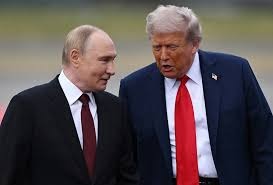
The Trump–Putin Summit and its implications for Sustainable Development
The Trump–Putin summit in Anchorage underscored shifting geopolitical dynamics with far-reaching consequences for sustainable development. While dominated by the Russia–Ukraine war, its implications extend to energy security, climate goals, food supply chains, and global cooperation. Agreements hinting at fossil fuel dependency, U.S. security guarantees to Ukraine, and weakened multilateralism risk slowing progress on the SDGs. With disruptions to trade, aid, and decarbonization, the summit highlights the need for vigilant international advocacy for sustainability, inclusivity, and cooperative governance.

The summit between U.S. President Donald Trump and Russian President Vladimir Putin in Anchorage, Alaska, on August 15, 2025, marked a significant moment in international diplomacy despite no ceasefire was announced and many critics consider that optics and tone were seen in Moscow as advantageous to Russia, widening splits with Europe and reframing U.S. priorities.
While the principal focus was on the ongoing conflict between Russia and Ukraine, the outcomes of the meeting have important implications for sustainable development, mostly concerning energy policies, international cooperation, security matters, food security and environmental governance.
- Energy policy and environmental implications
One of the most immediate impacts of the summit is the potential shift in global energy dynamics. President Trump has signalled a move towards reducing U.S. reliance on renewable energy initiatives, discouraging the promotion of sustainable development abroad. Conversely, President Putin’s administration continues to prioritize fossil fuel exports, using energy resources as a tool for geopolitical leverage. The summit discussions reportedly included agreements on energy cooperation, which could lead to increased fossil fuel dependency in Europe and other regions, potentially delaying progress towards global sustainability goals.
Additionally, because of the war-related uncertainty, the risk premia have increased for gas, oil, and power—especially if Russian supply tactics or infrastructure attacks persist. Each failed ceasefire window delays investment in grid upgrades, storage, and renewables integration across Europe.
On the other hand, if Washington’s stance wavers, EU may shoulder more of Ukraine’s energy security (backup thermal, interconnectors, emergency LNG). That reallocates capital from decarbonization to short-term security, slowing net-zero trajectories. Equally, if hostilities continue that means more displacement, contamination (UXO, industrial site damage), and stress on health systems, raising future cleanup and remediation bills and complicating safe returns.
2. International cooperation and security concerns
The summit’s outcomes would also affect international security arrangements, which are closely linked to sustainable development. President Trump agreed to provide Ukraine with security guarantees akin to NATO’s Article 5 protections, bypassing the issue of NATO membership. While this move aims to stabilize the region, it may strain relations with European allies and complicate collective efforts to address global challenges such as climate change and sustainable development.
Furthermore, the absence of Ukrainian President Volodymyr Zelenskyy from the summit and the subsequent unilateral decisions made by the U.S. and Russia raised concerns about the inclusivity of international decision-making processes and the multilateral cooperation essential for achieving sustainable development objectives. However, Trump–Zelensky meeting three days after at the White House in Washington, D.C., where key European/NATO leaders joined Ukraine President, allayed such concerns. According to the talks, it is possible to conclude that there are security “signals,” but not guarantees yet because there is not codified arrangement, situation that limits impact on European security architecture.
3. Food security and global markets
Ukrainian export disruptions (grains, oils, fertilizers) ripple through MENA and Sub-Saharan Africa. Without a verifiable ceasefire and secure corridors, price spikes and supply shocks resurface—hitting low-income net importers hardest. The leaders’ meetings did not yet deliver corridor guarantees or maritime security commitments.
Moreover, European authorities lack a cohesive Plan B if U.S. support recedes; bridging funds for Kyiv’s defence and reconstruction could crowd out Official Development Assistance (ODA) and climate finance for other regions (e.g., adaptation funds, loss-and-damage facilities). Likewise, the ambiguity over territorial status and security guarantees depresses bankability of Ukraine’s reconstruction infrastructure (transport, housing, health, green industry), delaying multiplier effects on jobs and livelihoods.
- Geopolitical dynamics and development priorities
During the summit, it was evidenced a shift in global geopolitical dynamics, with the U.S. appearing to prioritize bilateral agreements over multilateral frameworks. This approach may lead to a fragmented international system where development priorities are imposed by major powers rather than through inclusive global consensus. Such fragmentation can impede coordinated efforts to tackle pressing issues like poverty, inequality, and environmental degradation.
Conclusion
To sum up, the Trump–Putin summit has significant implications for sustainable development. While the immediate focus was on the war Russia-Ukraine, the broader outcomes suggest a trend towards energy policies that favour fossil fuels, a shift towards bilateral security arrangements, and a weakening of multilateral cooperation. These developments may pose challenges to the global community’s efforts to achieve the Sustainable Development Goals (SDG). It is highly recommendable for international stakeholders to remain vigilant and advocate for policies that promote sustainability, inclusivity, and cooperative governance in the face of these evolving geopolitical shifts.
Dr. Silvana Sosa Clavijo is Research Fellow for the Europe Program of The Sixteenth Council

Critical Minerals and the Green Transition: Europe’s New Dependency Risk