Tensions escalate as Venezuela mobilizes 4.5 million militiamen in response to US crackdown on drug trafficking.
Venezuela has announced the mobilisation of 4.5 million militiamen throughout the country in response to increased US naval movements in the Latin America and Caribbean (LAC) region. The conflict is based on the national security threat of drug cartel activities, which have history of illegal drug trade into the US. Venezuelan president Maduro argues that US military imposition in the region undermines sovereignty and independence. The conflict threatens peace and stability in the region, with potential consequences for Venezuela’s economic crisis and humanitarian challenges. For the US, it could mean increased control over oil reserves and immigration.

Strategic Overview
Relations between the United States and Venezuela reach a boiling point as concerns over drug trafficking escalates geopolitical tensions in the LAC region. Venezuela has begun significant military movement across the country, deploying 4.5 million militia personal within its borders in response to US deployment of warships into the LAC region on 18th of August 2025. This military escalation comes just weeks after the renewal of US oil company Chevron’s license to operate in Venezuela and the agreement to exchange political prisoners.
Operational Context
US Actions:
The mobilisation of US military assets follows Washington’s decision to increase the bounty for information leading to Venezuelan president Maduro’s capture, doubling it to $50 million USD. This was accompanied by the announcement that assets worth $700 million USD were seized from the Venezuelan head of state.
In an effort to counter drug cartels and illegal drug trafficking in Latin America, the US has orchestrated for three US Aegis guided-missile destroyers and 4000 military personal, together with combat aircraft and submarines, to arrive along Venezuela’s maritime borders. These military assets are to operate in international waters and airspace across several months.
Venezuelan Response:
The Venezuelan government has critiqued Washington’s accusations of drug trafficking as the failure of US policies. President Maduro stated that the presence of US military bases in Colombia was a threat to the independence of the region.
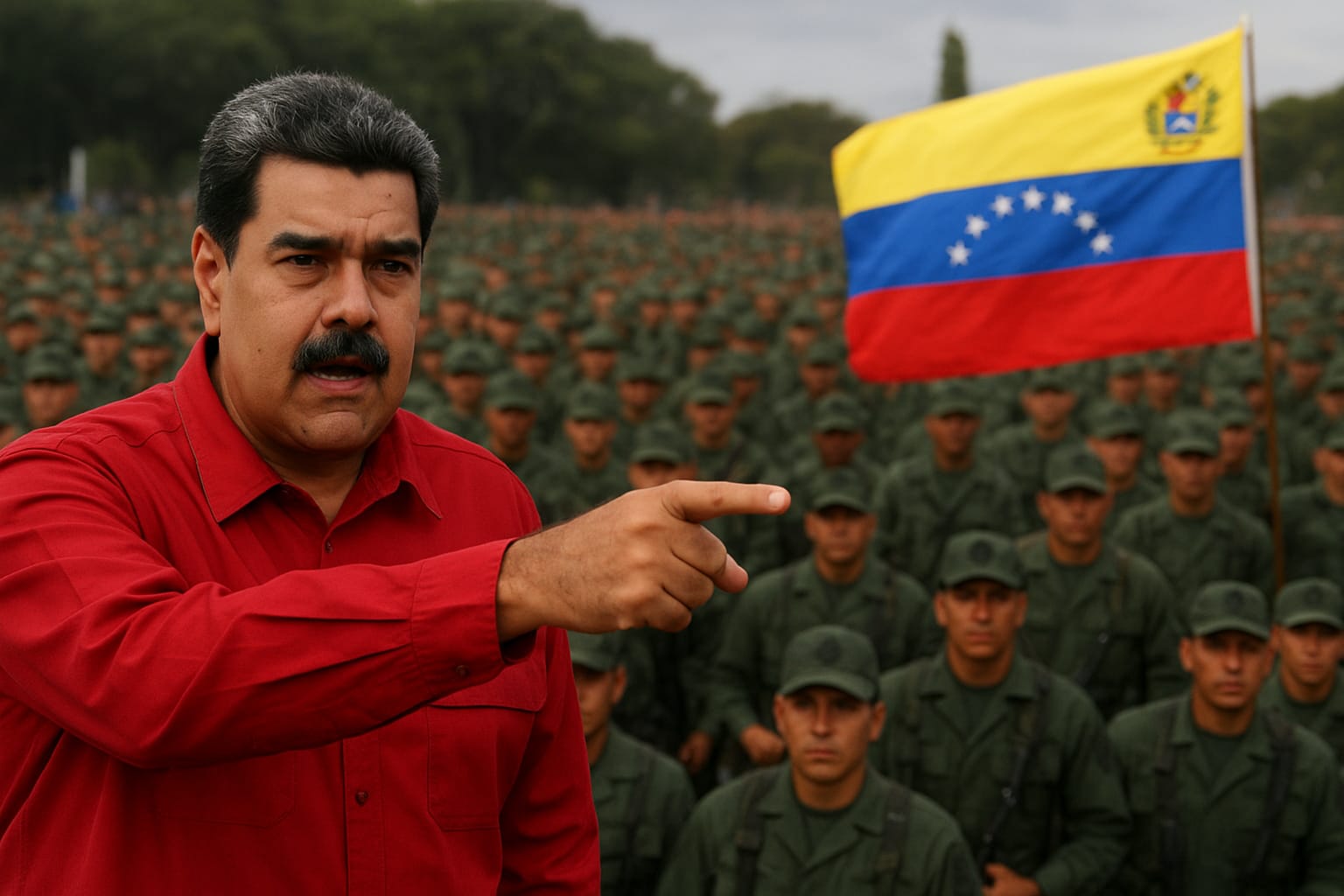
In response to US military interference and increase of troops sailing around the region, President Maduro has announced plans to mobilise 4.5 million militia members across the country in defence of Venezuela’s ‘territory, sovereignty, and peace’. The Venezuelan militia, created in 2005, is a subsect of the Bolivarian National Armed Forces focused on comprehensive defence. It calls on civilian and worker militias from factories and workplaces across the country to be armed with rifles and missiles.
Geopolitical Tensions
Political Conflict:
United States–Venezuela relations have traditionally been characterised by trade and investment alongside the cooperative battling of illicit drug transport, however political tensions between the countries have risen since the late 1990s, with accusations against the US of promoting violent anti-government ideologies.
Washington and Caracas ended bilateral diplomatic relations in the wake of the 2019 Venezuelan presidential crisis, after Trump announced the US recognised Juan Guaidó (President of the National Assembly) as interim president. The US’s stance persists despite the dissolution of Guaidó’s interim government in 2023.
US Military Presence in LAC region:
There are approximately 76 US military bases in Latin America. US department of State argue that strong military presence in this region provides security assistance, however the proposal of a new military base on Gorgona Island in the Colombian Pacific has sparked argument. At present there are no active US military bases within Colombian territory; the introduction of one would mark the start of greater US control in the region.
Drug Trafficking:
The Trump administration maintains that Maduro leads the Cartel of the Suns, and whose drug trafficking activities threaten US national security and borders. According to the United Nations, there has been an increase of cocaine trafficking through Venezuela since 2002, with Venezuela severing ties with the US Drug Enforcement Administration in 2005, resulting in a decline of cocaine seizures. In 2012 the US stated that the majority of drug trafficking aviation activity originated from Venezuela’s border area near Colombia, with accused ties to Colombian Guerrilla group FARC, Venezuelan drug trafficking group Cartel of the Suns, and Islamic militant group Hezbollah.
Immigration:
So far in his 2025 presidency, the Trump administration has also attempted to designate Venezuelan gang Tren de Aragua as a state-sponsored international terrorist organisation to support stricter measures against Venezuelan immigrants, although it has so far not been successful. In contradiction of the Trump administrations anti-immigration policy, immigration attorneys have said that the US’s stance on Venezuela has the potential to increase the number of asylum claims from the LAC region, as it lends legitimacy to fears of returning to the countries where these cartels operate.
Strategic Outlook
United States:
On the 19th of August 2025, US Department of Defence officials reported that there were currently no US ships in the area, and no ships had received orders to report there. When questioned, White House Press Secretary Karoline Leavitt reported that US President Donald Trump was ‘prepared to use every element of American power’ to prevent entry of drugs into the US. This included emphasis that the US did not recognise Maduro as a legitimate president. These accusations build a narrative validating military action. In light of US justifications, it should be expected that the first US strike will target any suspected transportation of illegal drugs.
Venezuela:
The Venezuelan government has taken the US governments actions seriously, and rejected all accusations of drug trafficking, stating that the US was resorting to ‘threats and defamation’ to justify undermining Venezuela’s sovereignty. Venezuelan Foreign Minister Yvan Gil has spoken that US threats ‘endanger the stability of the entire region, including the zone of peace’ as declared by the Community of Latin American and Caribbean States.
Venezuela’s countermeasures to US attack are likely to start strong with missile targeting of US assets. The Bolivarian Navy of Venezuela, which may step in to defend Venezuela’s coastline and maritime waters, should also be taken into consideration. However, the reliance on civilian militia members suggests systemic weakness, with its lower and middle ranks likely less equipped, making its effectiveness uncertain.
Implications for LAC Region
Military Conflict:
As Venezuela takes a sovereignty-first approach to US military interference in the region, they enter an escalating battle for control against a global superpower. The extent to which Venezuela could handle a drawn-out military conflict with the US is in question, but in the face of strong fire power, the mobilisation of such significant numbers of militia members suggests high levels of commitment to defence.
Economic Impacts:
Venezuelan reliance on civilian and workforce members for its militia carries severe implications for its country’s people and economy. With increased focus on defence procedures, normal factory and industry output will be affected. There is risk the conflict will exacerbate Venezuela’s economic crisis and humanitarian challenges.
Significance to US:
A US strongarm over Venezuelan sovereignty and internal operations is important to the US for Venezuela’s significant oil reserves, as well as its political and economic patterns with the US regarding immigration and regional stability. With Venezuela possessing the world’s largest proven oil reserves, past US sanctions on the Venezuelan oil sector have heavily impacted its economy and global oil markets. Further US interference with the region carries the possibility of continuing this trend.