
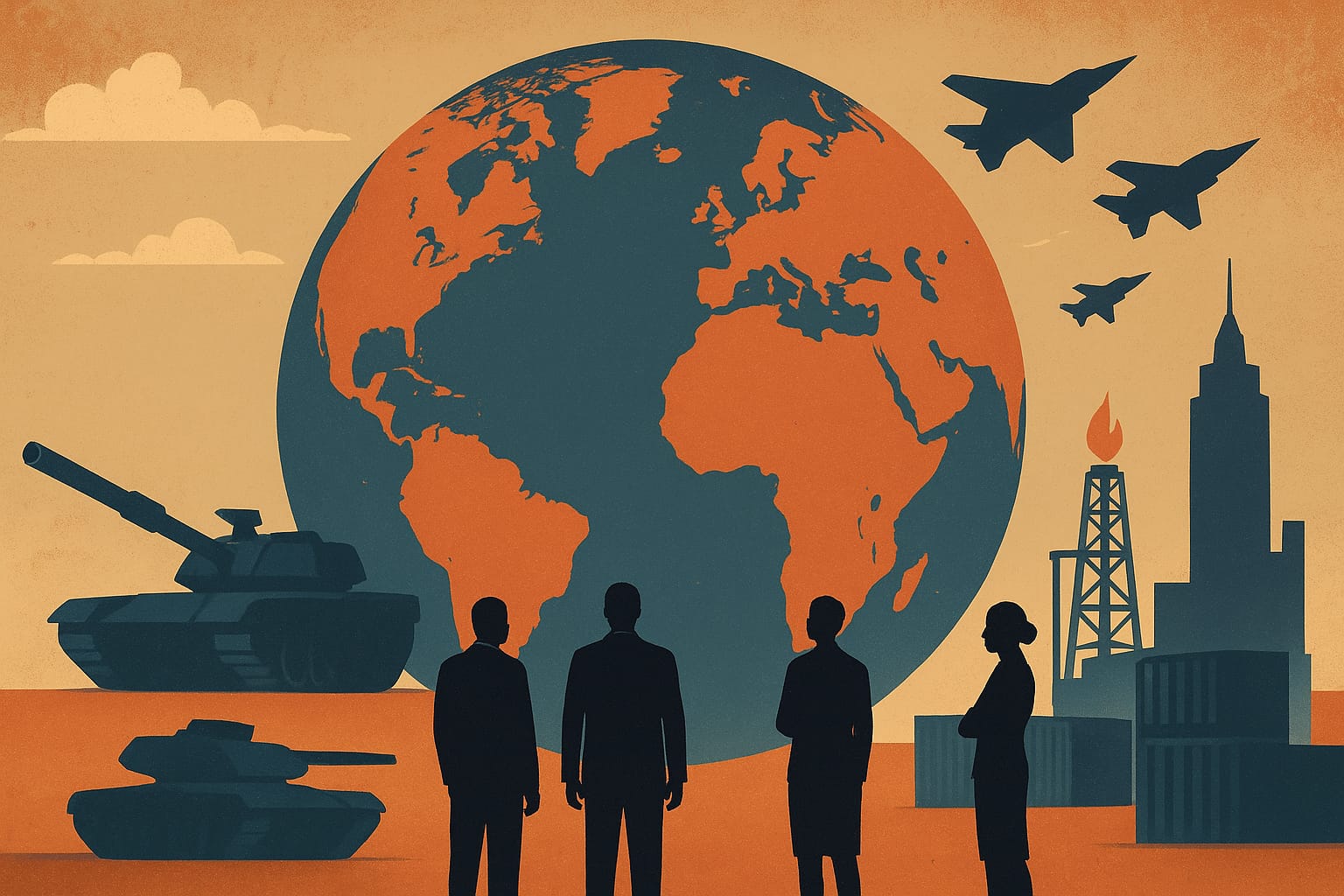
Navigating the Reconfiguration of the Global Order
The global order is undergoing its deepest reconfiguration since the Cold War. Power is diffusing beyond the U.S.–China axis to assertive regional powers, non-state actors, and transnational corporations. Conflicts, supply-chain shocks, and climate pressures are exposing the fragility of old institutions. De-risking strategies, digital competition, and the energy transition are redrawing economic and security maps in real time. Resilience, adaptability, and pragmatic cooperation—not outdated assumptions—will determine which nations and institutions thrive in this fluid, contested system.

The international system is undergoing its most profound transformation since the end of the Cold War. The pillars of the liberal order—free trade, multilateralism, and collective security—are eroding under the weight of protectionism, institutional fatigue, and the resurgence of great-power rivalries. This is not merely a cyclical downturn in cooperation, but a structural reconfiguration of the global landscape.
Power is increasingly diffuse. While the U.S. – China competition remains the dominant axis of contestation, it unfolds in a multipolar arena shaped by assertive regional actors, transnational corporations, and non-state players. Simultaneously, conflict zones across Europe, the Middle East, Africa, and Asia are multiplying, disrupting trade routes, fuelling humanitarian crises, and exposing the limits of existing governance structures. The Global Peace Index 2025 records the highest number of state-based conflicts since World War II, underscoring the scale of instability.
Layered onto these geopolitical and security pressures are seismic shifts in the economic, technological, and environmental domains. From the de-risking of supply chains and the search for alternatives to the dollar, to the strategic race in digital technologies and the precarious balance of energy transition, the global order is being redrawn in real time. The challenge for policymakers and institutions is not simply to adapt, but to redefine cooperation in a world where fragmentation has become the norm.
1. The decline of the liberal international order
The liberal international order, established in the mid-20th century, emphasized free trade, democracy, and international cooperation. However, recent developments have exposed its vulnerabilities:
- Erosion of multilateralism. Institutions like the World Trade Organization and the United Nations have faced criticism for inefficiencies and perceived biases, leading to a decline in multilateral cooperation.
- Rise of protectionism. Economic nationalism and protectionist policies have gained traction, challenging the principles of free trade and open markets.
- Geopolitical tensions. The resurgence of great power competition, particularly between the U.S. and China, has strained international relations and undermined collaborative efforts.
2. The emergence of new global actors
The relationship U.S. – China now operates inside a crowded field of actors — regional powers (India, Saudi Arabia, Turkey), Russia, and institutional layers (EU, ASEAN, African Union). This makes the order multipolar in practice even if the U.S. – China competition is the clearest axis of contestation.
In this context, these new actors are asserting their influence:
- China’s ascendancy: China’s New Silk Road and assertive foreign policy have positioned it as a central player in global affairs.
- Regional powers: Nations like India, Brazil, Saudi Arabia and Turkey are expanding their influence through regional partnerships and strategic alliances.
- Non-state actors: Multinational corporations, international organizations, and civil society groups are increasingly shaping global agendas.
3. Escalating conflicts across regions
The world is witnessing an unprecedented number of active state-based conflicts. According to the Global Peace Index 2025, there are currently 59 such conflicts, the highest since the end of World War II. This surge is attributed to factors such as geopolitical fragmentation, increasing militarization, and the erosion of traditional alliances.
Conflicts, such as in Ukraine, the Middle East and the Indo-Pacific maritime flashpoints, are not only local crises, but they also reshape alliances, trade corridors, military postures, and investor risk premia globally. In this scenario, conflict zones reinforce and interact with the broader shifts in at least these ways:
- Diversion of resources and attention. States embroiled in or adjacent to conflict zones must allocate more of their budgets and policy energy toward security, border control, migration management, and humanitarian aid, potentially deprioritizing long-term development, transition, or climate goals.
- Disruption of supply chains. War zones disrupt critical flows—food, energy (especially where pipelines or shipping routes pass through conflict zones), minerals. Unpredictability leads firms to resort to more de-risking strategies (reshoring, friend-shoring) even at higher cost.
- Refugee flows and migration. Conflicts generate large displacement, which can stress neighbouring states, provoke domestic political pressures in receiving foreigners, and create alliances or tensions depending on how the migration is managed.
- Escalation risk and proxy conflicts. Many of the active zones are interconnected. This complicates diplomatic efforts and increases the chance of wider escalations.
- Global normative and legal implications. Conflict zones put pressure on international institutions, legal norms, and global public opinion, and thus on the legitimacy of states and coalitions. This also factors into sanctions regimes, foreign aid, and investment risk assessments.
4. The economic reconfiguration and changes in the financial architecture
The post-pandemic era has accelerated “de-risking” — a pragmatic reorientation of supply-chain policy toward reshoring, friend-shoring, and diversification rather than wholesale decoupling. Analysis shows these moves are costly and will produce differentiated effects by sector and country: critical-input industries face higher incentives to onshore or diversify, while consumer goods remain globally dispersed.
Meanwhile, the expansion of alternative economic groupings (notably BRICS’ enlargement) signals political attempts to rebalance governance and development finance fora, though their economic coherence and operational effectiveness remain contested.
On the other hand, pressure to reform international financial governance (IMF, development banks) and initiatives to create alternative payment / reserve mechanisms have intensified. The BRICS enlargement and calls for greater voice by emerging markets challenge the post-Bretton Woods distribution of influence. Yet the US dollar’s incumbent position, network effects, and deep capital markets make immediate displacement unlikely.
5. Technological and environmental drivers
Advancements in technology and pressing environmental concerns are reshaping the global order:
- Digital transformation. The rise of digital platforms, artificial intelligence, and cybersecurity challenges are creating new arenas for competition and cooperation.
- Climate Change. Environmental degradation and climate-related disasters are prompting calls for global governance reforms and sustainable development practices.
The energy transition is accelerating investment in renewables and low-emissions tech, but the system still depends heavily on fossil fuels — and recent data show rising decline rates in mature oil and gas fields that increase volatility and the need for investment to maintain supply. Geopolitical shocks (e.g., conflicts involving major producers or transit regions) have proven able to cause rapid market dislocations. The result is an awkward overlay: countries race toward decarbonization while needing to secure near-term energy and mineral supplies.
Conclusion
What emerges from this reconfiguration is a world without a clear centre of gravity. Instead, it is characterized by overlapping spheres of influence, contested norms, and recurring shocks. The erosion of the liberal order has not produced outright chaos, but a more fluid and competitive environment where the lines between cooperation and confrontation are increasingly blurred.
In this context, resilience and adaptability are the defining currencies of power. Nations and institutions that can hedge against conflict, diversify their economic dependencies, secure technological and energy autonomy, and still engage in pragmatic cooperation will be best placed to shape the evolving order. Conversely, those that cling to outdated assumptions of stability or permanence risk strategic marginalization.
The new global configuration, then, is not just about the redistribution of power—it is about redefining the terms of order itself. Whether this shift leads to fragmentation and heightened conflict or to a more inclusive and resilient system will depend on the ability of states to balance rivalry with responsibility. The stakes are global, the timeline immediate, and the consequences generational.
Dr. Silvana Sosa Clavijo is Research Fellow at the Europe Program of The Sixteenth Council


Trump Can’t Take Greenland – and the World Knows Why