
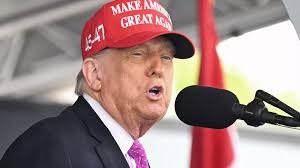
The Second Punch: Why Trump’s Student Visa Freeze Marks a Strategic Shift in U.S.–China Relations
President Trump’s freeze on student visa processing marks a strategic shift in U.S.–China relations. Framed as a response to campus antisemitism, the move is part of a broader effort to decouple from China. By targeting academic exchanges, the administration aims to protect America’s innovation ecosystem from foreign exploitation. This policy, following earlier tariffs, represents the second major strike in a systematic recalibration of U.S. geopolitical and economic priorities.

When President Trump halted student visa appointments across U.S. embassies, it was framed—on the surface—as a response to rising antisemitism on American campuses. But that explanation, while partially valid, obscures the deeper truth: this is not about campus protests. This is the second strategic strike in a broader campaign to reshape the global balance of power.
If the first punch was tariffs, this one is aimed directly at the intellectual lifeblood of China’s rise: access to American education, research, and innovation ecosystems. The world needs to understand this for what it truly is—an act of geopolitical recalibration, long overdue.
The True Power of American Universities
For over a century, the United States has maintained a unique and powerful triangle between government, university, and industry. This trinity has been the driving force behind American technological dominance, Nobel Prize-winning discoveries, startup revolutions, and even military superiority. The EU tried to replicate it; others merely admired it. No one matched it.
America’s university system has always been more than just a place of learning—it is a strategic asset. Within its walls, foreign students don’t just acquire degrees; they acquire networks, research experience, and access to cutting-edge innovations. In the STEM fields in particular, this immersion becomes a launchpad to develop competitive advantages back in their home countries.
And no country understood this better than China.
From Confucius Institutes to Deep Tentacles
The Chinese Communist Party (CCP) made a conscious and deliberate effort over the past two decades to embed itself deeply in the fabric of American academia. The scale was staggering:
Confucius Institutes mushroomed across campuses, often with opaque funding and ideological agendas.
Research collaborations proliferated, frequently lacking transparency around intellectual property rights.
Chinese scholars and students entered prestigious labs in large numbers—some to learn, others to extract.
And American academia, eyes wide shut, welcomed the revenue.
In elite institutions like Harvard, Chinese nationals now comprise around a third of the student body. The U.S. benefited from their tuition fees. China benefited far more—from the knowledge transfer, scientific immersion, and ideological access that came with it.
Let’s be clear: the CCP did not infiltrate the U.S. education system by accident. They found willing partners, eager for funding and prestige—even if it meant cohabiting with a totalitarian regime.
The Tariff Was the First Salvo. This Is the Second Punch.
When the Trump administration imposed tariffs during the first term, critics framed it as economic nationalism. But those tariffs were not merely about trade, they were a signal. A signal that America was awakening to the strategic threat posed by China’s rise, particularly in how it leveraged liberal systems to advance authoritarian goals.
That was punch one—economic.
Punch two has now landed—and it is intellectual.
By freezing student visa processing, halting Harvard’s ability to enroll international scholars, and linking universities to foreign adversaries, the Trump administration is weaponizing higher education as a tool of statecraft.
Ostensibly, this is about antisemitism and campus protests. But the official language from the State Department and the White House tells another story. The administration has explicitly accused institutions like Harvard of fostering collaboration with the Chinese Communist Party.
It was only a matter of time.
Talent is the New Oil
What the U.S. understands now—and is acting on decisively—is that in the 21st century, brains are the new oil.
Scientific talent, especially in AI, quantum computing, biotechnology, and advanced materials, determines who leads and who follows. Controlling talent flows is about controlling:
- Innovation
- Economic competitiveness
- Military advantage
The Trump doctrine is not isolationist. It is protective. It recognizes that American institutions, once global hubs of freedom and excellence, became pipelines that fed rival states—states that reject the very values those institutions were built to uphold.
China trained its next generation of engineers, researchers, and technocrats in U.S. labs. Now, the U.S. is shutting the door.
Strategic Decoupling in Four Stages
This student visa freeze fits neatly into the broader U.S. strategy of systematic decoupling from China. We are witnessing the progressive separation of American and Chinese systems across four fronts:
1. Trade and Tariffs – Reorienting supply chains and protecting domestic manufacturing.
2. Technology Sanctions – Cutting off Chinese access to semiconductors, AI chips, and advanced machinery.
3. Academic Isolation – Freezing visas, ending joint research, and shutting down ideological infiltration.
4. Capital and Financial Controls (Coming Soon?) – Limiting Chinese access to U.S. capital markets and investment opportunities.
Each punch is deliberate. Each is strategic. And each is aimed at unravelling the scaffolding that enabled China’s dramatic ascent.
Global Reverberations: The Hong Kong Response
China is not sitting idle. Within 48 hours of the U.S. visa freeze, Hong Kong’s Education Secretary called on local universities to attract displaced Harvard students. Three institutions extended public invitations. It was a clever move—designed to portray openness and gain prestige while subtly undermining U.S. policy.
But these gestures are not sustainable solutions. Chinese universities cannot replicate the intellectual and technological ecosystem that makes American higher education exceptional. Nor can they replicate the freedoms, debates, and heterodox thinking that fuel scientific breakthroughs.
This move by the U.S. is not just about visas. It is about global repositioning. Nations like the UK, Australia, and Canada must now choose: remain open and vulnerable to CCP influence or recalibrate as the U.S. has done.
Universities Must Choose a Side
Let us speak plainly.
Universities can no longer pretend they exist outside geopolitics. They are not neutral territory. They are battlegrounds.
Institutions that accept CCP funding, tolerate ideological conditioning, or serve as intellectual havens for foreign adversaries must face consequences. The age of academic innocence is over.
The Trump administration is sending a message, not just to China, but to every American university:
Choose your allegiance. You are either a vessel of American strategic interest or a liability to national security.
Some may decry this as authoritarian. But it is nothing more than strategic clarity. And it is long overdue.
A New Doctrine of National Renewal
Make no mistake: the Trump administration’s student visa ban is not a misstep. It is not overreach. It is doctrine.
It is part of a larger effort to restore American primacy by disentangling its institutions from regimes that seek to undermine it from within. It signals a new understanding that power flows not just from weapons or money—but from knowledge.
For decades, the U.S. exported education, believing it exported values. It turns out, it often exported capabilities to adversaries.
That chapter is closing. A new one is beginning—where America protects its crown jewels, not out of fear, but with strategic purpose.
The Goose, the Golden Eggs, and the Wake-Up Call
America’s scientific dominance has long been its golden goose. Immigrant scientists, many of them Chinese and Indian, have contributed vastly to that legacy. But that system was never designed to sustain a geopolitical rival on the rise.
Universities will scream. Lobbyists will complain. But the writing is on the wall:
The era of open doors is over. The age of strategic borders has begun.
And in this world, intellectual sovereignty is national sovereignty.
Dr Brian O. Reuben is the Executive Chairman of the Sixteenth Council.

Critical Minerals and the Green Transition: Europe’s New Dependency Risk