The Long Tariff War: U.S. Trade Pressure on China and Its Strategic Effectiveness
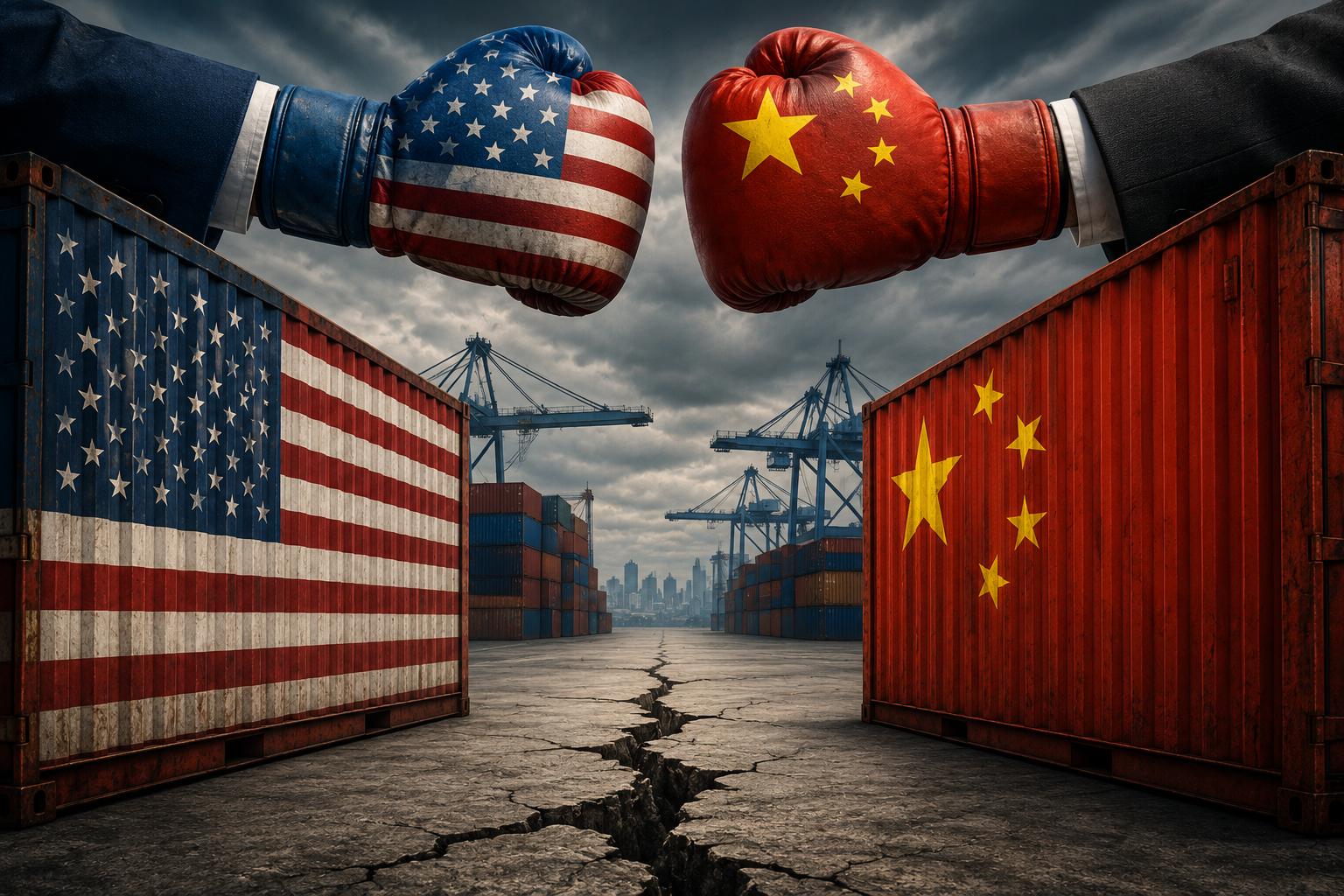
U.S. tariffs on China evolved from targeted trade measures into a central pillar of strategic competition between the world’s two largest economies. While tariffs accelerated supply-chain diversification and reshaped Washington’s approach to China, they failed to fundamentally weaken Beijing’s economic model or reverse China’s global manufacturing dominance. Instead, the trade war marked the end of the post-Cold War globalization consensus, transforming trade policy into a broader instrument of industrial strategy, technological containment, and geopolitical rivalry in an increasingly fragmented global economic order.

Strategic Overview
U.S. tariffs on China evolved from limited trade remedies into a central instrument of geopolitical competition. What began as targeted economic pressure gradually transformed into a broader strategy aimed at slowing China’s industrial ascent, reshaping supply chains, and reducing American dependence on Chinese manufacturing.
The core question, however, remains unresolved:
Have tariffs meaningfully weakened China, or have they merely increased the cost of globalization for both sides?
The answer is mixed. Tariffs succeeded in changing the strategic conversation around China and accelerated diversification away from Chinese supply chains. But they have not fundamentally reversed China’s rise, eliminated trade dependence, or significantly reduced the bilateral imbalance.
Instead, tariffs became part of a larger transition from economic integration toward strategic rivalry.
1. Early Frictions Before the Trade War (1990s–2016)
After China joined the World Trade Organization in 2001, the U.S. largely pursued engagement rather than confrontation.
Washington believed:
- integrating China into global markets would moderate its behavior,
- encourage political liberalization,
- and bind Beijing into a U.S.-led economic order.
Instead, China:
- became the world’s manufacturing center,
- accumulated massive trade surpluses,
- expanded industrial subsidies,
- and accelerated technological ambitions.
By the 2010s, concerns grew around:
- intellectual property theft,
- forced technology transfer,
- currency management,
- state subsidies,
- and industrial overcapacity.
Yet tariffs remained relatively limited and sector-specific.
2. The Trump Trade War Era (2018–2020)
President Donald Trump fundamentally changed U.S. trade strategy toward China.
The administration imposed sweeping tariffs on hundreds of billions of dollars in Chinese goods under Section 301 investigations, arguing that China’s trade practices threatened American industry and national security.
Key objectives included:
- reducing the trade deficit,
- pressuring China into structural reforms,
- encouraging reshoring of manufacturing,
- and slowing Chinese technological advancement.
China retaliated with tariffs on U.S. exports, particularly targeting:
- agriculture,
- industrial products,
- and politically sensitive regions.
This marked the first major economic confrontation between the world’s two largest economies since China’s rise.
3. Immediate Economic Effects
Positive Outcomes for the U.S.
Supply Chain Diversification: Companies began shifting portions of production toward:
- Vietnam,
- India,
- Mexico,
- and Southeast Asia.
Strategic Awareness: Tariffs forced governments and corporations to recognize the risks of overdependence on Chinese manufacturing.
Political Leverage: Tariffs demonstrated that economic interdependence itself could become a geopolitical weapon.
Domestic Industrial Signaling: The trade war revived industrial policy discussions in Washington after decades of globalization consensus.
Negative Outcomes for the U.S.
Higher Costs: American importers and consumers absorbed much of the tariff burden through:
- higher prices,
- increased production costs,
- and inflationary pressure.
Limited Trade Deficit Reduction: The overall U.S. trade deficit persisted despite tariffs.
Agricultural Damage: American farmers suffered from Chinese retaliation and required significant federal subsidies.
Corporate Complexity: Many firms rerouted supply chains through third countries rather than fully exiting China.
4. Chinese Adaptation
China proved more resilient than many expected.
Beijing responded by:
- expanding domestic industrial policy,
- strengthening indigenous technology programs,
- diversifying export markets,
- increasing trade with the Global South,
- and accelerating financial insulation efforts.
Rather than abandoning state-led capitalism, China doubled down on it.
Tariffs also reinforced a growing Chinese narrative that:
economic dependence on the West had become a national security vulnerability.
This accelerated Beijing’s push for:
- semiconductor self-sufficiency,
- alternative payment systems,
- and strategic decoupling in sensitive sectors.
5. Biden Continuity and Trump 2.0 Escalation (2021–Present)
Although President Joe Biden softened the rhetoric of the trade war, his administration largely preserved the tariff architecture introduced under President Trump. This revealed a rare bipartisan consensus in Washington: China was no longer viewed merely as a trade competitor, but as a long-term strategic rival.
Under Biden, the policy evolved beyond tariffs into broader technological containment through:
- semiconductor export controls,
- investment restrictions,
- industrial subsidies,
- and supply-chain security initiatives.
Trump’s return to office in 2025 accelerated this trajectory further. Trump 2.0 has revived aggressive tariff expansion, economic nationalism, and “America First” trade positioning with renewed intensity. The administration increasingly frames tariffs not simply as economic tools, but as instruments of fiscal leverage, industrial revival, and geopolitical coercion.
The strategic shift is now unmistakable: U.S.–China economic relations are no longer operating within a globalization framework, but within a long-term competition framework where trade, technology, finance, and manufacturing are all treated as components of national security.
6. Strategic Effectiveness: The Real Assessment
Where Tariffs Worked
- They accelerated supply-chain diversification.
- They changed elite consensus in Washington about China.
- They exposed vulnerabilities in over-globalized production systems.
- They slowed some Chinese access to advanced technologies when combined with export controls.
Where Tariffs Failed
- China remained deeply integrated into global trade.
- The U.S. still relies heavily on Chinese manufacturing in many sectors.
- Tariffs alone did not revive American industrial dominance.
- Chinese exports continued finding alternative markets.
- Inflationary effects hurt American consumers and businesses.
Most importantly:
tariffs did not fundamentally alter China’s political or economic model.
7. The Larger Strategic Shift
The tariff era marked the symbolic end of the globalization consensus that dominated after the Cold War.
For decades, the assumption was:
- economic integration reduces geopolitical conflict.
The U.S.–China tariff confrontation shattered that assumption.
Economic interdependence is now increasingly viewed through a security lens.
Trade policy has become:
- industrial policy,
- security policy,
- and geopolitical strategy simultaneously.
Strategic Outlook
Baseline: Tariffs are likely to remain a permanent feature of U.S.–China relations regardless of administration changes. The deeper rivalry is now structural.
What to Watch (next 2–6 weeks):
- New technology restrictions tied to semiconductors and AI.
- Chinese countermeasures around rare earths or industrial exports.
- Supply-chain relocation trends toward India, Mexico, and Southeast Asia.
- Political pressure in the U.S. for expanded protectionist measures ahead of elections.
Implications
For the United States: Tariffs demonstrated that economic leverage can slow strategic competitors, but they also revealed the limits of coercion inside a deeply interconnected global economy.
For China: The trade war reinforced Beijing’s determination to reduce technological and financial dependence on the West while expanding influence across alternative markets.
For Global Markets: The era of frictionless globalization is fading. Supply chains are increasingly being redesigned around resilience, political alignment, and strategic security rather than pure efficiency.
For Emerging Economies: Countries such as India, Vietnam, Mexico, and Indonesia increasingly benefit as corporations diversify manufacturing away from China, reshaping the geography of global production in the process.