
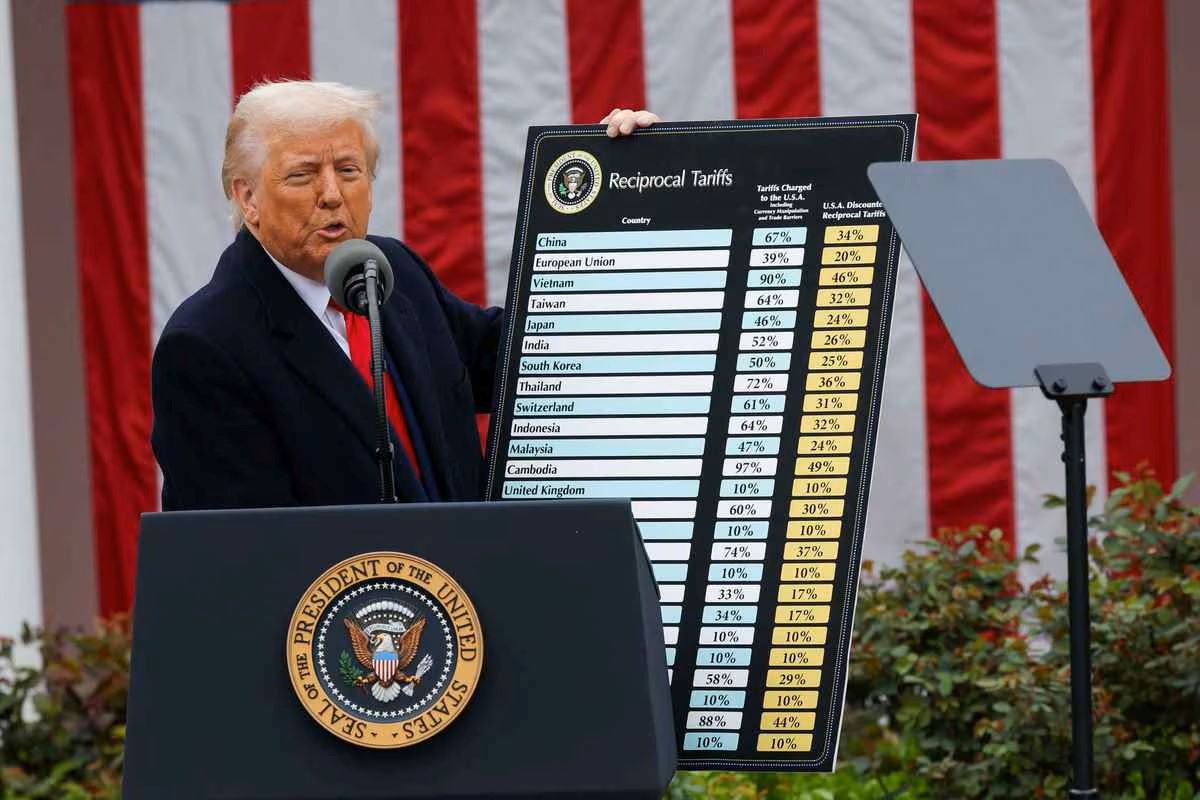
Tariffs and Trump: Reciprocity or Recklessness?
On May 21st, Donald Trump announced sweeping tariffs on EU goods and issued a sharp warning to Apple: move production to the U.S. or face penalties. It’s classic Trump; loud, provocative, and deeply strategic. But is it smart policy or reckless power play? This piece unpacks the logic behind the move, weighing its morality, fairness, and real-world impact in a tense moment for global trade and economic diplomacy.

On May 21st, President Donald Trump declared his intent to impose a 50% import tariff on all goods from the European Union—a sweeping move that sent shockwaves through diplomatic and financial circles alike. Even more provocative was his direct warning to Apple Inc.: either shift manufacturing to the United States or face a 25% import tax on its products.
For critics, this is the old Trump playbook: bluster, brinkmanship, and belligerence. But to dismiss it as mere populist noise is to miss the deeper logic at play. Trump is not improvising—he is executing a philosophy of economic nationalism, grounded in a transactional, zero-sum view of global trade.
Let us examine the proposed policy using a moral and strategic framework that measures five core principles of public decision-making:
Moral defensibility, justice, truth, efficiency, and human flourishing.
1. Is it morally defensible?
From Trump’s vantage point, the answer is yes.
He believes America has for decades borne the cost of defending global trade rules while being economically undermined by allies who hide behind high tariffs and regulatory walls.
To him, defending American workers and forcing companies to reshore manufacturing is not just policy—it’s patriotic duty. In this moral logic, trade is not about harmony but about protecting the home front. It’s the ethics of a general, not a diplomat.
2. Is it just and equitable?
Here the argument becomes more complex. Trump’s notion of justice is deeply reciprocal: if the EU imposes taxes and barriers on U.S. goods, then the U.S. should do the same—only harder.
He is not wrong to point out that Europe has been protectionist in areas like agriculture and digital services. But equitable trade justice in a global economy requires measured negotiation, not blanket retaliation.
Justice in economic relations must be predictable, proportional, and sustainable—and in this, Trump’s threat may fail the test.
3. Is it grounded in truth and reality?
This is where the policy begins to unravel. Trump claims the EU was “formed to take advantage of the United States”—a statement that is historically false and geopolitically absurd.
The EU was created to ensure peace and prosperity in post-war Europe, not to undermine American prosperity.
Yes, America does run a trade deficit in goods with the EU, but that ignores the surplus in services the U.S. enjoys. More importantly, modern trade balances are not the best measure of national strength.
The reality is more nuanced than Trump admits—and policies built on distortions rarely produce long-term value.
4. Is it efficient and accountable?
If tariffs are a negotiating tactic, they can yield results—as seen in Trump’s Phase One trade deal with China. But if they are pursued as policy without strategy, they create inflation, retaliation, and economic dislocation.
The European Union is already preparing countermeasures. Global supply chains, already strained, would face further disruption. American companies that rely on European machinery, pharmaceuticals, and luxury goods will suffer.
Accountability would demand clear objectives and measurable outcomes. Here, Trump’s plan is short on specifics, and long on spectacle.
5. Does it advance human flourishing and societal peace?
If one defines “flourishing” narrowly—jobs for American workers—then perhaps. But if flourishing means broader prosperity, global stability, and cooperative economic growth, then no.
Trump’s tariff threats risk igniting a transatlantic trade war, undermining alliances, and weakening the very institutions that have underpinned global peace for decades.
A world driven by nationalist tariffs is a world of economic fragmentation and rising hostility. This does not serve humanity well.
Understanding the Other Side: Trump’s Strategic Mindset
To be fair, Trump is playing from a different script. He sees global economic relations as rigged against the U.S., with international institutions used to constrain American sovereignty.
In this context, tariffs are leverage, not policy. His goal is not protectionism per se, but forcing others to the table under pressure.
There’s a method in the madness. By starting with a 50% threat, Trump positions himself to “settle” for 20% and claim victory. Apple, under pressure, may be nudged into reshoring production—a goal shared by many American leaders across party lines.
But the risk is that such high-stakes gambits, if mishandled, can provoke economic retaliation and geopolitical rupture. Not every opponent fold under pressure.
Conclusion: National Will vs Global Wisdom
Trump’s tariff threat is neither absurd nor wholly unjustified. But it is imprudent, poorly grounded, and dangerously unilateral.
The path to sustainable American prosperity is not through trade wars, but through trade reforms, smart diplomacy, and a vision of leadership that uplifts partners rather than punishes them.
Economic statecraft should be strategic, not theatrical. The stakes are too high for anything less.
Dr Brian O. Reuben is the Executive Chairman of the Sixteenth Council

Critical Minerals and the Green Transition: Europe’s New Dependency Risk