

Is Europe About to Be Colonized?
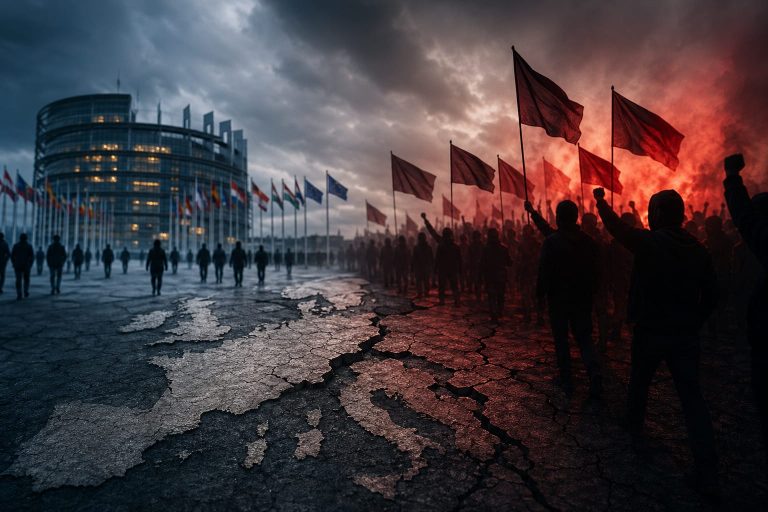
Europe stands at an uncomfortable crossroads, squeezed between Washington and Beijing. As the U.S. reasserts its security dominance and China deepens its economic reach, the continent risks drifting into a 21st-century form of colonial dependency—ceding sovereignty over defense, technology, and supply chains. Without a coherent, purpose-driven vision of its own, the EU could end up reacting rather than leading, becoming a strategic pawn instead of a power in its own right.

For centuries Europe imposed its will abroad. Today, in an astonishing reversal, it risks becoming the colonized. No tanks, no gunboats — instead, investment funds, digital platforms, supply chains, and security guarantees. American big tech, Chinese state-backed finance, and a fragmenting world order are eroding European sovereignty faster than any foreign army could. Unless Europe shakes off its illusions, it may find itself a junior province of other people’s empires.
From Center of Gravity to Geoeconomic Hinterland
In the 1990s and 2000s, Europe was the undisputed “normative power.” Its single market of 450 million consumers set the gold standard in environmental protection, privacy, and consumer rights. To gain access to Brussels’ market, companies and countries had to adjust their practices to European rules. This was soft power at its most elegant — the ability to shape others’ behavior without coercion.
That power is slipping. Supply chains now orbit Asia. Digital infrastructure is dominated by U.S. or Chinese players. Where the EU once dictated the terms of global trade, it now negotiates from a position of vulnerability, trying to prevent technological exclusion and to secure critical minerals from abroad. Europe is drifting from being a gravitational center to being a client region — a geoeconomic hinterland of two competing empires.
American Security, Chinese Supply Chains
This is a colonial pattern: one power provides security, another provides production, and the supposed sovereign sits in the middle, consuming but not controlling. Europe’s political elites talk of “strategic autonomy,” but without replacing either dependency with indigenous capacity or trusted partnerships, the phrase risks becoming a slogan rather than a policy.
The EU’s dependency is two-sided. On one flank, the U.S. still supplies the hard power — NATO troops, nuclear deterrence, missile defense, satellite intelligence. Washington’s decisions on export controls and sanctions reverberate directly through European markets. On the other flank, China remains Europe’s indispensable manufacturer. The continent’s energy transition, its car industry, and even its consumer electronics rely on Chinese batteries, rare earths, and components.
Brussels’ Slow Pace vs. Fast-Moving Empires
Neither Washington nor Beijing waits for consensus. The U.S. passes trillion-dollar packages overnight. China can mobilize its state banks and construction giants for entire continents. Europe, by contrast, moves in years, not months. Every trade deal is a labyrinth of member-state vetoes. Every industrial policy initiative is encased in state-aid disputes and regulatory caution.
This mismatch creates a power vacuum. When Europe dithers, others occupy the space. Chinese firms lock in African rare earths before Brussels has finished its white papers. U.S. tech giants set standards in AI and cloud computing while the EU debates its next directive. This is how colonial status forms without formal conquest: the metropole innovates, the periphery regulates.
This is a colonial pattern: one power provides security, another provides production, and the supposed sovereign sits in the middle, consuming but not controlling
Soft Power Without Hard Power
Europe’s regulatory prowess remains its signature. GDPR, the AI Act, and climate-linked tariffs such as CBAM are widely studied and emulated. But without industrial depth, military muscle, or technological leadership, these tools look increasingly like boutique products for a market that Europe no longer dominates. Soft power without hard power is simply moral suasion — attractive but nonbinding.
To reverse this, Europe must connect its values to real assets. Climate policy must be paired with investment packages that make decarbonization profitable for partners. Digital rights must be underpinned by European-made chips, satellites, and data centers. Only then do European standards become more than noble guidelines — they become the global default.
What Europe Must Do to Avoid Becoming the Colony
- Forge a True Geo-Economic Doctrine.
Europe needs a unified doctrine that fuses trade, foreign policy, industrial strategy, and defense. Every trade negotiation should be co-signed by national security and digital sovereignty experts, not only commercial lobbies. Without a doctrine, the EU acts as 27 disconnected mid-sized countries — easy prey for divide-and-rule tactics. - Rebuild Defense Autonomy.
Europe must invest jointly in missile defense, cyber capabilities, and space assets. This is not anti-Americanism; it’s realism. Dependence on U.S. systems limits Europe’s freedom of action in crises and leaves it vulnerable to U.S. political shifts. Defense autonomy would also give Brussels a more credible voice in mediating conflicts. - Control Critical Supply Chains.
The EU should secure rare earths, semiconductors, and AI capacity through alliances with Africa, Latin America, and Southeast Asia. But those alliances must be framed as joint ventures, not neo-colonial grabs. Europe must offer tech transfer, skills training, and co-ownership rather than one-sided extraction. - Invest in Strategic Technology Champions.
Rather than simply regulating Big Tech, Europe should nurture its own. The EU’s Horizon Europe and IPCEI funds should be scaled up, and national champions in sectors like aerospace, biotech, and quantum computing should be protected from hostile takeovers. - Move at Speed.
A permanent fast-track mechanism for strategic investments, trade deals, and industrial projects should be created. The Commission needs delegated powers to act decisively in defined areas. Otherwise, by the time Europe acts, the opportunity will already belong to Washington or Beijing.
A Psychological Shift
The greatest obstacle is mental, not material. Europe still thinks of itself as a postmodern arbiter of norms rather than a player in a competitive arena. In a multipolar world, power no longer flows from declarations; it flows from capabilities. The EU must learn to view itself as a bloc engaged in statecraft, not as a well-meaning think tank attached to history.
This requires new leadership cultures. Officials must be rewarded for strategic risk-taking rather than procedural caution. Parliaments must educate voters on why autonomy costs money in the short term but preserves freedom in the long term. And European publics must be persuaded that sovereignty is worth the effort — otherwise populists will fill the vacuum with easy answers.
The Stakes
If Europe does not adapt, its future will be decided in Washington, Beijing, and Silicon Valley boardrooms rather than Berlin, Paris, or Brussels. This is colonialism by another name — a 21st-century model of control without conquest. The EU still has the resources, human capital, and regulatory sophistication to chart a third path. But it must act like a power bloc, not an NGO.
History’s irony is cruel: the world’s greatest former colonizer at risk of becoming the most elegantly governed colony of the digital age. Europe can still reverse the drift — but only if it stops believing that norms alone equal power and starts behaving like a sovereign actor in its own right.
Final Word
The question “Is Europe about to be colonized?” is not hyperbole. It’s a warning. Autonomy is never given; it’s taken and maintained. Europe still has the capacity to reclaim its status as a true pole of power. But it must stop mistaking regulation for sovereignty, comfort for security, and nostalgia for strategy. Otherwise, the continent that once ruled the world will find itself politely ruled by others.
Dr Brian O Reuben, Executive Chairman of the Sixteenth Council is the Special Envoy on European Transformation and Global Coherence
Existing Indian Economic and Strategic Interests in Cuba: Challenges and Prospects