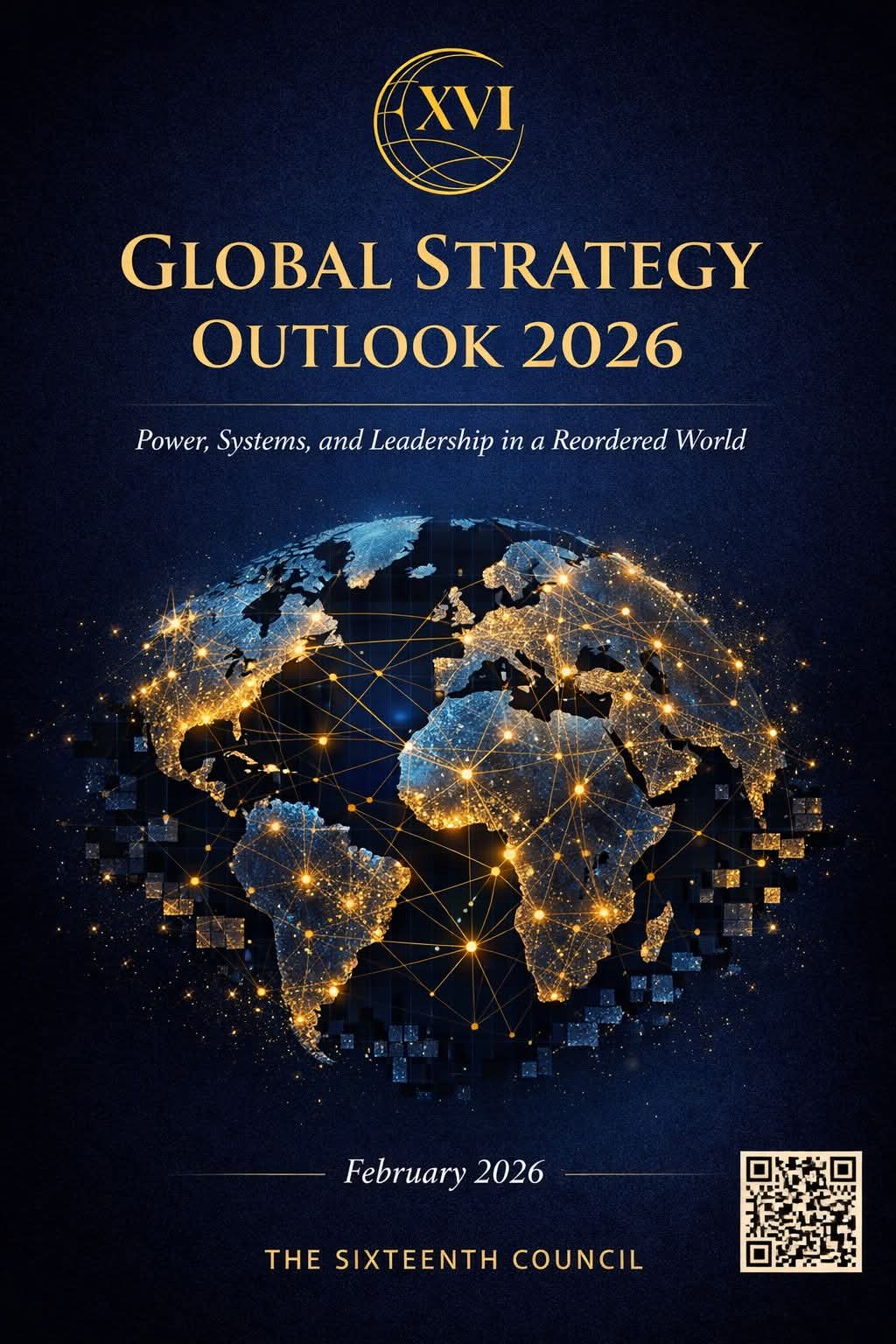
Global Strategy Outlook 2026
The year 2026 marks the beginning of a new global cycle shaped by geopolitical fragmentation, technological disruption, economic divergence, and declining institutional trust. After more than a decade of crisis management, the central challenge for leaders is shifting from responding to shocks to redesigning systems capable of operating in persistent volatility. Global Strategy Outlook 2026 outlines the major forces reshaping the world and presents a ten-point leadership agenda to help nations strengthen resilience, competitiveness, and strategic influence between 2026 and 2030.

The world is entering a decisive transition period. By 2026, the international system is no longer defined primarily by crisis management but by deeper structural changes in geopolitics, economics, technology, and governance. The assumptions that shaped the last two decades—relatively stable globalisation, predictable economic integration, dominant power hierarchies, and gradual technological change—are rapidly giving way to a far more complex environment. Today’s leaders must navigate a landscape characterised by geopolitical fragmentation, economic divergence, accelerating technological disruption, environmental volatility, and declining public trust in institutions.
At the same time, this moment presents an extraordinary strategic opening. Nations that recognise the scale of the transition and respond with clarity, discipline, and long-term planning will shape the next decade of global influence and prosperity. The choices governments make now—about economic strategy, technological governance, security cooperation, and institutional reform—will determine whether they emerge from this period stronger, more resilient, and more competitive.
Global Strategy Outlook 2026 examines this transformation and identifies the core forces reshaping the international order. It argues that the world is moving from a prolonged period of reactive crisis management—defined by financial shocks, pandemics, supply-chain disruptions, and geopolitical tensions—into a phase of strategic redesign. The challenge for leadership is no longer simply to respond to emergencies, but to build systems capable of operating effectively amid persistent volatility.
Five structural dynamics are particularly significant. Power is redistributing across a more fragmented geopolitical landscape, with major powers competing while influential middle states expand their diplomatic and economic reach. Global economic integration is being rewired as supply chains diversify, debt pressures intensify in developing economies, and new growth corridors emerge in Asia, Africa, and Latin America. Technology—especially artificial intelligence, digital infrastructure, and cyber capabilities—is becoming a central arena of economic and geopolitical competition. Environmental variability is creating new pressures on infrastructure, food systems, and productivity. And across regions, declining trust in institutions is challenging governance legitimacy and political stability.
Together, these shifts are redefining the operating environment for governments, businesses, and international institutions. The coming decade will demand new approaches to diplomacy, economic policy, technological governance, and societal resilience. Linear forecasts and short-term policymaking will prove insufficient; leadership must instead develop strategies that remain effective across multiple possible futures.
This report therefore sets out a ten-point global leadership agenda for the period 2026–2030, providing a practical framework for policymakers and institutional leaders seeking to navigate a rapidly evolving world order. The agenda focuses on stabilising international cooperation, rebuilding trust in governance, securing critical infrastructure and supply chains, governing emerging technologies responsibly, strengthening environmental resilience, preparing labour markets for technological disruption, and protecting the global commons.
The central conclusion is straightforward but consequential: the next decade will not be defined simply by external shocks, but by how effectively leaders redesign systems to manage them. Nations that act decisively, invest intelligently, and reform strategically will shape the emerging global landscape—while those that remain trapped in reactive crisis management risk falling behind in an increasingly competitive and fragmented world.