
What Trump Really Wants in Venezuela and How it Affects India?
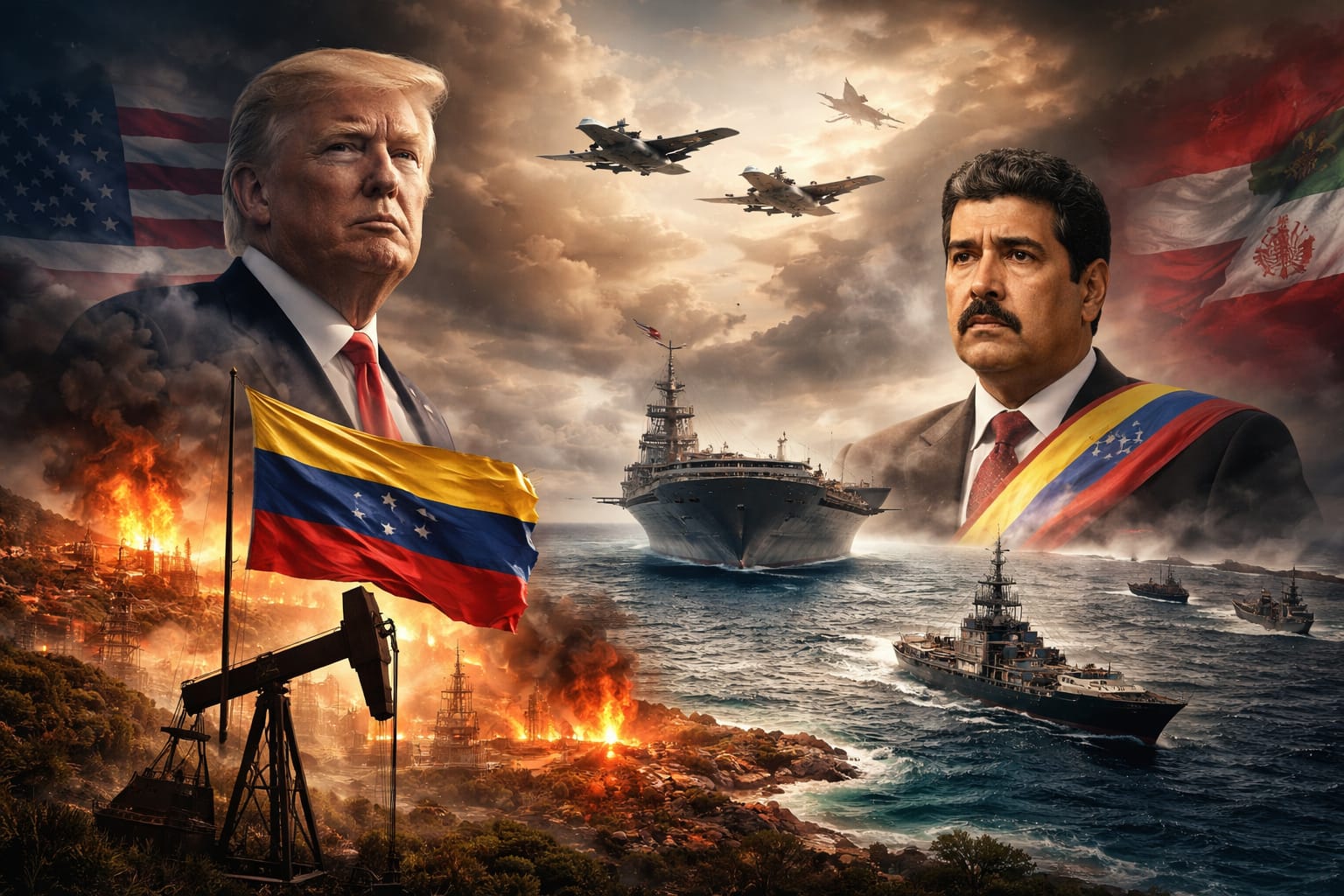
Trump’s Venezuela strategy is less about democracy and more about power: oil leverage, geopolitical signaling, and dismantling rival influence from Russia, China, and Iran. By framing pressure on Caracas as a war on drugs, Washington creates legal and political cover for escalation. For India, the fallout is tangible—sanctions disrupt crude supplies, stall ONGC Videsh investments, and expose the fragility of energy planning in a sanctions-driven world. Geopolitics, not markets, now dictates access.

Introduction
On December 9, 2025, the US military launched two fighter jets over the Gulf of Venezuela. It seems the closest US warplanes have come to the South American country’s airspace since the Trump administration started putting pressure on it. Public flight-tracking websites revealed two US Navy F/A-18 fighter jets flying over the Gulf of Venezuela, which is only about 150 miles (241 kilometres) wide at its widest point. However, a US defence official said that the two planes were on a “routine training flight” in the area.
The US has also launched a series of deadly attacks on ships suspected of smuggling drugs in the Caribbean Sea and the eastern Pacific Ocean, which further complicates regional security dynamics. Donald Trump says that ground strikes are coming soon, but he has not specified where they will happen, underscoring the uncertainty surrounding US regional military strategies.
Nicolás Maduro, the President of Venezuela, says that the real goal of the US military operations is to remove him from power, which could escalate regional tensions and impact international relations. The Trump administration is coming under more and more scrutiny from US lawmakers because of the campaign of attacks on boats that have killed at least 87 people in 22 known bombings since early September. Trump has said that the US is in an “armed conflict” with the cartels and that the attacks are a necessary escalation to stop the flow of narcotics into the nation. However, these actions and statements highlight the potential for regional instability and the broader international repercussions of US military strategies in Latin America. In this context, this report examines the Trump administration’s fundamental objectives in the region and their implications for India.
Trump in Venezuela: Actions and Consequences
The relationship between the US and Venezuela has reached an all-time low, with multimillion-dollar awards, unprecedented military deployments, and secret connections making things even more tense. There is more friction between the US and Venezuela than there has been in years. A succession of political decisions and military measures has drastically changed the situation in just a few months. The big question today is what this escalation might lead to and, most importantly, what would happen if Nicolás Maduro stepped down. Experts say that the actual problem will arise if the Maduro government falls apart. Following the Venezuelan elections last year, which sent María Corina Machado into hiding and Edmundo González into exile, Washington has taken various actions to apprehend Maduro, including offering a reward of $50 million (more than €43 million), labelling the Cartel of the Suns as a “terrorist organisation,” sinking multiple suspected drug-running boats in the Caribbean, and deployment of its largest aircraft carrier to the region. Caracas is now under unprecedented pressure as a result of all this.
On top of that, US President Donald Trump has threatened to shut down Venezuela’s airspace in addition to publicly acknowledging that the CIA has conducted operations on Venezuelan soil. Even Maduro’s inner circle was taken aback by the president’s recent admission that he had held direct talks with him. Experts say that the US president’s “multiple” objectives are apparent: to send a message of power to his supporters, to fight drug trafficking, and to break up the axis made up of Cuba, Nicaragua, and Venezuela. Experts also believe that, for the Trump Administration, the Venezuelan case is not only a diplomatic concern but also a problem framed within US national security. The US policy towards Venezuela is driven by a mix of impulses, gut feelings, and internal pressures, but it lacks a clear strategy. A US ground invasion is very unlikely, but other options such as covert actions, targeted bombings, commando operations aimed at decapitating the “regime,” clandestine CIA sabotage, or an economic and diplomatic blockade intended to induce internal collapse, remain on the table.
Experts indicate that the US military mobilisation in the Caribbean “takes on a markedly different connotation following the designation of the Cartel of the Suns as a terrorist organisation” and caution that this measure could offer “legal justification” for a potential US offensive. The significant concern remains: who will assume governance of Venezuela if Maduro were to fall?
The “Maduro regime” is currently experiencing a period of “nervousness” driven by an international isolation that it is increasingly unable to surmount. Contrary to previous periods, Latin America has transitioned towards a democratic consensus that is opposed to Caracas. The hemisphere has undergone a profound transformation; Latin America has moved beyond that acquiescent silence. Additionally, a new factor has emerged: the support of Caribbean nations, which have become active participants in response to the direct effects of drug trafficking, irregular migration, and other illicit activities associated with the Venezuelan state. For many of these countries, it is a clear indication that the situation has changed significantly and that Washington is now ready to take action. Experts say that Trump is entirely unpredictable. Today, he might shake hands, but tomorrow, he might do something on his own without warning. Because of the US president’s personal approach, a direct and private conversation between the two leaders is possible. However, Corina Machado and González, who are the real opposition, must be at the table.
Experts assert that Venezuelan society is undergoing a dual experience of hope and fear. There is a desire for change, yet there exists a concomitant fear. They are aware that any protest may provoke swift repression. The deployment of the US military exacerbates existing fears, as any miscalculation could trigger an armed conflict in which Caracas is unlikely to prevail, thereby heightening anxiety within the “Bolivarian regime.” They recognise that this time they do not have control over all factors as previously, and that, in light of such a deployment, any military action would constitute both political and military suicide.
If Maduro Falls?
Experts indicate that the Venezuelan opposition is weakened and fragmented, with many leaders in hiding or exile, complicating any orderly transition in the event of an abrupt collapse of the Venezuelan government. Even if Trump were to accomplish some of his objectives, such as instigating a mistake that could lead to internal collapse and prompt Maduro’s exit, it remains uncertain who would have the institutional capacity to prevent Venezuela from devolving into a “failed state.”
Trump’s Objectives in Venezuela:
For years, the conflict between the US and Venezuela has been framed as a moral battle: democracy vs. dictatorship, freedom vs. authoritarianism, the fight against drug trafficking vs. a state that has become a haven for criminals. However, what has happened in the last few weeks, like the private call between Donald Trump and Nicolás Maduro, the expired ultimatum, the shutting down of Venezuelan airspace, and the deployment of troops to the Caribbean, shows that things are more complicated than they seem. The fight is not just about politics or ideas. It involves money, politics, and the economy. Experts believe that the following are some of the factors which can be the true objectives of Trump’s interest in Venezuela:
Oil
Venezuela has the world’s most proven oil reserves, underscoring its strategic importance and potential influence in global energy markets. It is the centre of the battle. Even though the country no longer produces much due to years of corruption, sanctions, and a downturn in industry, there is still a massive underground energy trove. For the US, and especially for Trump, who is preoccupied with energy independence and market dominance, a change of government in Caracas would mean restructuring the global crude oil market during a time of rising tensions around the world and getting new allies to replace Venezuelan barrels that are currently out of reach, as Russia is under sanctions, and the Middle East is always at risk. Rebuilding the Venezuelan oil sector is crucial, and understanding how and with which private companies to do so can empower policymakers to influence global energy power structures. It is the starting point for understanding military and diplomatic pressure: energy is the language of world power, and Venezuela is an untapped energy wealth.
Check Russia, China and Iran
Maduro is a strategic partner of three powers and Washington thinks that Russia has exploited Venezuela as a base for financial and intelligence operations and as a way to gain power in the Caribbean and China is the regime’s biggest creditor and a major stakeholder in the country’s energy and technology infrastructure. In the other hand, Iran is a military partner and a secret source of fuel and technology to get around sanctions.
The Trump administration thinks in terms of blocs and geopolitical payback, so it is hard to imagine them allowing these three countries to remain strong in the Western Hemisphere. If Venezuela’s government changed, it would have an immediate effect: it would take down one of the strongest parts of the anti-American axis in Latin America, making its supporters weaker and giving Washington back a territory, it has claimed since the Monroe era. In this view, Maduro is not merely a target; he is a symbol of resistance to the United States that the White House seeks to remove.
The War on Drugs as a Reason
The “narco-regime” label applied to Maduro’s administration is not coincidental. A strategic move. It enables the framing of military operations as security measures. It establishes an obvious and immoral adversary. He defends the deployment of American aircraft carriers, submarines, and destroyers to the Caribbean in the eyes of the American people. It paves the way for a more assertive foreign policy and harsher sanctions. Truthfully, Washington’s goal in waging the war on drugs is to apply military pressure to a regime that it is unable to deal with on equal terms.
Maduro as the Ideal Adversary
Among the various adversaries available to the United States, Maduro stands out as one of the most strategically advantageous: Maduro is experiencing international isolation. The economy is in a state of devastation. Their strategic allies are located at a considerable distance. The entity’s legitimacy has significantly diminished, both domestically and internationally. The internal strength of its military apparatus is evident; however, it shows vulnerabilities when under significant pressure from Washington. For Trump, Maduro is a strategic asset: an adversary that can be controlled, serving as a symbolic target that enables Him to project strength while avoiding significant military risks.
Implications for India:
The US Navy’s increased presence in the Southern Caribbean has worsened relations with Venezuela, highlighting geopolitical risks that threaten India’s energy security and trade strategies. For India, Venezuela is more than just a far-off political problem; it demonstrates how US sanctions on India’s key energy sources can rapidly undermine energy plans. India benefited from buying heavy crude from Venezuela after the US relaxed sanctions in 2024. However, the reimposition of sanctions in January 2025 has caused supplies to dwindle, underscoring how quickly geopolitics can undermine India’s energy plan. OVL owns 40% of the San Cristobal and 11% of the Carabobo-1 project, both located in the Orinoco heavy oil belt, which spans most of Venezuela and eastern Colombia.
Maduro had agreed in principle to give OVL operational management of the two fields from the state-run PDVSA, but only if ONGC obtained the requisite clearances under US sanctions. ONGC sought a special licence from the US Office of Foreign Assets Control (OFAC) to operate the fields, similar to that granted to the US oil company Chevron. It would let them use American banking systems. Before new restrictions were put in place in January of this year, ONGC was in advanced talks with OFAC officials about an operational licence that would have let OVL increase production to more than 12,000–15,000 barrels per day.
Venezuelan oil has greatly benefited India. Venezuela had significant excess capacity due to US sanctions. India might buy more oil from Venezuela, as Caracas has agreed to accept payments in Indian rupees, which could weaken US sanctions and shift the US dollar out of the oil trade. India’s pharmaceutical exports to Venezuela, which were worth $111 million in 2024, are also at risk due to payment issues and sanctions. The TATA Group’s plan to build a car factory in Venezuela was put on hold due to low consumer demand. The country has also been heavily indebted to the Indian textile and pharmaceutical industries in recent years. India’s exports to Venezuela went from $200 million in FY 2013–14 to just $21 million in FY 2017–18. India’s options for obtaining crude oil from different sources have been much reduced because it lost oil from Iran and Venezuela, and Russia’s supply has dropped due to US sanctions. India’s energy plan needs to develop new legal and financial mechanisms to overcome one-sided constraints. India cannot let outside factors stop it from trading with other countries, whether it is crude oil, pharmaceuticals, textiles, or other goods.
Conclusion:
Under the Trump administration, the changing geopolitical situation around Venezuela shows a complicated mix of power, resources, and strategic objectives. The US military measures and harsh words against Maduro’s government show that the US is not only committed to fighting drug trafficking, but also wants to have more power over a country with a lot of oil reserves that is seen as a symbol of resistance to US interests in Latin America. The instability in Venezuela has significant effects on India, as it threatens its energy security and economic ties, particularly due to U.S.-imposed sanctions that undermine Indian investments and resource access.
As developments continue, Indian politicians must take steps to protect their economic interests. In a world where geopolitical tensions are rising, it is more important than ever to diversify energy sources, strengthen diplomatic relations, and build robust systems to address international sanctions. Ultimately, it will be important for India to grasp the many different reasons why the US is acting in Venezuela as it makes its own strategic decisions to protect its interests on the world stage. India’s capacity to navigate these challenges while building a stable, safe energy future will be a significant factor in what happens next.
Dr. Punit Gaur is a Visiting Fellow at The Sixteenth Council


Trump Can’t Take Greenland – and the World Knows Why