

Trump’s High-Stakes Litmus Test: Can Peace Through Strength Survive the Israel–Iran War?
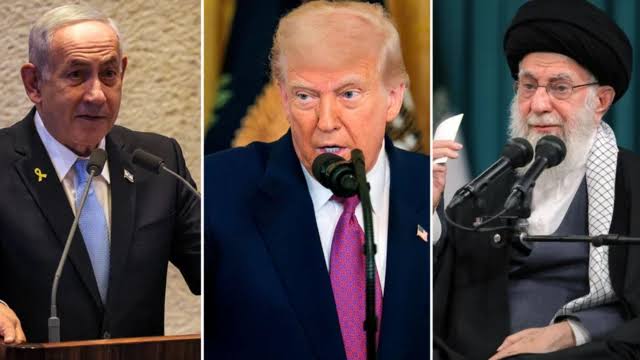
Trump’s doctrine of “peace through strength” faces a defining test in the escalating Israel–Iran war. As Tehran defies U.S. deterrence, Trump must choose between bold retaliation, risky ambiguity, or compromise—each with global consequences. The world is watching, from Beijing to Moscow. Can Trump project credible strength without losing his base or dragging America into war? This isn’t just about the Middle East—it’s a litmus test for U.S. power in a shifting world.

When Donald Trump returned to office in 2025, he came with a familiar promise: Peace through strength. It was the cornerstone of his first term’s foreign policy and the banner under which he campaigned once more. But just months into his second administration, that doctrine is now facing its most dangerous and complex test — the escalating war between Israel and Iran.
This is not just a regional conflict. It is a strategic crucible for Trump’s approach to global leadership. Can projecting raw power still deter America’s adversaries? Or has the global order shifted too much for Trumpian strength to mean anything?
1. The Doctrine Revisited: What Trump Means by “Peace Through Strength”
Trump’s version of peace through strength has always been unapologetically muscular: increased defense spending, maximum pressure sanctions, unpredictable retaliation, and a disdain for “entangling diplomacy.” Under this view, peace is secured not through alliances or treaties but by convincing adversaries that any move against U.S. interests will trigger devastating consequences.
In his first term, Trump launched missile strikes in Syria, ordered the killing of Iranian General Qassem Soleimani, and imposed crippling sanctions on Tehran. These moves were meant to restore deterrence and signal that America, under his watch, would not be trifled with.
But deterrence only works if it’s both believable and sustainable.
2. Why the Israel–Iran Conflict Undermines the Doctrine
If strength is Trump’s currency, the Israel–Iran war is testing its value on the global market—and the world is watching the exchange rate
Despite Trump’s swagger, the outbreak of full-scale war between Israel and Iran in 2025 has raised doubts about the deterrent value of his doctrine. Trump has promised unwavering support for Israel, even suggesting that U.S. forces would “stand by our greatest ally in the Middle East.” Yet Iran, emboldened by years of U.S. inconsistency and regional power vacuums, has not backed down.
Instead, it has escalated directly, using conventional missiles, drone swarms, and proxy militias to strike both Israeli and Western targets. This marks a significant evolution: Iran is no longer hiding behind proxies — it’s stepping into the ring.
If Trump’s approach was meant to intimidate, why is Iran still standing?
3. A Moment of Strategic Reckoning
The Trump administration now finds itself at a critical crossroads:
Intervene directly, risking a broader regional war that could entangle U.S. forces in yet another Middle Eastern quagmire
Maintain strategic ambiguity, which risks appearing weak or indecisive
Or broker a ceasefire, which contradicts the image of strength Trump prides himself on
None of these options allow him to emerge unscathed. The Israel–Iran war is exposing the limits of unilateralism in a multipolar world where alliances have frayed, and adversaries are willing to gamble.
4. The Global Optics: Who’s Watching?
Trump’s every move is being closely watched not just in Tehran or Tel Aviv, but in:
Beijing, where President Xi is testing Western resolve over Taiwan
Moscow, where Putin is recalibrating in Ukraine and the Black Sea
Pyongyang, where Kim Jong-un is watching to see whether Trump is still the “deal-maker” he once claimed to be
If Trump cannot manage escalation or reimpose deterrence, America’s adversaries may conclude that strength under Trump is more show than substance. That weakens the global order — and undermines U.S. credibility far beyond the Middle East.
5. Trump’s Base vs. Trump’s Burden
Ironically, Trump’s foreign policy now collides with the expectations of his own support base. His “America First” crowd wants strength, but not another foreign war. They expect Trump to stand tall — not get dragged into endless entanglements. How does he show resolve without reigniting the very kind of interventionism he once condemned?
Trump is walking a tightrope of perception: if he appears soft, he loses face; if he intervenes too much, he loses his base.
6. What Does “Winning” Look Like for Trump?
The Trump administration’s goal must now be to restore deterrence without deep entanglement. That will require:
Strategic precision in response — punishing Iran without provoking wider war
Leveraging allies more effectively — not just Israel, but Saudi Arabia, the UAE, and Egypt
Clear messaging — domestically and globally — to demonstrate that the U.S. is not stepping back from its commitments
If Trump can navigate this crisis, reassert American dominance in the region, and avoid escalation, he may vindicate his doctrine. But if the conflict spirals out of control, it will be the most visible failure of “peace through strength” in modern memory.
7. A Doctrine on Trial
Ultimately, the Israel–Iran war is not just a foreign policy challenge. It is a referendum on the viability of Trump’s geopolitical worldview.
“Peace through strength” only works when the strength is credible, coherent, and strategically applied. This moment may show whether Trump’s approach is still fit for purpose—or a dangerous relic of a world that no longer exists.
Either way, this is no longer a test just for Israel, Iran, or the Middle East. It is Trump’s doctrine on trial, and the verdict will shape the world’s perception of U.S. power for years to come.
Dr Brian O. Reuben is the Executive Chairman of the Sixteenth Council
Critical Minerals and the Green Transition: Europe’s New Dependency Risk