
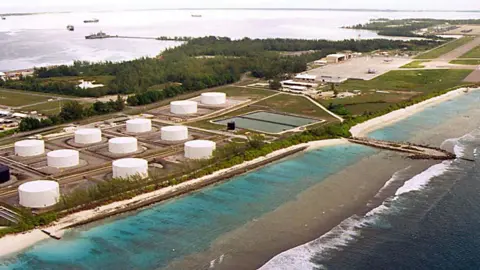
The Chagos Islands Deal: A Pragmatic Resolution Amid Political Backlash
In 2019, the International Court of Justice (ICJ) ruled that Britain’s continued occupation of the islands was illegal and that sovereignty should be transferred to Mauritius. The United Nations General Assembly (UNGA) reinforced this ruling, urging the UK to cede control. However, successive British governments refused, citing strategic security interests.
Prime Minister Starmer’s agreement to transfer sovereignty while securing a 99-year lease for the military base is a long-overdue response to international legal obligations

The recent decision by UK Prime Minister Sir Keir Starmer and U.S. President Donald Trump to transfer sovereignty of the Chagos Islands to Mauritius while securing a long-term lease for the Diego Garcia military base has sparked intense political debate in Britain.
Critics, including Conservative leader Kemi Badenoch and Reform UK leader Nigel Farage, have vehemently opposed the agreement, arguing that it is a betrayal of British interests and an unnecessary financial burden on taxpayers. Their criticisms, however, fail to account for the broader strategic, legal, and moral considerations underpinning the deal. Rather than a reckless surrender, this agreement represents a pragmatic resolution to a long-standing international dispute—one that ensures both Britain and the United States maintain their strategic military presence in the region while upholding international law.
Understanding the Chagos Islands Dispute
The Chagos Islands, officially known as the British Indian Ocean Territory (BIOT), have been under British control since 1965. In the 1960s and 1970s, the UK forcibly evicted the native Chagossians to make way for a joint U.S.-UK military base on Diego Garcia, the largest of the islands. This move was widely condemned as a violation of human rights.In 2019, the International Court of Justice (ICJ) ruled that Britain’s continued occupation of the islands was illegal and that sovereignty should be transferred to Mauritius. The United Nations General Assembly (UNGA) reinforced this ruling, urging the UK to cede control. However, successive British governments refused, citing strategic security interests.
Prime Minister Starmer’s agreement to transfer sovereignty while securing a 99-year lease for the military base is a long-overdue response to international legal obligations. It not only resolves a historical injustice but also ensures that Britain and the U.S. retain their strategic foothold in the Indian Ocean—an increasingly contested region amid China’s growing influence.
—
The Opposition: Kemi Badenoch and Nigel Farage’s Nationalist Stance
Kemi Badenoch’s Objections
Kemi Badenoch has framed the agreement as a reckless giveaway of British territory. During Prime Minister’s Questions, she declared, “This is an immoral surrender so north London lawyers can boast at their dinner parties.” This rhetoric, designed to appeal to nationalist sentiments, ignores the fundamental reality: the UK does not legally own the Chagos Islands.
The argument that Britain should defy international law and retain the territory indefinitely disregards the long-term consequences of such an approach. It would weaken the UK’s diplomatic standing, invite legal reprisals, and potentially alienate key allies, including the United States.
Nigel Farage’s Economic Concerns
Nigel Farage has been even more forceful in his condemnation, arguing that the UK will be paying a heavy financial price for this deal. He claims that the annual £90 million payment to Mauritius over 99 years will ultimately cost British taxpayers over £50 billion, given projected inflation rates.
While this is a considerable sum, Farage’s argument fails to acknowledge the potential cost of continued defiance. Had the UK refused to comply with the ICJ ruling, it could have faced economic and diplomatic sanctions. Moreover, legal battles and reputational damage would have made future trade negotiations and strategic partnerships more difficult.
Most importantly, this agreement does not mean the UK is losing access to Diego Garcia. Instead, the military base remains operational under a secure lease, ensuring Britain retains its strategic presence in the region without further legal disputes.
—
The Strategic Importance of Diego Garcia
For both Britain and the U.S., Diego Garcia is a critical military asset. It serves as a key hub for operations in the Middle East, Africa, and the Indo-Pacific.
A Stronger U.S.-UK Alliance
The agreement strengthens the Anglo-American alliance by removing a major diplomatic irritant. Previous American administrations had been reluctant to pressure the UK on the Chagos issue, but with growing geopolitical tensions in the Indo-Pacific, the Biden administration and now the Trump administration saw resolving this dispute as essential. By securing a long-term lease, Trump has ensured that Diego Garcia remains a cornerstone of Western military strategy.
Countering China’s Expanding Influence
China has been aggressively expanding its presence in the Indian Ocean, establishing naval bases in Djibouti and seeking influence in Sri Lanka and the Maldives. If the UK had continued to resist the ICJ ruling, it risked pushing Mauritius closer to Beijing, potentially leading to a scenario where China gained leverage over the territory.
By proactively negotiating a favorable deal, the UK and U.S. have prevented this geopolitical risk.
—
The Moral and Legal Imperative
One of the most overlooked aspects of this deal is its moral significance. The Chagossians were forcibly removed from their homeland, and despite multiple legal battles, successive UK governments have refused to allow them to return.
With this agreement, Mauritius has committed to facilitating the resettlement of the Chagossians. This is not only a legal necessity but a moral responsibility. The UK has long championed human rights and the rule of law—continuing to occupy the Chagos Islands in defiance of international rulings would have been a glaring contradiction.
This deal allows Britain to finally correct a historical injustice while maintaining its strategic security interests.
—
Addressing the Critics’ Misconceptions
“This Weakens the UK’s Strategic Position”
Critics argue that ceding sovereignty weakens Britain’s military posture. However, the Diego Garcia lease ensures that UK and U.S. operations continue unhindered. If anything, the deal strengthens Britain’s global credibility by demonstrating its commitment to international law while securing its long-term military presence.
“This is a Bad Deal Financially”
While the £90 million annual payment is significant, it pales in comparison to the costs of potential legal battles and diplomatic fallout. Furthermore, by fostering a stable relationship with Mauritius, the UK may open new economic and strategic opportunities in the region.
“We Should Ignore International Rulings”
This stance is both impractical and dangerous. If Britain selectively ignores international law, it sets a precedent that could be used against it in other disputes. Respecting legal rulings strengthens Britain’s position in advocating for the rule of law globally, including on issues like Hong Kong and Ukraine.
—
Conclusion: A Necessary and Pragmatic Agreement
Despite the political grandstanding of Kemi Badenoch and Nigel Farage, the Chagos Islands agreement is a necessary and pragmatic solution to a complex issue.
By transferring sovereignty to Mauritius, Britain is upholding international law, rectifying a historical injustice, and securing long-term strategic interests in the region. The 99-year lease of Diego Garcia ensures that the UK and the U.S. maintain their military presence without further legal disputes.
Far from being an act of surrender, this agreement strengthens Britain’s global standing and reinforces its commitment to diplomacy and strategic foresight. Critics who oppose it are clinging to an outdated imperial mindset that ignores the realities of modern geopolitics.
The Starmer-Trump agreement should be seen for what it is: a bold, necessary, and ultimately beneficial decision that secures Britain’s future in an increasingly uncertain world.
Dr. Brian O. Reuben is the Executive Chairman of the Sixteenth Council.
Existing Indian Economic and Strategic Interests in Cuba: Challenges and Prospects