Hedging or Heading Away? The Quiet Drift of US Allies Toward China

US allies are quietly recalibrating their relationships with China, exploring economic and technological partnerships while maintaining security commitments to Washington. This hedging reflects pragmatic flexibility rather than outright abandonment, but signals a growing multipolar reality. Europe and Asia are diversifying trade, infrastructure, and tech ties with Beijing, testing limits of US influence. The trend highlights a critical choice for Washington: adapt to conditional loyalty and shared influence, or risk incremental erosion of its global primacy as allies hedge for security and opportunity

Read MoreHedging or Heading Away? The Quiet Drift of US Allies Toward China

Negotiations and Tariff Threat of Ongoing US-Europe Territory Dispute

The US-Europe dispute over Greenland reflects a new era of geopolitically driven trade policy. President Trump’s threats of escalating tariffs aim to force European acquiescence, prompting discussions on Europe’s anti-coercion measures. NATO deployments to Greenland, debates over US missile defence, and concerns from Russia and China underscore the stakes. Failure to reach agreement risks severe economic disruption for Europe, particularly Germany, while US-EU trade faces uncertainty. The crisis signals that tariffs are increasingly a tool of strategic coercion rather than revenue generation.

Read MoreNegotiations and Tariff Threat of Ongoing US-Europe Territory Dispute

The Fragmentation of Western Politics 

Western politics is fragmenting as unilateral power eclipses post-WWII cooperation. Assertive US interventions, from Venezuela to Greenland, expose weak international enforcement and embolden rival powers. Europe faces alliance uncertainty, rising nationalism, and economic coercion while NATO’s credibility strains. The precedent of unchecked interference risks normalising ‘might makes right,’ encouraging China and Russia to test boundaries. Without renewed collective security and democratic oversight, Western cohesion erodes, reshaping global stability and accelerating a volatile, multipolar order under growing strategic mistrust worldwide today.

Read MoreThe Fragmentation of Western Politics 

Who Checks Trump? Who Checked the U.S.?

The U.S. capture of Nicolás Maduro marks a dangerous rupture in global governance. By openly declaring its intent to “run” Venezuela, the United States has crossed from influence into occupation, undermining the very rules-based order it once championed. For Africa and states like Ghana, the message is stark: sovereignty is now conditional, and unchecked power—not law—risks becoming the new global norm.

Read MoreWho Checks Trump? Who Checked the U.S.?

U.S. Capture of Nicolás Maduro and the Inception of a New, Volatile Foreign Policy Doctrine

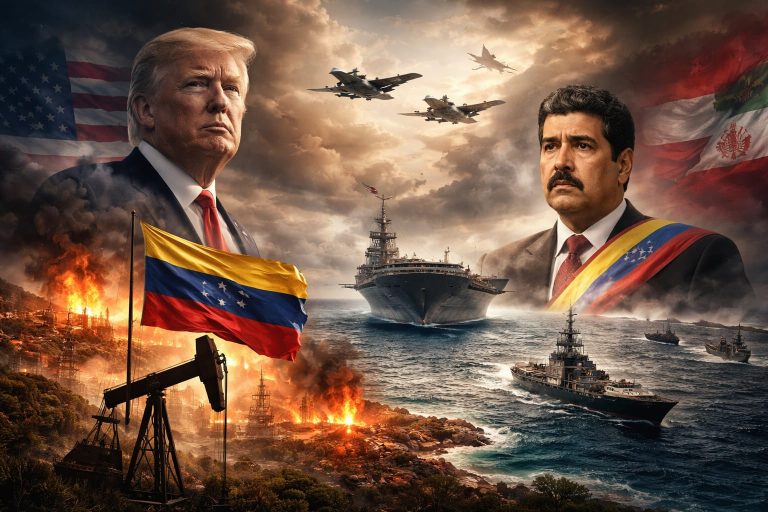
The U.S. capture of Nicolás Maduro marks a watershed in global politics: a shift from rules to raw power. Framed as law enforcement by United States under Donald Trump, the operation signals a new doctrine of unilateral regime removal tied to strategic resources. The immediate prize is Venezuelan oil; the long-term cost is a destabilized international order, where sovereignty becomes conditional and retaliation increasingly likely.

Read MoreU.S. Capture of Nicolás Maduro and the Inception of a New, Volatile Foreign Policy Doctrine

Global Trade in 2025: From Efficiency to Power

By 2025, global trade stopped pretending to be neutral. Efficiency gave way to resilience, markets to strategy, and institutions to power. Shipping routes, carbon rules, currencies, and data flows became tools of statecraft rather than technical details. Trade did not collapse; it realigned around security and political trust. The era of frictionless globalization ended quietly, replaced by a world where who you trade with now matters as much as what you trade.

Read MoreGlobal Trade in 2025: From Efficiency to Power

What Trump Really Wants in Venezuela and How it Affects India?

Trump’s Venezuela strategy is less about democracy and more about power: oil leverage, geopolitical signaling, and dismantling rival influence from Russia, China, and Iran. By framing pressure on Caracas as a war on drugs, Washington creates legal and political cover for escalation. For India, the fallout is tangible—sanctions disrupt crude supplies, stall ONGC Videsh investments, and expose the fragility of energy planning in a sanctions-driven world. Geopolitics, not markets, now dictates access.

Read MoreWhat Trump Really Wants in Venezuela and How it Affects India?

Global Order Under Strain: The Major Foreign-Policy Shocks of 2025

2025 exposed a global order under strain, defined less by decisive realignments than by accumulating shocks. U.S.–China economic confrontation became visibly symmetric, conflict mediation in Ukraine and the Middle East lost credibility, and regional actors assumed security roles once held by global powers. Trade routes, supply chains, and deterrence norms all proved fragile. The year underscored a central reality: major powers retain ambition, but their ability to enforce outcomes is increasingly constrained, producing a more volatile and contested international system.

Read MoreGlobal Order Under Strain: The Major Foreign-Policy Shocks of 2025

Prioritising Safety and Accountability: Addressing the Drug Cartel Threat in the US

Over the past ten months, some political debates have centred on complex issues: opposition to a comprehensive audit of federal government operations, decisions around the deportation of certain undocumented immigrants, and questions about the inclusion of biological males in women’s sports. Among these, the matter of drug trafficking has drawn particular attention.

Read MorePrioritising Safety and Accountability: Addressing the Drug Cartel Threat in the US

Navigating the Reconfiguration of the Global Order

The global order is undergoing its deepest reconfiguration since the Cold War. Power is diffusing beyond the U.S.–China axis to assertive regional powers, non-state actors, and transnational corporations. Conflicts, supply-chain shocks, and climate pressures are exposing the fragility of old institutions. De-risking strategies, digital competition, and the energy transition are redrawing economic and security maps in real time. Resilience, adaptability, and pragmatic cooperation—not outdated assumptions—will determine which nations and institutions thrive in this fluid, contested system.

Read MoreNavigating the Reconfiguration of the Global Order