
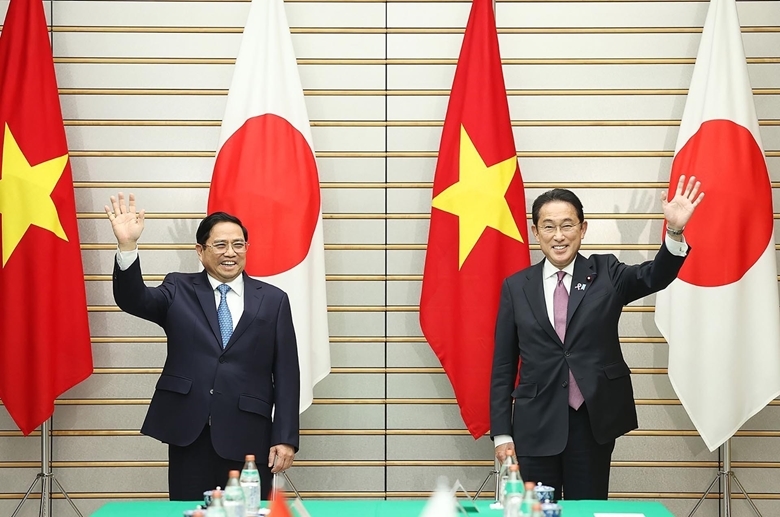
Strategic Alignment in a Fragmented World: Japan-Vietnam Economic Cooperation and the Shifting Balance of Power in Asia
In a world increasingly marked by fragmentation, protectionism, and economic uncertainty, Japan and Vietnam have emerged as proactive leaders seeking to reinforce stability and prosperity through a new bilateral trade pledge. In April 2025, both countries committed to boosting trade and investment flows, while upholding global rules and ensuring the free flow of goods

In a world increasingly marked by fragmentation, protectionism, and economic uncertainty, Japan and Vietnam have emerged as proactive leaders seeking to reinforce stability and prosperity through a new bilateral trade pledge. In April 2025, both countries committed to boosting trade and investment flows, while upholding global rules and ensuring the free flow of goods. This seemingly modest announcement carries profound implications not just for their domestic economies, but for the geopolitical balance in the Asia-Pacific and the resilience of the global trading system.
A Timely Pact Amidst Global Disruptions
The agreement comes at a time when global supply chains are still reeling from the effects of the COVID-19 pandemic, the U.S.-China trade war, and escalating tensions in the South China Sea. Japan and Vietnam have chosen to respond not by retreating into protectionism, but by embracing multilateralism and reinforcing mutual economic cooperation. Their new partnership reflects a shared commitment to the principles of free trade and a rules-based order.
Economic Synergy: Complementary Strengths
Japan, a technology and manufacturing giant, and Vietnam, a rapidly industrializing nation with a young labor force, have complementary economic profiles. Japan needs reliable manufacturing partners as it seeks to diversify away from overdependence on China. Vietnam, in turn, benefits from access to advanced Japanese technology, capital, and infrastructure expertise.
This new initiative is expected to:
Expand Japanese investment in Vietnamese sectors such as high-tech manufacturing, automotive components, and digital infrastructure.
Increase Vietnamese exports to Japan, particularly in electronics, garments, agricultural products, and processed foods.
Encourage joint ventures in green energy, smart cities, and logistics infrastructure.
Strategic Hedge Against Chinese Dominance
Geopolitically, this partnership signals a subtle but strategic hedge against China. While both Japan and Vietnam maintain economic ties with Beijing, they share concerns about China’s assertiveness in the Indo-Pacific. Vietnam, a claimant in the South China Sea disputes, finds in Japan a trustworthy partner with both diplomatic clout and economic muscle.
The cooperation aligns with Japan’s broader “Free and Open Indo-Pacific” strategy, which aims to secure maritime routes, promote the rule of law, and ensure a multipolar Asia. For Vietnam, the benefits go beyond economics—it reinforces its foreign policy of “bamboo diplomacy,” balancing relations with major powers without being overly dependent on any single one.
Reinforcing the Multilateral Trading System
This pact also serves as a rare affirmation of commitment to multilateralism. Amid the rise of nationalism and unilateral trade measures, Japan and Vietnam are standing up for a global system built on transparency, reciprocity, and cooperation. Both countries are signatories to the Comprehensive and Progressive Agreement for Trans-Pacific Partnership (CPTPP), and their bilateral initiatives are expected to strengthen this regional framework.
This sends an important message to the world: that small and medium-sized nations can lead by example, sustaining the spirit of free trade in a world where major powers are increasingly turning inward.
Catalyzing Investment and Supply Chain Resilience
One major consequence of this alignment is the expected surge in Japanese investment in Vietnam. Already one of Vietnam’s top foreign investors, Japan is likely to accelerate infrastructure development projects, energy investments, and tech transfers. These include:
High-speed rail and urban metro systems in Hanoi and Ho Chi Minh City.
Expansion of ports and industrial zones in Da Nang and Hai Phong.
Joint research in semiconductors and artificial intelligence.
This also strengthens Vietnam’s position as a key hub in the “China+1” strategy, which seeks to reduce dependence on Chinese manufacturing by diversifying production bases.
Lessons for Africa and Other Developing Regions
For Africa and other developing regions, this partnership offers valuable insights:
Strategic positioning matters: Vietnam’s geopolitical balancing act has allowed it to attract multiple partners.
Credibility is currency: Vietnam’s stable political environment and commitment to trade rules make it a reliable destination for investment.
Regional integration and global alliances are not mutually exclusive. They can reinforce one another when built on trust and shared interests.
African countries can draw from this example by creating favorable investment climates, engaging with reliable partners like Japan, and maintaining diplomatic agility in a multipolar world.
Potential Challenges and Critiques
No agreement is without its hurdles. Critics point to the risks of overreliance on Japanese capital, which may reduce Vietnam’s bargaining power. There are also environmental and labor concerns regarding rapid industrialization. Additionally, China may respond with subtle economic pressure or attempts to undermine the partnership through regional influence.
Furthermore, the success of this initiative depends heavily on domestic implementation. Vietnam must continue reforms to improve governance and legal transparency, while Japan must navigate domestic opposition to deeper foreign entanglements.
Conclusion: A Strategic Blueprint for the Future
The Japan-Vietnam trade pact is more than a bilateral arrangement—it is a forward-looking strategy in a time of global transition. It reflects pragmatism, foresight, and a shared vision for stability through interdependence. As other nations grapple with nationalism, fragmentation, and retreat, Japan and Vietnam have chosen cooperation, openness, and strength through partnership.
Their actions set a powerful precedent: that middle powers, through smart alliances and principled leadership, can help shape the future of global trade and regional peace.
Dr Brian O. Reuben is the Executive Chairman of the Sixteenth Council.
Critical Minerals and the Green Transition: Europe’s New Dependency Risk