
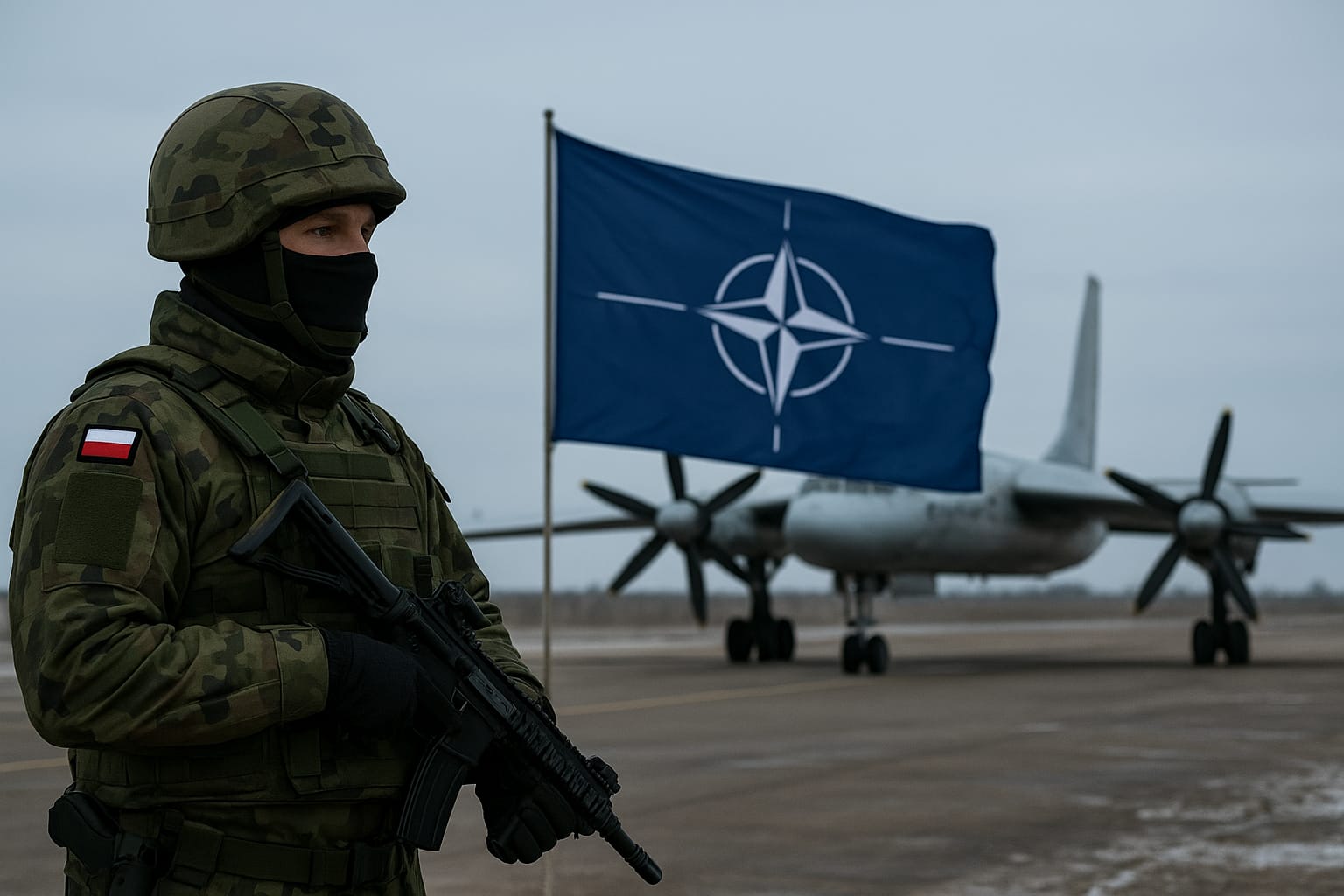
Guarding Europe’s Eastern Horizon: How NATO and Poland Can Turn Russian Probes into Strategic Strength
As tensions mount on NATO’s eastern flank, Poland emerges as a pivotal actor in defending Europe’s security architecture. Russia’s aerial and cyber probes are not only a threat but also a test of alliance cohesion. By investing in forward defense, intelligence sharing, and rapid-reaction capabilities, Poland and NATO can transform these provocations into opportunities to harden Europe’s eastern horizon, signaling to Moscow that unity and readiness—not hesitation—define the future of European security.

Introduction – From Border to Testbed
Poland and its Baltic neighbours are no longer simply NATO’s outer perimeter. They have become laboratories in which the Alliance’s ability to deter hybrid aggression, ambiguous incursions and electronic warfare is tested almost daily. In September 2025 alone, Poland and Estonia faced unprecedented airspace violations by Russian drones and fighter jets – incidents that underscored a truth many European leaders have long suspected but struggled to operationalise: NATO’s credibility will live or die on the eastern flank.
What makes this moment different from earlier Cold War or post-Cold War standoffs is that the stakes are no longer merely territorial. Russia is mounting a campaign to erode NATO’s political cohesion and decision-making predictability. For Moscow, each probe offers three prizes: intelligence, intimidation, and internal division among allies. For NATO, each probe poses a binary question: is the Alliance capable of acting as one, quickly and visibly, or is it still improvising crisis by crisis?
Russia’s Strategy – Incremental Incursion, Maximum Effect
Drones and Jets as “Strategic Feeler Gauges”
Moscow’s latest moves – nearly two dozen drones crossing Polish airspace on 9–10 September 2025, and three Russian MiG-31s entering Estonian skies on 20 September – are part of a deliberate pattern. The Kremlin prefers to probe below the threshold of war, using uncrewed systems, brief overflights, or deniable cyber activity to map NATO’s reflexes without incurring automatic retaliation.
By forcing Poland to scramble interceptors and Estonia to invoke Article 4 consultations, Russia gains valuable data on radar coverage, command-and-control timing, and the political psychology of Alliance capitals. These are not minor provocations but strategic “X-rays” of NATO’s defensive organism.
The Propaganda Loop
Each incursion is also a performance. Russian state media can showcase NATO’s reactions as evidence of “Western hysteria,” reinforcing domestic narratives of Kremlin strength. Abroad, the same incidents can be spun to fence-sitting states as proof that opposing Moscow carries real costs and uncertainty. This dual messaging undermines NATO’s deterrence even without a single shot being fired.
The Alliance Under Pressure – Unity Tested
Article 4 as a Warning Bell
When Poland and Estonia invoked NATO’s Article 4 – the consultation mechanism used when a member feels threatened – they were sending a signal about seriousness and expectations. Article 4 is not a prelude to automatic military escalation, but a political alarm bell. The fact that two front-line states used it within weeks of each other tells us that “routine” Russian incursions are already reshaping security perceptions inside NATO.
The Messaging Gap
While NATO’s Secretary General, the EU’s foreign policy chief, and many European capitals issued rapid and unambiguous condemnations, the U.S. response was more fragmented. Secretary of State Marco Rubio called the drone swarm “reckless” and promised “serious consequences” if deliberate targeting were proved. President Trump, however, posted that the incidents “could have been a mistake” and called for restraint. That divergence matters. Deterrence is ultimately psychological, and Moscow reads hesitation and mixed messaging as permission to keep pushing.
Consequences Beyond Security – Economics and Politics
Markets and Investment
Eastern Europe’s post-Cold War economic story is built on the assumption of credible defence guarantees. When airports close and skies are briefly contested, investors take notice. Critical infrastructure, from energy pipelines to data cables, becomes harder to finance. The political risk premium rises, and with it the cost of doing business in the region.
Domestic Narratives
Inside NATO countries, these incursions fuel both hawkish and dovish factions. One bloc argues for escalatory measures – more deployments, harsher rhetoric. Another bloc argues for negotiation or restraint to avoid “World War III.” Moscow exploits both narratives simultaneously, using its media echo chambers and disinformation networks to amplify divisions.
Turning the Test Around – A New NATO Playbook
1. Codify and Publicise Response Protocols
NATO needs to establish and communicate clear rules for dealing with drones, jets and cyber intrusions. When does a drone get shot down? When does an overflight prompt sanctions or diplomatic expulsions? Codification erodes Moscow’s ability to exploit ambiguity.
2. From Rotational to Permanent Deterrence
Operation Eastern Sentry – launched in September 2025 – is a strong first step, pooling fighters and surveillance assets from France, Germany, Denmark and others. But rotational deployments send a mixed signal of commitment. Permanent forward-stationed air defence systems, anti-drone batteries and ISR assets in Poland, the Baltics and Romania would shift the dynamic from reaction to prevention.
3. Integrate Civil and Military Resilience
The closure of Polish airports during the drone incursions exposed vulnerabilities beyond the purely military realm. NATO and the EU should support front-line states in integrating civilian early-warning systems, airport contingency plans and cross-border emergency communications.
4. Command the Narrative
Every incursion must be framed as reckless Russian aggression, not as NATO “overreaction.” That means coordinated press releases, evidence sharing, and rapid translation into multiple languages. Legal documentation of violations also matters for long-term accountability and sanctions.
5. Speak With One Voice
Deterrence depends as much on political cohesion as on radar coverage. Leaders in Washington, Berlin, Paris and London must align their statements and actions. Even a hint of daylight between them emboldens Moscow. NATO should rehearse not only military responses but also joint political messaging.
Broader Implications – Rethinking Collective Security
If NATO handles this moment effectively, it can transform Russian probes into a stress test that strengthens the system. Permanent air defence integration, unified messaging, and expanded civil resilience would create a more credible deterrent than any one-off deployment. This would also reassure markets and populations, signalling that Eastern Europe is a stable investment environment, not a perpetual flashpoint.
Conversely, failure to adapt would allow Russia to normalise airspace violations, sap confidence in Article 5, and ultimately fracture the post-Cold War security order. The lesson from the 1930s is not that alliances fail under direct attack, but that they corrode under incremental testing.
Conclusion – The Red Line Is Now a Discipline
The real contest around Poland is not about territory but about discipline – the discipline to respond quickly, consistently and collectively. Moscow’s “probe and deny” tactics are designed to induce hesitation. NATO’s answer must be to remove hesitation from its playbook.
Poland is not merely a waypoint on a map; it is the living embodiment of NATO’s credibility. Integrated defences, rehearsed political responses, and disciplined messaging can ensure that Russia’s incursions remain futile gambles rather than strategic gains. In doing so, NATO would reaffirm the principle that Europe’s eastern horizon is defended not only in treaties but in practice – every hour, every incursion, every time.
Dr Brian O Reuben is the Executive Chairman, Sixteenth Council and Special Envoy on European Transformation and Global Coherence


Existing Indian Economic and Strategic Interests in Cuba: Challenges and Prospects