
Economic Deals and Syria Sanctions Lift- The Implications of Trump’s Middle East Tour
During a four-day tour of Saudi Arabia, Qatar, and the UAE, U.S. President Donald Trump secured historic economic and defense deals, including a $600 billion investment pact with Saudi Arabia and a $1.4 trillion AI agreement with the UAE. In a surprise move, Trump also announced the lifting of U.S. sanctions on Syria, signaling a potential diplomatic reset and opening the door to regional economic investment and reconstruction.

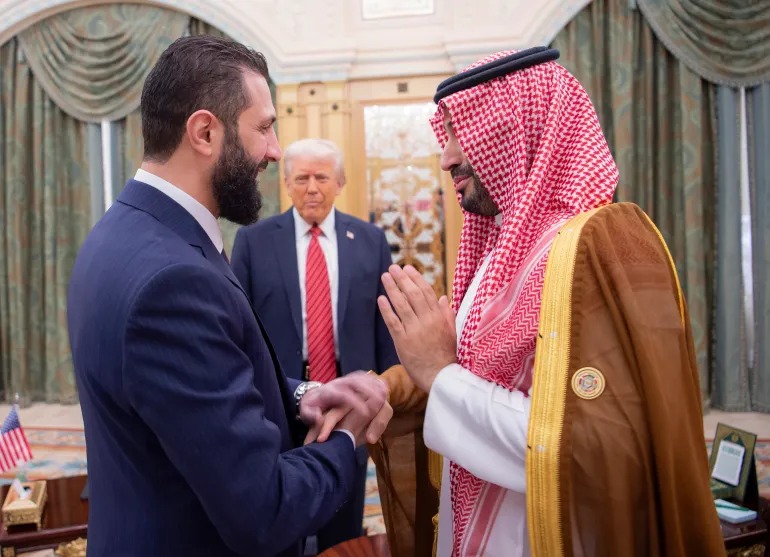
US President Donald Trump has just wrapped up his Middle East tour after spending four days in Saudi Arabia, Qatar and the United Arab Emirates. This tour of the Gulf States was predominantly focused on economic deal-making and the strengthening of diplomatic relations between the US and the Middle East. One surprising outcome of this tour was the announcement that Trump was going to lift the sanctions that have been placed on Syria after meeting the Syrian President Ahmed Al Sharaa in Saudi Arabia. The economic successes as well as the announcement of ending sanctions on Syria can have implications that will reverberate throughout the region. The purpose of this article is to analyse the results of Trump’s Middle East tour and their potential implications. This analysis will focus on the following sections to understand the outcomes of Trump’s Middle East Tour:
- US-Gulf States Economic Deal-Making Success
- Ending Sanctions on Syria and its Implications
US-Gulf States Economic Deal-Making Success:
In terms of economic deal-making, it can be argued that Trump’s tour of the Gulf States can be considered a resounding success story. Trump’s visit resulted in numerous investment deals being made between the US and the Gulf States across different sectors, which can open up future opportunities for the US to invest in the Gulf States, as well as create opportunities for the Gulf States to invest in the US economy. This is prevalent in the case of Saudi Arabia, as an investment deal amounting to approximately $600 billion was made, which can prove to be beneficial to strengthening the US-Saudi partnership (Doyle, 2025). Naturally, this $600 billion deal can result in more lucrative exchanges between the US and Saudi Arabia and potentially can be used to strengthen diplomatic ties between the US and Saudi. Furthermore, the US and Saudi Arabia were also able to close a deal relating to arms sales, which can be helpful in boosting Saudi defense. This is clear as the US and Saudi Arabia signed a $142 billion arms deal, which although could take time to “pan out”, can help Saudi Arabia defend itself in times of insecurity and uncertainty (Turak, 2025). Through these deals, Trump is able to develop closer economic and security ties with Saudi Arabia, which can be beneficial for Trump’s economic footprint in the region.
While the Saudi deal is noteworthy in its own right, the investment deals Trump made with the UAE and Qatar look to be more lucrative and have the potential to boost economic cooperation between the US and GCC in the future. This is clear as the Trump and Sheikh Mohammed bin Zayed managed to sign an investment deal relating artificial intelligence, which will see the UAE invest $1.4 trillion into the US AI sector, which will allow the UAE to build and finance data centers in the US in order to develop AI models (Al Jazeera and News Agencies, 2025). The AI deal negotiated between the US and UAE can be essential to the UAE’s economic ambitions, as it would allow the UAE to diversify its investment portfolio into the emerging tech market, which could result in an economic boom for the UAE. Moreover, it could provide the US an opportunity to promote its own technological advancements to new markets in the Middle East, with the resounding endorsement of the UAE.
Moreover, in the case of Qatar, Trump deal-making with the Qatari Emir Sheikh Tamim bin Hamad not only resulted in lucrative economic deals, but also a lucrative defense deal. This is evident as the US and Qatar signed a deal that will see Qatar purchase 160 Boeing jets worth $200 billion (Samuels, 2025). Besides the Boeing deal, the US also signed a deal with Qatar, which will see the two countries engage in an economic exchange for years to come. This is clear as the US and Qatar signed a $1.2 trillion economic exchange deal while Trump was visiting Doha (Frolo, 2025). An economic exchange of that total can provide numerous opportunities for economic cooperation between the US and Qatar that can help turn Qatar into a reliable economic partner for the US. Overall, Trump’s successful negotiations of lucrative deals between the US and the Gulf States can create numerous investment opportunities that have the potential to boost economic cooperation between the parties involved.
Ending Sanctions on Syria and its Implications
While the primary purpose of Trump’s Middle East tour was to strengthen economic ties between the US and the Gulf States, his announcement regarding the lifting of sanctions on Syria can be considered the highlight of this tour. For context, the US sanctions on Syria were designed to place economic pressure on former President Bashar Al-Assad to end the Syrian Civil War and step down as leader. In 2024, the Al-Assad regime was toppled by Hayat Tahrir Al Shams (HTS), which saw current President Ahmed Al Sharaa replace Al-Assad as Syrian leader. The sanctions on Syria had a painful impact on the Syrian population, as the Syrian economy shrunk significantly, which led to 69% of Syrians living in poverty (Salem, 2025). Naturally, Trump’s lifting of sanctions on Syria was welcomed by the Syrian government as well as the Syrian population.
One can argue that Trump’s lifting of sanctions on Syria can lead to economic investment and the strengthening of diplomatic ties in the region and abroad. This is clear as former US Ambassador to Syria Robert S. Ford claimed that “… removing the sanctions that will enable international capital flows to go into Syria from Gulf states, from other Arab states and from different aid agencies is absolutely vital” (Ford, 2025 cited in Smith and Debusmann Jr, 2025). Beyond aid and reconstruction as mentioned by Ambassador Ford, the lifting of sanctions would allow the Gulf States, who have already cultivated ties to the Al Sharaa government, to invest heavily in Syrian industries, which can help Syria develop economic ties with the rest of the region. This is clear as the Gulf States have an interest in investing in Syrian mineral and oil reserves, however, were restricted previously by US sanctions and hence could not invest (Ordoñez and Batrawy, 2025). It must be noted however, that sanctions relief may take time to have a meaningful impact on Syrian society and therefore, it will be essential for Al Sharaa to enact domestic economic reform such as fixing Syria’s banking sector to get the ball rolling on economic reconstruction (Salhani, 2025). By ending sanctions on Syria, Trump creates an opportunity to open Syria up for foreign investment, which can go a long way towards Syria’s reconstruction and economic development.
While the lifting of sanctions can have positive implications for Syria’s economy, it can also have diplomatic implications. This is clear as Paul Salem from the Middle East Institute states “Mr Al Shara succeeds in building a more inclusive and stable Syrian state and economy, and one that is not ideologically hostile to an independent Lebanon and aligned with the main Arab countries and the West, Lebanon’s path to regaining sovereignty and building a vibrant economy…will have a solid and sustainable path forward” (Salem, 2025). The implication is that if Syria can build strong relations with the West as well as powerful Arab countries, Syria could position itself as a reliable economic and diplomatic ally to the new Lebanese government. Furthermore, it can be argued that Trump’s decision to end sanctions also serves as a catalyst for normalising diplomatic ties with Syria. This is clear as Trump met with Al Sharaa and held discussions in Saudi Arabia following the announcement of ending sanctions on the possibility of Washington forming diplomatic ties with the new Syrian government (Salem, 2025). Therefore, it can be said that by ending the sanctions on Syria, Trump created an opportunity for the US to build a foundation for a new relationship with Syria.
Conclusions
Overall, it can be argued that Trump’s Middle East tour can be considered a success for Trump’s Middle East policy. The economic deals that he was able to secure lucrative deals with the Gulf States, which allowed for increased economic cooperation between the parties involved and opened up opportunities for investment relating to the areas of technology and defense. Moreover, the ending of sanctions on Syria has the potential to create economic opportunities for investment in Syria that can benefit the US and Middle East countries, while also paving the way for Syria’s reconstruction. Furthermore, the ending of sanctions has diplomatic implications as it can allow the US to normalise its ties with the new government, which can lead to economic and potential defense cooperation in the future, while allowing neighbouring Lebanon to have a potential partner to help in its political and economic development. In the end, it can be said that Trump’s Middle East tour was successful and can boost Trump’s image in the region as a diplomatic and economic dealmaker.
Sherif Amin is a non-resident research fellow at the American Program of the Sixteenth Council

Critical Minerals and the Green Transition: Europe’s New Dependency Risk