
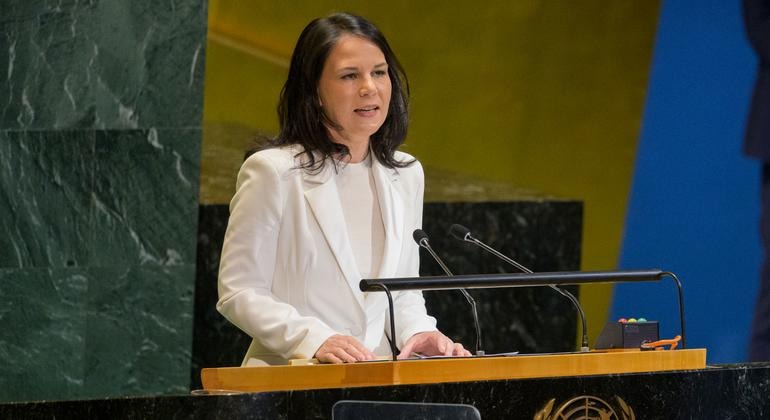
Annalena Baerbock Elected UNGA President: A Defining Moment for Global Leadership
On 2 June 2025, Annalena Baerbock, former German Federal Foreign Minister and member of Alliance 90/The Greens, was elected President of the 80th United Nations General Assembly. Her election, secured by 167 votes in a rare secret ballot, marks the first time a German and only the fifth woman has held this role in the UNGA’s 80-year history. Baerbock’s presidency begins amid global conflicts, climate emergencies, and institutional scepticism. With a bold vision prioritising multilateral renewal, SDG acceleration, peace and security, and gender inclusion, Baerbock aims to reinvigorate the General Assembly's relevance. While her past foreign policy positions, particularly on Ukraine, spark debate about her impartiality, her commitment to inclusive diplomacy and reform could help reshape the UN at a critical historical crossroads.

On 2 June 2025, Annalena Baerbock, former German Federal Foreign Minister and prominent member of the Alliance 90/The Greens party, was elected as the President of the 80th session of the United Nations General Assembly (UNGA). She secured an overwhelming majority, receiving 167 votes out of 188 ballots cast, following a rare secret ballot initiated by the Russian Federation, which accused her of displaying bias, particularly regarding the ongoing conflict in Ukraine. This deviation from the traditional acclamation process underscored the heightened geopolitical tensions shaping today’s multilateral diplomacy.
Baerbock’s appointment is historic in several respects. She is the first German and only the fifth woman to preside over the UN General Assembly in its 80-year history. This reflects both Germany’s growing international clout and the increasing global emphasis on gender parity in leadership. Her election also occurs at a pivotal juncture for the multilateral system, amid escalating conflicts, climate emergencies, and widespread scepticism about the efficacy of global institutions. In this context, Baerbock’s leadership promises both a symbolic and practical renewal of the UN’s founding charter and goals.
Leadership in Transition: Philemon Yang and Annalena Baerbock Compared
Baerbock succeeds H.E. Mr. Philemon Yang of Cameroon, who presided over the 79th UNGA session. Yang’s term was defined by a strong emphasis on Africa’s peace and development agenda. A former Prime Minister of Cameroon, Yang focused his presidency on disarmament, notably curbing the illicit flow of small arms, preserving human dignity during armed conflict, combating child labour, and accelerating the Sustainable Development Goals (SDGs) via digital transformation and education initiatives.
By contrast, Annalena Baerbock’s background as a former Foreign Minister of Germany from 2021 to 2025 and her experience navigating multiple geopolitical crises lend her a distinctly globalised perspective. She emerged as one of Europe’s most vocal advocates for a rules-based international order. Her tenure was marked by strong condemnation of Russia’s invasion of Ukraine, unwavering support for human rights, commitment to multilateral climate agreements, and a robust foreign policy that repositioned Germany as a proactive global actor.
Unlike Yang, whose approach prioritised consensus among developing nations, particularly in Africa, Baerbock’s leadership record suggests she is willing to confront authoritarianism and defend democratic values, even at the risk of diplomatic confrontation. This marks a potential shift in the tone and focus of the General Assembly, from quiet diplomacy to active, values-based engagement.
Baerbock’s Strategic Vision for the 80th Session
In her address following her election, Baerbock articulated a vision grounded in three overarching themes: strengthening multilateralism, revitalising the United Nations’ relevance in the 21st century, and building bridges through trust-based dialogue. She pledged to act as an honest broker among all 193 UN member states, reaffirming the principle that the General Assembly, where every state has an equal vote, is the most representative and democratic body of the UN system.
She outlined the following core priorities:
Multilateral Renewal: Baerbock stressed the urgent need to make the United Nations fit for the 21st century, calling for reforms in funding, efficiency, and decision-making. Her advocacy reflects longstanding concerns about institutional inertia within the UN and aims to reorient it towards swift, tangible outcomes.
Accelerating the SDGs: Baerbock reiterated her commitment to the 2030 Agenda for Sustainable Development. As Foreign Minister, she championed Germany’s contributions to climate finance, global vaccination equity, and renewable energy investments across the Global South. Her presidency is expected to re-energise global commitments to these goals, particularly those lagging behind in the wake of the COVID-19 pandemic and global economic downturn.
Peace and Security: While acknowledging the limitations of the UN Security Council, Baerbock emphasised the General Assembly’s critical role in maintaining peace, particularly when the Council is gridlocked. She committed to working closely with the Security Council and the Peacebuilding Commission to promote conflict resolution through a holistic lens that integrates development, justice, and human rights.
Inclusion and Gender Equality: As only the fifth woman in the UNGA presidency’s history, Baerbock pledged to champion women’s equal participation in international affairs. “Peace and development can only be sustained when women have an equal seat at the table,” she declared. She also committed to engaging civil society and youth, whom she described as essential allies in global transformation efforts.
A Presidency Under Global Scrutiny
Baerbock’s presidency will not be without controversy. The circumstances of her election, prompted by a secret ballot initiated by Russia, suggest a polarised General Assembly. Critics from the Global South and certain non-aligned nations may question whether her foreign policy record, especially her vocal support for Ukraine, can truly embody the impartiality expected of the UNGA presidency.
Nevertheless, her record also shows a capacity for multilateral compromise. She worked with China and India on climate financing mechanisms, cooperated with Latin American countries on renewable energy policy, and supported humanitarian aid in Gaza, Syria, and the Sahel. Her presidency will test whether such diplomatic versatility can bridge ideological divides in an increasingly fragmented world.
Conclusion: A Mandate for Change
Annalena Baerbock assumes the presidency of the 80th UNGA session with both immense promise and formidable challenges. Her election marks a decisive moment for the international community to renew its faith in multilateralism, not merely as a diplomatic ideal but as a functional tool to address the pressing crises of our time. With the United Nations facing existential questions about its relevance, Baerbock’s leadership could chart a course towards a more effective, inclusive, and courageous global institution.
Her call to support the partnerships that strengthen what unites us because we are better together echoes the founding spirit of the UN Charter, written 80 years ago in the aftermath of world war. Today, amid war in Europe, genocide in Sudan, mass displacement in Gaza, and economic collapse in Haiti, the world demands not platitudes but bold, coordinated action.
In the months ahead, all eyes will be on the General Assembly. If Baerbock can transform aspiration into action, she will not only redefine the presidency but help rebuild trust in the multilateral system itself.
Aric Jabari is the Editorial Director of the Sixteenth Council.

Trump Can’t Take Greenland – and the World Knows Why