Five Nations Elected to the United Nations Security Council for 2026–2027
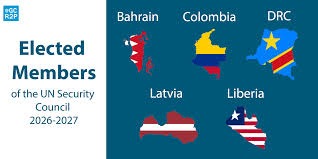
On June 2, 2025, Annalena Baerbock was elected President of the 80th UN General Assembly, becoming the first German and fifth woman in the role. The following day, Bahrain, Colombia, the DRC, Latvia, and Liberia were elected as non-permanent members of the UN Security Council for 2026–2027. Each secured the required two-thirds majority in uncontested elections, reflecting a commitment to diverse and representative global leadership.

New York, 3 June 2025 – The General Assembly has elected five new non-permanent members to the Security Council for the 2026–2027 term. Following a secret ballot held at UN Headquarters, Bahrain, Colombia, the Democratic Republic of the Congo (DRC), Latvia and Liberia each secured the required two-thirds majority in an uncontested slate. Their terms will commence on 1 January 2026, replacing the outgoing members: Algeria, Sierra Leone, the Republic of Korea, Guyana and Slovenia.
The Security Council, mandated to maintain international peace and security, comprises 15 member states. These include five permanent members with veto power (China, France, Russia, the United Kingdom and the United States), and ten non-permanent members elected for staggered two-year terms. Elections are guided by the principle of equitable geographical distribution. Even when candidates are unopposed within their respective regional groups, they must still receive a minimum of 129 votes from the 193-member General Assembly. This process affirms the political legitimacy and collective trust required for Council participation.
The Weah and Nyanti Continuum: Liberia’s Security Council Bid in Context
Liberia’s successful bid for a UNSC seat marks a pivotal achievement in its post-conflict diplomatic trajectory. The campaign was formally launched under President George Weah in January 2023. At the time, Weah pledged that Liberia would champion a transparent and peace-oriented agenda on the Council, rooted in the country’s hard-won recovery from civil war. Internationally recognised for his post-war reconciliation efforts, Weah had previously been nominated for the Nobel Peace Prize and named a Global Peace Ambassador.
In a notable gesture of political maturity and national unity, Liberia’s newly appointed Foreign Minister, Sara Beysolow Nyanti, wrote to former President Weah in September 2024 to request his endorsement and active support for the campaign. In her letter, widely circulated among diplomatic channels, Minister Nyanti acknowledged Weah’s global profile and emphasised that his support would elevate Liberia’s candidacy. The outreach was diplomatically significant, signalling continuity in Liberia’s foreign policy and a unified front before the international community.
Minister Nyanti, a seasoned United Nations official, brings deep institutional experience to the role, having served in senior humanitarian and diplomatic capacities in Nigeria, South Sudan and Yemen. While she has yet to unveil a comprehensive foreign policy doctrine, her multilateral background suggests a focus on preventative diplomacy, inclusive governance and humanitarian coordination. Her tenure appears to build upon, rather than diverge from, the foundation established by the Weah administration.
Election Results
The voting outcomes confirmed broad General Assembly support for all five candidates:
- Bahrain: 186 votes
- Democratic Republic of the Congo (DRC): 183 votes
- Liberia: 181 votes
- Colombia: 180 votes
- Latvia: 178 votes
All five states were elected unopposed from their respective regional groups and surpassed the required two-thirds majority.
The Responsibility to Protect (R2P): Relevance to New Members
The doctrine of the Responsibility to Protect (R2P), unanimously endorsed at the 2005 UN World Summit, remains a guiding but non-binding framework for international action to prevent genocide, war crimes, ethnic cleansing and crimes against humanity. The effectiveness of the Security Council in upholding R2P depends on the collective political will of its members.
While specific R2P-related policy stances of the five newly elected states during this election cycle are not comprehensively documented, each has demonstrated past engagement with humanitarian principles and global governance norms. The Global Centre for the Responsibility to Protect notes that effective implementation of R2P rests not merely on rhetoric but on decisive, timely action in the face of atrocity crimes.
Their presence on the Council may shape how the international community responds to threats against civilian populations, particularly in conflict zones where swift action is vital.
Country-Specific Diplomatic Outlooks
1. Bahrain
Bahrain’s election underscores its strategic alliance with Western powers and its role within the Gulf Cooperation Council. Amid ongoing instability in the Middle East, Bahrain is expected to prioritise maritime security, counterterrorism and regional de-escalation, particularly in the Strait of Hormuz.
2. Colombia
With its lived experience in conflict resolution and transitional justice, Colombia is poised to advocate for peacebuilding, human rights protection and sustainable development. Its UNSC role may also reflect growing international discourse on climate security and illicit trafficking.
3. Democratic Republic of the Congo (DRC)
The DRC’s return to the Council, following its withdrawal from the 2021 race to preserve African consensus, signifies a resurgence of diplomatic ambition. With the planned drawdown of the MONUSCO peacekeeping mission, Kinshasa is likely to focus on security sector reform, regional peace frameworks and strengthening the role of African-led solutions in peacekeeping.
4. Latvia
As a member of the European Union and NATO, Latvia is expected to advocate robustly for the rule of international law, state sovereignty and digital security. Its tenure on the Council is expected to reflect growing concerns over disinformation, cyber threats and regional instability, particularly in Eastern Europe amidst ongoing Russian aggression in Ukraine.
5. Liberia
Liberia’s transformation from post-conflict state to active global player reflects a remarkable diplomatic journey. Its presence on the Council is likely to emphasise gender inclusion, transitional justice and peace consolidation. The combined legacy of Weah and Nyanti provides an opportunity for Liberia to contribute a unique, community-informed voice to Council deliberations, bridging grassroots realities with global mandates.
Global Implications and Challenges Ahead
The 2026 to 2027 term begins during a period of heightened global instability and Security Council paralysis. Widespread criticism of the Council’s inability to address crises in Gaza, Sudan and Ukraine underscores a critical need for assertive and principled non-permanent members. The five newly elected nations carry the weight of expectation to restore credibility to multilateral diplomacy and invigorate a Council that many now view as deadlocked by geopolitical rivalries.
These states represent a composite of global South leadership, post-conflict resilience and strategic alliance-building. Their tenure will test whether new members can provide the momentum needed to champion collective security, uphold international humanitarian law and act where the Council has too often remained silent.
Conclusion: The Moment Demands More Than Mandates
The election of Bahrain, Colombia, the DRC, Latvia and Liberia is more than a routine rotation of Council membership. It is a potential inflection point for global diplomacy.
For Liberia, it is a vindication of two decades of democratic renewal. For the DRC, it is a platform to shift from security recipient to regional peace contributor. For the international community, it is an opportunity, perhaps the last in this decade, to reaffirm faith in collective action.
These five states now carry the hopes of the world’s most vulnerable populations. Whether they act with independence, conviction and vision will determine not only their legacy but the credibility of the Security Council itself.
The world is watching. History, as always, will record who stood firm and who stood aside.
Aric Jabari is the Editorial Director of the Sixteenth Council.