
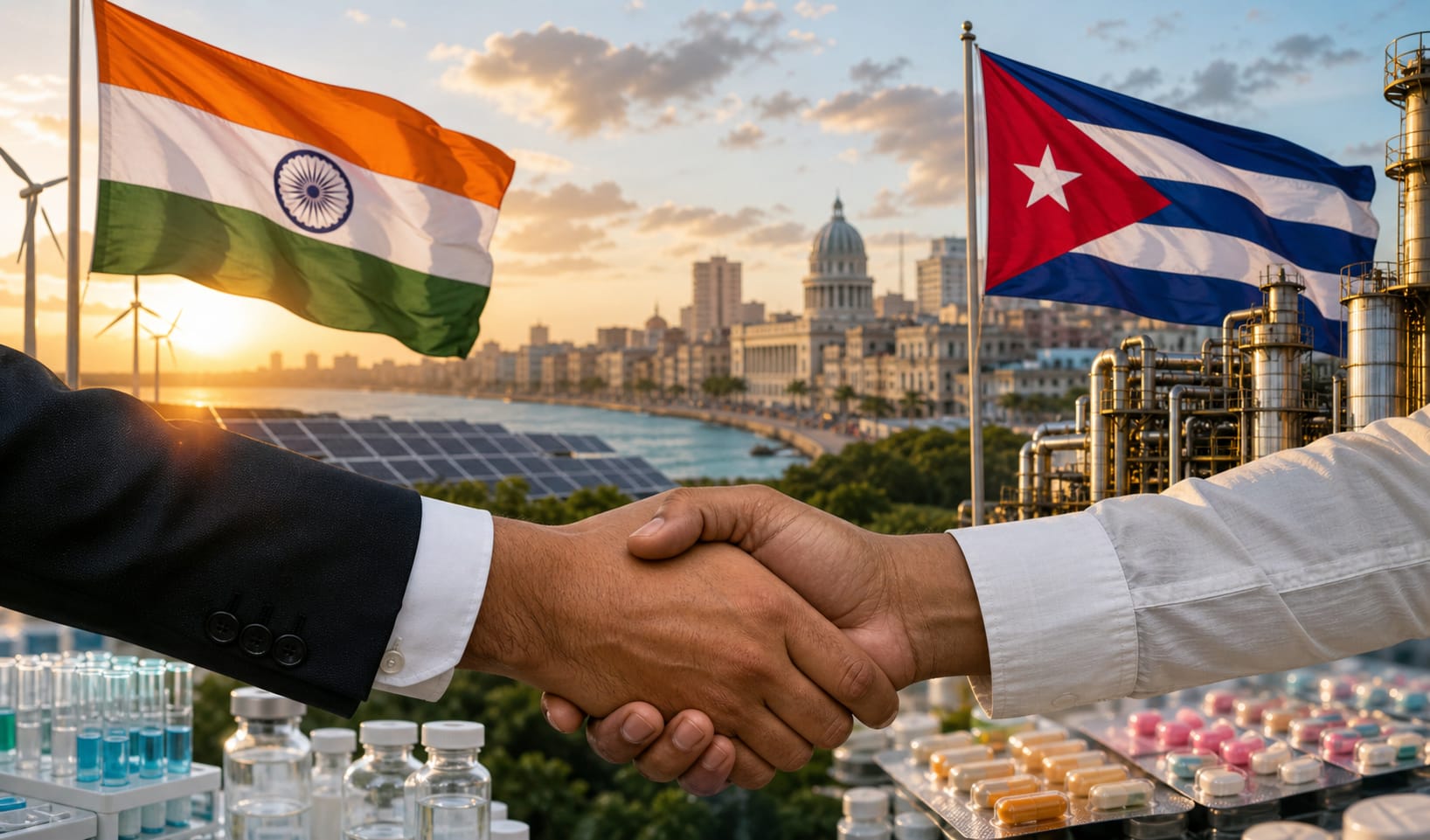
Existing Indian Economic and Strategic Interests in Cuba: Challenges and Prospects
India’s economic and strategic engagement with Cuba spans pharmaceuticals, renewable energy, digital cooperation, and development assistance, rooted in decades of South-South solidarity. Yet this relationship remains underutilised due to U.S. sanctions, Cuba’s economic fragility, and implementation gaps in key projects. With Cuba’s BRICS partner status and expanding renewable energy ambitions, India has a timely opportunity to convert commitments into tangible outcomes, deepening its role as a credible Global South partner while unlocking high-value sectors for bilateral growth.

Introduction
The India-Cuba relationship is among the most enduring, rooted in a shared philosophy of non-alignment, anti-colonialism, and South-South solidarity. Since the Cuban Revolution, their warm bilateral engagement has been grounded in these principles—a bond tracing its origins to Che Guevara’s 1959 visit to India.
India was the first Asian country to recognise the new Cuban government following the Revolution’s triumph in 1959. Just six months later, Che Guevara visited India — his first stop in Asia — travelling to Delhi and Calcutta, where he held memorable meetings with Prime Minister Jawaharlal Nehru. Diplomatic relations between the two countries were formally established on January 12, 1960, and 2025 marks the 65th anniversary of those ties.
Today, as India asserts itself as a leading voice of the Global South and Cuba navigates severe economic headwinds, the contours of their bilateral relationship have evolved considerably. India has deployed a range of economic and strategic stakes in Cuba — from Lines of Credit (LoCs) and pharmaceutical partnerships to digital cooperation and renewable energy investments. Yet the relationship remains underperforming relative to its potential. This article provides a detailed analytical assessment of India’s existing economic and strategic stakes in Cuba, the challenges impeding their full utilisation, and the prospects for a more robust partnership.
Historical Trade Trajectory and Current Trade Profile
The Rise and Fall of Bilateral Trade
Bilateral trade between Cuba and India was around US$300 million in the 1980s. However, following the dissolution of the Soviet Union in 1991 and India’s economic liberalisation in the 1990s, bilateral trade between the countries declined sharply. The collapse of the Soviet bloc, which had been Cuba’s primary energy lifeline, affected its economy, and India’s pivot toward a market economy simultaneously disrupted the architecture of its commercial ties.
The main items of Indian export to Cuba are pharmaceutical products, organic chemicals, plastic products, medical equipment, engineering goods, textile products, metal products, mineral oil products and tools. Imports from Cuba primarily comprise pharmaceutical and tobacco products. With bilateral trade between India and Cuba valued at over US$100 million annually, and Cuba gaining international recognition for innovations such as its groundbreaking diabetes treatment Heberprot-P, the nation offers Indian businesses both a platform into the broader Latin American market and opportunities for innovation-driven collaborations.
India’s Lines of Credit — The Cornerstone of Economic Engagement
Overview of LoC Commitments
Cuba depends on 80% of its energy on oil. There are also recurring natural disasters which affect the power supply. Therefore, Lines of Credit (LoCs) extended by India’s Exim Bank represent the most tangible expression of India’s economic footprint in Cuba.
The Government of India has extended Lines of Credit for 3 energy-related projects in Cuba: (i) US$ 90 million 50 MW Power Co-generation Project at the 30 November Sugar Mill (under implementation); (ii) US$ 75 million 75 MW Photovoltaic solar power projects (approved, yet to commence); and (iii) US$ 70 million 51 MW Wind Energy Farm project at Rio Seco (feasibility under evaluation).
Challenges
Despite the scale of these commitments, actual disbursement and project implementation have faced significant obstacles. While the DPRs (Detailed Project Reports) for the Power Co-generation Project and the Photovoltaic solar power projects are under consideration by the Ministry, none of the companies has qualified for the projects. This reflects a broader structural challenge: Cuba’s inability to attract and qualify international contractors due to its constrained financial environment and the shadow of U.S. sanctions.
Cuba’s renewable energy sector offers investment opportunities, but US sanctions, coupled with the country’s ongoing economic crisis, characterised by inflation, a shortage of hard currency, and a fragile financial system, limit its capacity to mobilise the resources needed for large-scale energy projects. Moreover, Cuba’s ability to secure financing for renewable energy projects is hindered by its exclusion from international financial institutions, such as the World Bank and the International Monetary Fund.
Pharmaceutical and Biotechnology Interests
The India-Cuba Pharma Connection
The pharmaceutical and biotechnology sector constitutes the most dynamic and strategically significant dimension of India-Cuba economic relations. The partnership has deep historical roots: the Empresa Farmacéutica 8 de Marzo was designed by UNIDO experts, equipped with Indian technology via Sarabhai Chemicals, and financed by contributions from India and the United Nations Development Programme, making it an early example of South-South and triangular industrial cooperation.
While India is the world’s largest producer of generic drugs, Cuba’s affordable and efficient healthcare sector has generated a global reputation. The deal leaves room for expansion in partnership in the health sector.
Cuba is a pioneer in biotechnology and pharmaceuticals, with biopharma products exported to 45 countries. Over the decades, Cuba has built a state-supported biotech ecosystem that integrates research, clinical development and manufacturing, producing vaccines, cancer therapies, diabetes treatments and immunological products.
Key Institutional Agreements
The combination of Cuban expertise in biotechnology and pharmaceuticals with India’s renowned research and manufacturing capabilities promises high-quality, high-margin business opportunities. The countries already have an MoU on biotechnology cooperation between the Department of Biotechnology of India’s Ministry of Science and Technology and BioCubaFarma of Cuba.
Active Pharmaceutical Ingredients (APIs) and Humanitarian Dimension
India sent Cuba 90 tons of nine “active pharmaceutical ingredients” to be used in the production of “essential antibiotics in the form of tablets, capsules, syrups and injections, for the treatment of chronic communicable diseases.” India is one of Cuba’s top 20 trading partners, and among the 32 million dollars sent in exports to the Island in the 2024 fiscal year, pharmaceutical and chemical products predominated.
The donation of these APIs will enable Cuban drug manufacturers to produce antibiotics, providing sufficient supply to address the shortage for 6 months to 1 year. Cuban firms have partnered with Indian companies, such as Panacea Biotec, to produce life-saving vaccines, including the pentavalent vaccine for children.
Mariel Special Development Zone Opportunity
A joint venture has been established to develop and commercialise innovative biotechnology products in the Mariel Special Development Zone, Cuba. The Mariel Special Development Zone is the first-of-its-type in Cuba, and enjoys a privileged geographic location in the centre of the Caribbean Sea. This zone presents a structured entry point for Indian pharmaceutical companies seeking to co-develop and export to Latin American and Caribbean markets.
Energy Cooperation — Strategic Interests Under Stress
India’s Role in Cuba’s Energy Transition
To help Cuba meet its renewable energy goals despite the challenges posed by the US sanctions, Cuba has received support from many countries, including India, which is contributing technology, investment, and lines of credit. India’s assistance to Cuba, including its invitation to join the Coalition for Disaster Resilient Infrastructure (CDRI) and Global Biofuel Alliance (GBA), underscores its commitment to fostering South-South solidarity and mutually beneficial partnerships through sustainable development and capacity-building initiatives.
Cuba’s Energy Crisis: Context for Indian Investment
Cuba’s energy sector is in an acute crisis, creating both urgency and risk for Indian investment. In 2025, despite mounting cash constraints, the Cuban government launched an aggressive investment program to accelerate the transition toward renewable energy, with a strong focus on solar PV systems. A total of 51 new solar parks (1,000 MW) were synchronised to the grid in 2025, more than quadrupling the country’s renewable electricity generation capacity in a single year.
In 2022, the Cuban government admitted it was unable to access a €1.2 billion Russian loan intended for its thermoelectric plants, having failed to provide the required 10% upfront payment (€120 million). Estimates suggest that modernising the country’s electrical infrastructure would require at least $10 billion, a figure that far exceeds the government’s financial capacity. This context underscores why India’s LoC-backed renewable energy projects, though delayed, remain strategically relevant.
Development Cooperation and Technical Assistance
ITEC Programme and Capacity Building
Bilateral assistance through India’s Indian Technical and Economic Cooperation (ITEC) programme has increased in the last few years, and ITEC has become popular in Cuba. Following the announcement of 10 additional slots in 2018, a total of 70 slots are now allocated to Cuba.
India donated an IT Centre — the India Cuba Knowledge Centre — to Cuba, implemented by NIIT, for 2 years, which was later extended for another year. NIIT conducted a three-year training programme for over 1,900 Cuban citizens in various fields, which concluded in July 2010.
Disaster Relief and Humanitarian Assistance
India has consistently provided disaster relief to Cuba in times of crisis. India wrote off a $62 million loan, plus interest, that it had provided to the Cuban government in 2008. This gesture of debt forgiveness remains one of the most significant acts of financial solidarity in the bilateral relationship.
Strategic and Diplomatic Interests
Multilateral Alignment
India and Cuba maintain close contacts through the UN, NAM, and other international fora. Cuba has been a staunch supporter of India’s bid for a permanent seat in a restructured UN Security Council. Conversely, India has consistently stood by Cuba in the UN General Assembly, urging the US to lift its sanctions against the Caribbean nation.
Cuba’s BRICS Partner Status: A New Strategic Dimension
A significant geopolitical development with direct implications for India-Cuba ties is Cuba’s new association with the BRICS grouping. In 2024, Cuba joined BRICS as a “partner state,” a designation that reflects the group’s evolving structure and ambitions to expand its influence. At the 16th BRICS summit in Kazan, Russia, in 2024, the bloc introduced a new category, “partner states,” that allows countries to engage with BRICS initiatives and receive support from existing members without immediate full membership.
This development is strategically significant for India. As a founding BRICS member, India can leverage Cuba’s new partner status to deepen institutional linkages, coordinate positions on multilateral trade and financial reform, and expand the India-Cuba economic corridor within a structured multilateral framework.
Digital Cooperation: India Stack and IT Engagement
An MoU on Cooperation in the field of sharing successful digital solutions implemented at the population scale for digital transformation was signed between the Secretary, Ministry of Electronics and IT (India) and the Cuban counterparts. This “India Stack” initiative — encompassing digital public infrastructure such as payment systems, identity platforms, and data governance — represents a cutting-edge strategic stake that positions India as a development partner of choice in Cuba’s digital transformation.
India’s expertise in IT, technology, and education could be leveraged to support Cuba’s economic development through tech transfer, skill-building initiatives, and collaborative research.
Key Challenges
U.S. Sanctions and the Embargo Shadow
The single most pervasive constraint on India’s economic stakes in Cuba is the long-standing U.S. embargo. The long-running U.S. embargo has restricted Cuba’s access to international finance and deterred foreign investment in energy infrastructure. While renewable energy is widely viewed as a viable long-term solution, progress has been slow due to limited capital, climate risks, and regulatory hurdles created by sanctions.
Indian companies, many of which have significant exposure to the U.S. market, are particularly vulnerable to secondary sanctions risk. This creates a chilling effect on Indian private sector participation in Cuba, even in sectors where LoCs have been extended.
Cuba’s Macroeconomic Fragility
The collapse of the energy sector is symptomatic of a deeper structural crisis in the Cuban economy. Even state officials have described the country as operating under the conditions of a “war economy.” Over the past decade, the country has faced a compounding set of structural challenges: declining productivity, an investment rate significantly below that of other Caribbean countries, a widening fiscal deficit, high inflation, persistent scarcity of consumer goods, and growing social inequality. These trends have pushed the economy into a state comparable to the early 1990s “Special Period,” marked by severe contraction and supply shortages.
LoC Disbursement Gaps
Cuba faces mounting challenges in managing its electricity crisis. Despite access to international lines of credit, the country’s economic challenges limit its effective utilisation. The failure of any company to qualify for renewable energy LoC projects (as noted in India’s own MEA brief) indicates that the gap between financial commitment and on-the-ground implementation remains wide.
Trade Imbalance and Low Diversification
Bilateral trade has been moderate. The trade relationship is heavily skewed in India’s favour and concentrated in a narrow band of products — primarily pharmaceuticals and chemicals on the Indian side, and tobacco and pharmaceutical products from Cuba. There is no Bilateral Investment Protection Agreement (BIPA) in force, limiting legal certainty for Indian investors.
Competition from China
Amid a worsening energy crisis and limited access to international financing, the Cuban government has increasingly turned to China as a strategic partner. In particular, it is banking on Chinese support to expand renewable energy production. China’s deeper financial capacity, willingness to accept non-cash compensation, and existing infrastructure in Cuba pose a competitive challenge to India’s more cautious engagement model.
Prospects and Strategic Recommendations
Pharmaceutical Joint Ventures as a Growth Engine
Cuba sees India as a strategic partner with the scale, regulatory experience and manufacturing capacity to jointly address health needs in emerging and developing markets. These steps are intended to support long-term partnerships, including joint research centres, manufacturing facilities and technology transfer arrangements in the health and life sciences sectors.
Indian companies should actively explore joint ventures with BioCubaFarma, particularly in cancer therapies, biologics, and novel vaccines. The Mariel Special Development Zone offers a tax-advantaged and legally structured platform for such investments.
Renewable Energy: Operationalising the LoCs
The three pending renewable energy LoCs (totalling US$ 235 million) represent India’s most significant unrealised economic stake in Cuba. India should consider deploying Indian public sector undertakings (PSUs) such as NTPC, SECI, or IREDA as lead implementing agencies.
Structuring payment mechanisms in non-dollar currencies or through commodity-linked arrangements (e.g., nickel, tobacco). Leveraging the International Solar Alliance framework to fast-track project clearances.
The Cuban government plans to add another 1,000 MW of solar capacity in 2026. Renewables accounted for 2% of electricity generation in 2024 and 10% in 2025, with projections to reach 24% by 2030, 40% by 2035, and 100% by 2050. This aggressive national programme creates a real demand window for Indian solar and wind technology.
BRICS Framework as a Diplomatic Enabler
Cuba’s BRICS partner status creates a new institutional channel for India to deepen economic engagement. India should champion Cuba’s integration into BRICS-linked development financing mechanisms, which could help circumvent some of the constraints imposed by Cuba’s exclusion from Western-led financial institutions.
Digital Economy and India Stack Expansion
India’s proven digital public infrastructure — UPI, Aadhaar, DigiLocker, CoWIN — offers a compelling model for Cuba’s nascent digital transformation agenda. The India Stack MoU should be operationalised through specific pilot projects, creating a visible, high-impact Indian presence in Cuba’s digital governance landscape.
People-to-People and Cultural Diplomacy
India and Cuba are celebrating 65 years of diplomatic relations, and recent conferences have reinforced their commitment to expanding business and trade opportunities. Discussions have centred around increasing pharmaceutical exports, leveraging India’s expertise in biotech innovations, and enhancing Cuba’s access to advanced medical technologies.
Expanding ITEC slots, establishing a joint India-Cuba Centre of Excellence in Biotechnology, and promoting Ayurveda and yoga — interest in Ayurveda and Indian Naturopathy is increasing in Cuba, and a Panchakarma Centre was established in Cuba at the International Health Centre “La Pradera” on 6 November 2019 — can deepen the people-to-people foundation that sustains the strategic relationship.
Conclusion
India’s economic and strategic stakes in Cuba are real, diversified, and historically meaningful, spanning pharmaceutical partnerships, renewable energy commitments, digital cooperation, development assistance, and robust multilateral alignment. However, these stakes remain significantly underutilised due to a combination of Cuba’s macroeconomic fragility, the pervasive shadow of U.S. sanctions, implementation gaps in LoC projects, and the absence of a comprehensive investment protection framework.
The relationship is at an inflexion point. Cuba’s accession to the BRICS as a partner state, the 65th anniversary of diplomatic ties, and the acceleration of Cuba’s renewable energy programme all create new opportunities for India. The challenge for New Delhi is to move from a posture of principled solidarity to one of purposeful economic partnership — converting its financial commitments into tangible projects, its MoUs into operational joint ventures, and its diplomatic goodwill into market presence.
In the broader context of India’s Global South leadership and its ambition to be a reliable partner for developing nations, Cuba represents both a test case and an opportunity. A more strategically engaged India in Cuba would not only deepen a cherished bilateral relationship but also reinforce India’s credibility as a development partner that delivers — an increasingly important attribute in a multipolar world.
Prof Punit Gaur is a Senior Fellow at the Sixteenth Council
Escalation of Far-right Politics in Europe