
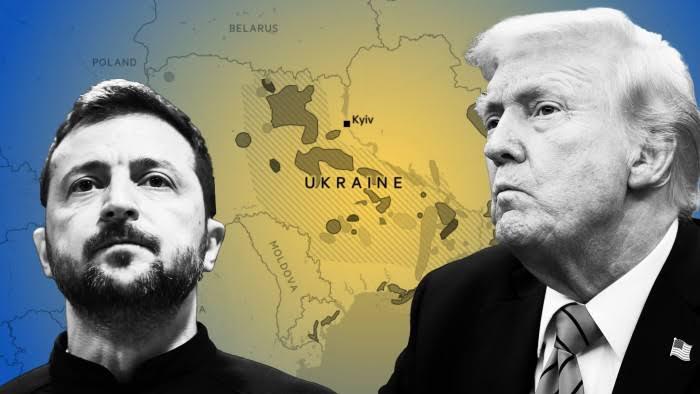
Trump tells Ukraine ‘You should have never started the war, you could have given up land’
President Trump’s stance, as captured by a BBC broadcast and supported by fresh statements from his Florida residence at Mar-a-Lago, goes further than his previous rhetorical positioning. Instead of stressing deterrence through strength—his usual rationale—he placed partial responsibility on Ukraine, suggesting that a territorial concession could have averted the conflict altogether. These statements have elicited strong reactions worldwide, most notably in Ukraine itself, which has borne the brunt of the Russian invasion.

In a striking move that has reignited controversy, U.S. President Donald Trump recently asserted that Ukraine “should have never started the war” and could have avoided bloodshed by relinquishing land to Russia before the conflict began. His comments surfaced during a period of intense diplomatic activity involving multiple global powers—from negotiations in Saudi Arabia to separate high-level meetings in Turkey and Paris—all centred on the ongoing war in Ukraine.
President Trump’s stance, as captured by a BBC broadcast and supported by fresh statements from his Florida residence at Mar-a-Lago, goes further than his previous rhetorical positioning. Instead of stressing deterrence through strength—his usual rationale—he placed partial responsibility on Ukraine, suggesting that a territorial concession could have averted the conflict altogether. These statements have elicited strong reactions worldwide, most notably in Ukraine itself, which has borne the brunt of the Russian invasion.
President Trump’s stance, as captured by a BBC broadcast and supported by fresh statements from his Florida residence at Mar-a-Lago, goes further than his previous rhetorical positioning. Instead of stressing deterrence through strength—his usual rationale—he placed partial responsibility on Ukraine, suggesting that a territorial concession could have averted the conflict altogether. These statements have elicited strong reactions worldwide, most notably in Ukraine itself, which has borne the brunt of the Russian invasion.
This article presents a comprehensive look at the latest developments, weaving together verified reports from the BBC, statements from both U.S. and Russian officials, and data from reputable international organisations such as the United Nations (UN) and the North Atlantic Treaty Organization (NATO). With the war entering its third year, the stakes are high: diplomatic manoeuvres in Riyadh, Turkey, and Western European capitals could accelerate or reshape the path to peace.
Trump’s Claim to End the War
- Trump’s Confidence in Diplomacy
President Trump declared himself the only person capable of ending the war, reiterating that it would never have started had he been in office three years ago. Historically, Trump has contended that Russian President Vladimir Putin would not have “dared” to invade while he held the White House. However, his new remarks go a step further, implicitly blaming Ukrainian leadership for not negotiating a land-for-peace agreement with Moscow. - Shifting the Narrative
In a key segment of his recent speech, President Trump told reporters:
“You’ve been there for three years. You should have ended it. Three years, you should have never started it. You could have made a deal. I could have made a deal for Ukraine that would have given them almost all of the land… and no one would have been killed.”
Many analysts note the departure from standard Western positions, which generally oppose territorial concessions to Russia because such actions would legitimise or reward aggression. - International Backlash and Public Perception
- Ukrainian officials quickly condemned the comments, claiming that they echo Russian talking points and undermine Ukraine’s sovereignty.
- European leaders were equally unsettled, given their long-standing insistence that Ukraine’s territorial integrity must be preserved.
- Russian state media, however, welcomed President Trump’s statements, emphasising them as a sign that certain factions in the West might be open to negotiation more aligned with Russian demands.
Diplomatic Talks in Saudi Arabia
Perhaps even more remarkable than President Trump’s statements was the meeting in Riyadh, Saudi Arabia, between high-level American and Russian diplomats:
- American and Russian Presence
- U.S. Secretary of State Marco Rubio (according to BBC coverage) headed the American delegation.
- Russian Foreign Minister Sergey Lavrov, sanctioned by the United States for his part in the war, led the Russian contingent.
- Purpose of Talks
Despite initial impressions that these were negotiations aimed at resolving the conflict, both parties later clarified that these discussions were more exploratory than definitive. The U.S. State Department indicated they were merely setting “parameters” for future talks. - Exclusion of Ukraine and European Allies
Notably, neither Ukraine nor European Union representatives were invited to this round of discussions. Ukraine’s President Volodymyr Zelensky expressed frustration with the arrangement, emphasising that any dialogue about the country’s future without its direct involvement could lack legitimacy. - Outcome and Significance
- Both sides expressed a willingness to continue talking, which some interpret as a positive step towards defusing tensions.
- Sceptics, however, warn that further negotiations that sideline Ukraine could undermine the principle of self-determination and risk setting a dangerous precedent in international relations.
Ukraine’s Perspective
- War Realities
Ever since Russia’s full-scale invasion began, Ukraine has faced unrelenting missile barrages, drone attacks, and heavy ground combat. As of early 2025, the Office of the UN High Commissioner for Refugees (UNHCR) estimates that over 8 million Ukrainians have been displaced internally and across Europe. - Response to Trump’s Remarks
- Many Ukrainians expressed anger at the suggestion that they “started” the war, pointing to Russia’s initial land grab in Crimea in 2014 and the subsequent full-scale invasion.
- President Zelensky has repeatedly stated that Ukrainian sovereignty is non-negotiable, refusing to legitimise any Russian occupation through territorial concessions.
- Ongoing Resilience
Despite major losses and infrastructure damage, Kyiv remains resolute. According to official Ukrainian Ministry of Defence figures (collated with BBC and UN data):
- Over 200,000 buildings have been damaged or destroyed.
- Multiple wave attacks on key cities, including Kyiv, Kharkiv, and Odesa, continue on a near-weekly basis.
- Approximately 9,000 Ukrainian military personnel have been killed, with estimates of civilian casualties varying among international monitors.
Europe’s Involvement and Reactions
- Emergency Summit in Paris
European Union members convened an emergency summit in Paris, discussing the potential ramifications of U.S.-Russia bilateral talks that do not involve them. European leaders stressed the importance of unity and collaborative decision-making. - Concerns over Sidelines
- French President (unnamed in the BBC report) vocalised alarm, highlighting that an imposed settlement might leave Europe vulnerable to future aggression.
- Germany’s Chancellor also raised questions about whether the reintroduction of Russian diplomacy by the U.S. could “normalise” the conflict, overshadowing Ukrainian interests.
- Strategic vs. Moral Imperatives
European powers find themselves balancing strategic autonomy from the U.S. with moral imperatives to defend Ukrainian sovereignty. There are growing calls within the EU for greater defence integration and a more robust security framework, should Washington’s stance shift.
Russia’s Position
- From Pariah to Partner?
The Riyadh talks signalled, from Moscow’s viewpoint, a chance to break away from global isolation. Russian state-owned channels, such as Channel One and RT, hailed the meeting as a “triumph” of President Putin’s foreign policy. One commentator declared:
“The events in Riyadh are a triumph for Putin’s foreign policy. I congratulate all Russians on having such a president.” - Demands at the Negotiating Table
- Russia insists that Ukraine never join NATO.
- The Kremlin rejects any Western military presence in Ukraine, whether under NATO or European Union banners, labelling such forces as provocations.
- It continues to assert sovereignty over occupied territories like Crimea and parts of the Donbas region, complicating any potential peace deal.
- Future Steps
With continuing missile attacks and no sign of a complete retreat, Moscow remains strategically assertive. The question remains: how much ground (literally and figuratively) might Russia be willing to cede in genuine negotiations?
The Role of the United States
- Shifting Dynamics
The White House under Donald Trump has pivoted from the approach of previous administrations, who championed an unyielding pro-Ukraine stance, including the provision of advanced weapon systems, training, and intelligence sharing. - Secretary of State Marco Rubio’s Comments
Speaking in Riyadh, Rubio noted that while the discussions were “upbeat and constructive,” no formal promises or concessions were made. He emphasised that future negotiations would ultimately involve Kyiv and Washington’s European allies, but details remain fuzzy. - Potential Domestic Implications
As the U.S. heads toward another election cycle, President Trump’s handling of the Ukraine war could become a significant campaign issue. Some lawmakers, both Republican and Democrat, have expressed discomfort with the idea of bypassing Ukraine in negotiations.
Potential for Peacekeeping
- Military Footprints and Debate
The BBC’s defence correspondent has reported on large-scale NATO exercises in Romania, approximately 16 miles from Ukraine’s border. Britain, Romania, and other European partners have conducted defensive drills simulating both conventional and hybrid warfare. - British Troop Deployment
- Labour Party Leader Sir Keir Starmer suggested he would consider deploying British troops for peacekeeping in Ukraine if a formal ceasefire or peace agreement is reached.
- This notion stands in direct contrast to the Kremlin’s stance that it will not tolerate NATO-aligned forces on Ukrainian territory.
- Historical Precedents
Past peacekeeping missions under UN mandates have demonstrated how precarious maintaining ceasefires can be. The complexities of verifying demilitarised zones and preventing flare-ups (often from non-state actors or breakaway militias) loom large over any prospective arrangement.
Historical Context and Data
- Longstanding Tensions
This war did not erupt in a vacuum. Tensions date back at least to 2014, when Russia annexed Crimea, sparking international condemnation. The conflict in Eastern Ukraine’s Donbas region simmered for eight years before Moscow’s full-scale invasion. - Humanitarian Cost
- According to UNHCR data, more than 8 million refugees have fled Ukraine, primarily to Poland, Germany, and other EU nations.
- The Office of the UN High Commissioner for Human Rights (OHCHR) has documented thousands of civilian deaths, but actual numbers could be considerably higher due to limited access to frontline areas.
- Economic Fallout
Sanctions against Russia have reverberated across global energy and commodity markets, contributing to increased energy prices, particularly in Europe. Ukraine’s agricultural exports—essential for the worldwide food supply—have also been severely disrupted, as reported by the Food and Agriculture Organization (FAO).
Conclusion: A Call for Principled Peace
The rumblings of a potential peace or ceasefire in Ukraine are echoing across diplomatic corridors worldwide. Yet the path remains perilously narrow. President Trump’s remarks—suggesting Ukraine “should have never started the war” and hinting at the cession of territory—underscore a profound shift in tone for an American leader. For many Ukrainians, these comments strike at the heart of their national identity, raising the spectre of a forced settlement that may, in their view, reward aggression and disregard the sacrifices already endured.
The Riyadh meeting, while historic in reintroducing direct U.S.-Russia talks, has also highlighted the risk that key stakeholders, especially Ukraine, might be sidelined at critical junctures. European allies, deeply anxious about any arrangement that undercuts regional security, are convening emergency summits to maintain a unified front and reaffirm commitment to Ukraine. Russia, for its part, celebrates renewed engagement, perceiving it as an end to Western attempts at isolation.
Amid these shifting sands, it is the ordinary people of Ukraine who bear the daily struggle—families living under drone strikes, soldiers entrenched in bitter fighting, and displaced individuals seeking refuge far from home. Their voices, fears, and hopes cannot be dismissed. While negotiations are vital to end the war’s devastation, any final agreement should not come at the cost of human dignity, sovereignty, and the international principle that borders cannot be reshaped by force.
The world now watches to see whether these diplomatic efforts will bring a just and lasting peace or set a precedent for appeasement. Genuine peace requires more than deals struck behind closed doors; it demands inclusive dialogue, respect for sovereignty, and robust international guarantees. The most enduring solutions come when all affected voices—especially those in the direct line of fire—are heard, protected, and given a stake in their future.
In times like these, it is crucial to reflect on the human cost and the lessons of history. Ceasefires imposed without genuine reconciliation often unravel, leading to renewed cycles of violence. As global leaders navigate these troubled waters, we must collectively advocate for a resolution that honours the hardships of the Ukrainian people, upholds international norms, and lays a foundation for real, lasting stability. The pursuit of peace, after all, should champion not only the cessation of hostilities but also a fair and principled path forward—one that resonates with justice, humanity, and the shared hopes of millions longing for an end to the devastation.
Aric Jabari is the Editorial Director at the Sixteenth Council

Energy, Food, and Power: The New Geopolitics of Global Markets