
Tensions Reignite: The Aftermath of Operation Sindoor
Muhammad Khalid Jamali, issued a provocative warning during a televised interview: Pakistan is prepared to use the “full spectrum of power, including nuclear,” should India attempt to either restrict water flows from the Indus system or carry out additional cross-border strikes. The statement raised alarm across global capitals, intensifying concerns about potential military escalation between two nuclear-armed neighbors.

South Asia stands on edge once again as tensions between India and Pakistan escalate sharply in the wake of Operation Sindoor, India’s precision airstrike targeting terrorist infrastructure over nine identified locations across the border. What made this operation symbolically striking was its execution—led reportedly by two female operatives, a gesture loaded with meaning in the attack’s gendered and communal landscape. The message: India will not hesitate to defend its sovereignty with both force and symbolism. Yet, despite the precision and the messaging, the strike’s diplomatic reception has been far more fraught.
This flare-up comes just a day after Pakistan’s Ambassador to Russia, Muhammad Khalid Jamali, issued a provocative warning during a televised interview: Pakistan is prepared to use the “full spectrum of power, including nuclear,” should India attempt to either restrict water flows from the Indus system or carry out additional cross-border strikes. The statement raised alarm across global capitals, intensifying concerns about potential military escalation between two nuclear-armed neighbors.
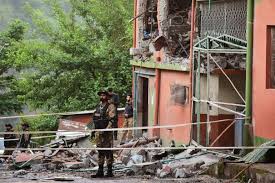
Meanwhile, the situation on the Line of Control (LoC) has deteriorated rapidly. Since the Pahalgam attack, which claimed the lives of 26 civilians and triggered Operation Sindoor, ceasefire violations have occurred nearly daily, with over 13 consecutive days of artillery exchanges reported. Both civilian and military casualties have been recorded on either side. The frequency and intensity of these violations mark a sharp departure from the relative calm that had followed the 2021 India-Pakistan ceasefire agreement, signaling a worrying slide back into a tit-for-tat cycle of retaliation.
Cross-border firing intensified sharply after Operation Sindoor, with Pakistani forces reportedly targeting forward Indian posts and civilian areas in sectors such as Poonch, Rajouri, and Uri. In response, India has returned fire, hitting alleged militant launchpads and infrastructure along the L.O.C.. The border residents are facing renewed trauma—displaced families, shuttered schools, and emergency shelters have become common once again, reviving memories of the turbulent years before the 2021 thaw.
As expected, the international community demanded proof of Pakistan’s involvement in harboring the terrorists behind the Pahalgam incident. In response, India presented concrete evidence linking the attackers to groups with known bases in Pakistan—primarily Jaish-e-Mohammed and Lashkar-e-Taiba, long designated as terrorist organizations by the UN and Western powers. Recovered materials, intercepted communications, and interrogation records have reportedly been shared with key allies.
Still, Pakistan’s official stance remains one of denial and deflection. The country’s Information Minister recently declared that there are no terrorist camps on Pakistani soil, instead casting Pakistan as a “frontline state against terrorism” and a “victim of terrorism.” He pointed to ongoing military operations in Pakistan’s western provinces. However, these narrative rings hollow for many international observers, given Pakistan’s documented history of harboring or enabling extremist groups as part of its regional strategy.
From the Mujahideen era of the 1980s to the Taliban’s resurgence in Afghanistan, Pakistan’s intelligence-military nexus has often seen extremist proxies as tools for influence, particularly in Kashmir. These longstanding patterns severely undermine its claim to be merely a victim, and increasingly strain its credibility on the global stage.
That said, India’s airstrike on what it claims was a militant training camp could have been a more thought through and collaborative effort. While rooted in a legitimate national security imperative, a multilateral approach or more transparent consultation with global partners might have limited the risk of escalation. A sudden strike, even if carefully planned, inevitably complicates diplomatic channels.
Further, Pakistan’s retaliatory posture, both rhetorical and military, appears less aimed at counterterrorism than at reasserting parity with India. By convening its National Command Authority and publicly discussing the nuclear option, Islamabad is sending signals that alarm more than reassure. It reflects a troubling strategic choice: to escalate against a neighboring state rather than act decisively against extremist groups.
Amid this spiraling crisis, India must now demonstrate strategic restraint. If Operation Sindoor achieved its intended impact, both in terms of deterring future attacks and responding to domestic expectations, it is imperative to pivot toward diplomacy. Border populations, especially in areas like Poonch and Rajouri, are already suffering immensely from the renewed shelling. Every additional volley of fire deepens human costs without bringing lasting solutions.
Moreover, the threat of nuclear retaliation looms disturbingly large. Unlike India, which adheres to a No First Use (NFU) nuclear doctrine, Pakistan has never made such a commitment. Its nuclear posture is intentionally ambiguous, designed to allow for the first use of nuclear weapons in response to what it deems existential threats, even conventional military attacks. This includes the adoption of a “full spectrum deterrence” strategy, which encompasses the potential use of tactical nuclear weapons on the battlefield. Such flexibility, while intended as a deterrent, dangerously increases the risk of rapid escalation and miscalculation. As India also faces growing pressure from the Chinese front, the margin for error is perilously slim, and the need for careful strategic restraint from all parties becomes ever more critical.
The road ahead must prioritize dialogue. Jammu and Kashmir remains a shared and volatile legacy, requiring not just military vigilance but sustained political and diplomatic engagement. Escalation, especially of a nuclear nature, must remain unthinkable. The world is watching, and both nations owe it to their citizens to pull back from the brink.
Nandita Singh is a non resident Research Fellow at the America Program of the Sixteenth Council

Critical Minerals and the Green Transition: Europe’s New Dependency Risk