
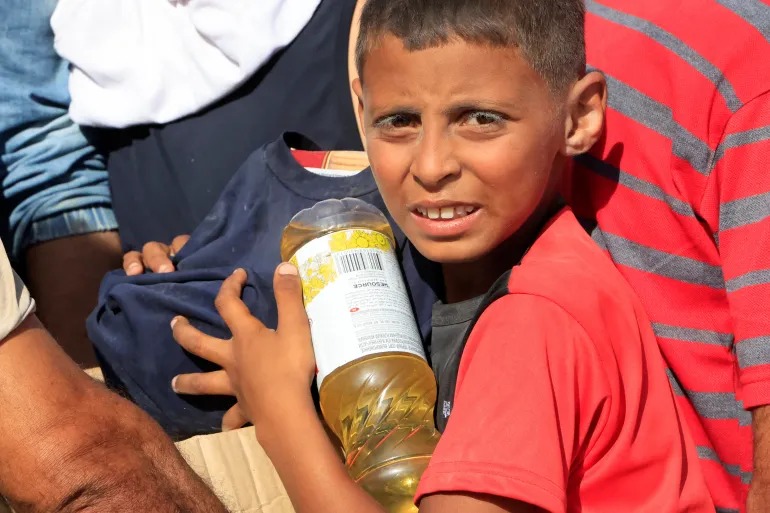
Starving Gaza: Aid Chaos Erupts as Crisis Deepens Under Israeli Blockade
Gaza is on the brink of famine, with over a million people facing starvation under an 11-week Israeli blockade. Aid efforts have collapsed, and new initiatives like the U.S.-backed Gaza Humanitarian Foundation face criticism for being politicised and ineffective. As desperation grows, international agencies warn of total healthcare system failure. Without urgent UN-led intervention and the reopening of border crossings, Gaza’s humanitarian crisis will spiral into a full-blown catastrophe.

As of May 2025, the Gaza Strip is facing an intense humanitarian disaster. According to the United Nations, over 1.1 million people, nearly half of Gaza’s population, are experiencing catastrophic hunger, with the territory on the verge of famine. This crisis has been worsened by an 11-week total siege and blockade imposed by Israel, which has severely limited the entry of food, fuel, medicine, and essential supplies.
The blockade has triggered a sharp increase in food prices, with some items rising by as much as 1,400 per cent. All 25 bakeries supported by the World Food Programme (WFP) had shut down by the end of March due to a lack of wheat flour and cooking fuel. Community kitchens, previously a consistent source of food support, now face the risk of running out of supplies within weeks.
Establishment and Role of the Gaza Humanitarian Foundation (GHF)
In February 2025, the Gaza Humanitarian Foundation (GHF) was founded as a Delaware-based organisation, backed by the United States and Israeli governments. Its mandate is to deliver humanitarian assistance in Gaza while bypassing traditional United Nations-led mechanisms. However, the foundation has been criticised for politicising aid and lacking the necessary experience in effective humanitarian response.
The United Nations and several leading humanitarian organisations have expressed concern that GHF’s approach may breach key principles such as impartiality and neutrality. Allegations have surfaced suggesting that the foundation’s distribution model could contribute to forced displacement within Gaza and further complicate an already dire situation.
Aid Distribution Challenges in Rafah
On 27 May 2025, chaos broke out at a GHF-managed aid distribution site in Rafah, southern Gaza. Thousands of desperate Palestinians overran the centre, breaching perimeter fences and prompting Israeli forces to fire warning shots in an attempt to disperse the crowd.
Reports indicate that the aid parcels distributed contained only minimal quantities of food, insufficient for most families. Many residents expressed fear and reluctance to approach the area due to security concerns, with some describing the location as more akin to a military installation than a humanitarian aid site.
Reactions from Hamas and the International Community
Hamas has denounced GHF’s aid distribution efforts, calling the programme a failure and accusing Israel of exploiting it to displace Palestinians. The organisation asserts that this form of aid delivery is being used as a strategic tool of control, disguised as humanitarian assistance.
The United Nations and other international agencies have also criticised GHF’s operations, arguing that they undermine well-established humanitarian protocols. Many have urged for the reopening of border crossings and for humanitarian aid to be delivered through traditional, impartial mechanisms.
Statements from Cindy McCain and Aid Distribution Concerns
Cindy McCain, Executive Director of the World Food Programme, has publicly dismissed allegations that Hamas is stealing humanitarian aid. She emphasised that no credible evidence has emerged to support these claims and noted that incidents of looting are driven by the desperate conditions of a starving population.
Despite ongoing efforts, the volume of aid entering Gaza remains far below what is needed. McCain pointed out that only a small percentage of the required assistance is reaching affected populations, and the humanitarian situation remains perilous.
GHF’s Operational Details and Criticisms
GHF has established four aid distribution centres within Gaza and intends to serve over one million people. Nevertheless, the initiative has faced criticism for its limited reach and reliance on private United States-based security contractors. These factors have raised concerns about the increasing militarisation of aid delivery and the exclusion of established humanitarian actors.
Jake Wood, the Executive Director of GHF, resigned shortly before the commencement of distribution operations, citing disagreements over humanitarian principles. His resignation has further fuelled doubts about the organisation’s approach and its adherence to international humanitarian norms.
Implications and Outlook
GHF’s current operational model, involving limited access points and private security personnel, is seen by many as inadequate in addressing the scale of humanitarian needs across Gaza. Critics argue that such an approach is likely to foster distrust among both the local population and the global community, potentially prolonging the crisis.
Humanitarian agencies and international institutions continue to advocate for aid to be channelled through recognised, neutral pathways. Only by working with experienced organisations and depoliticising the aid process can access to life-saving resources be ensured for all who need them.
Conclusion: The Human Toll and Urgent Call for UN Intervention
The humanitarian emergency in Gaza has reached a tipping point. With more than a million people facing acute hunger and over 66,000 children suffering from severe malnutrition, the physical and psychological toll on civilians is devastating. Families are forced to survive on scraps, while many go days without a single meal. The young, the elderly, and the sick are particularly vulnerable.
The collapse of Gaza’s healthcare infrastructure compounds the crisis. Hospitals are operating with minimal electricity and dwindling medical supplies, rendering them unable to deliver critical care. The World Health Organization has warned that if international support is not mobilised immediately, the region’s healthcare system may suffer total collapse.
The United Nations must intervene without delay. The international community must demand that Israel reopen all border crossings to allow the safe and unrestricted delivery of humanitarian assistance. Neutral and experienced humanitarian organisations must be reinstated to oversee distribution, ensuring aid reaches those most in need. The cost of inaction is too high. Gaza’s people cannot afford to wait.
Aric Jabari is the Editorial Director of the Sixteenth Council.


Critical Minerals and the Green Transition: Europe’s New Dependency Risk