
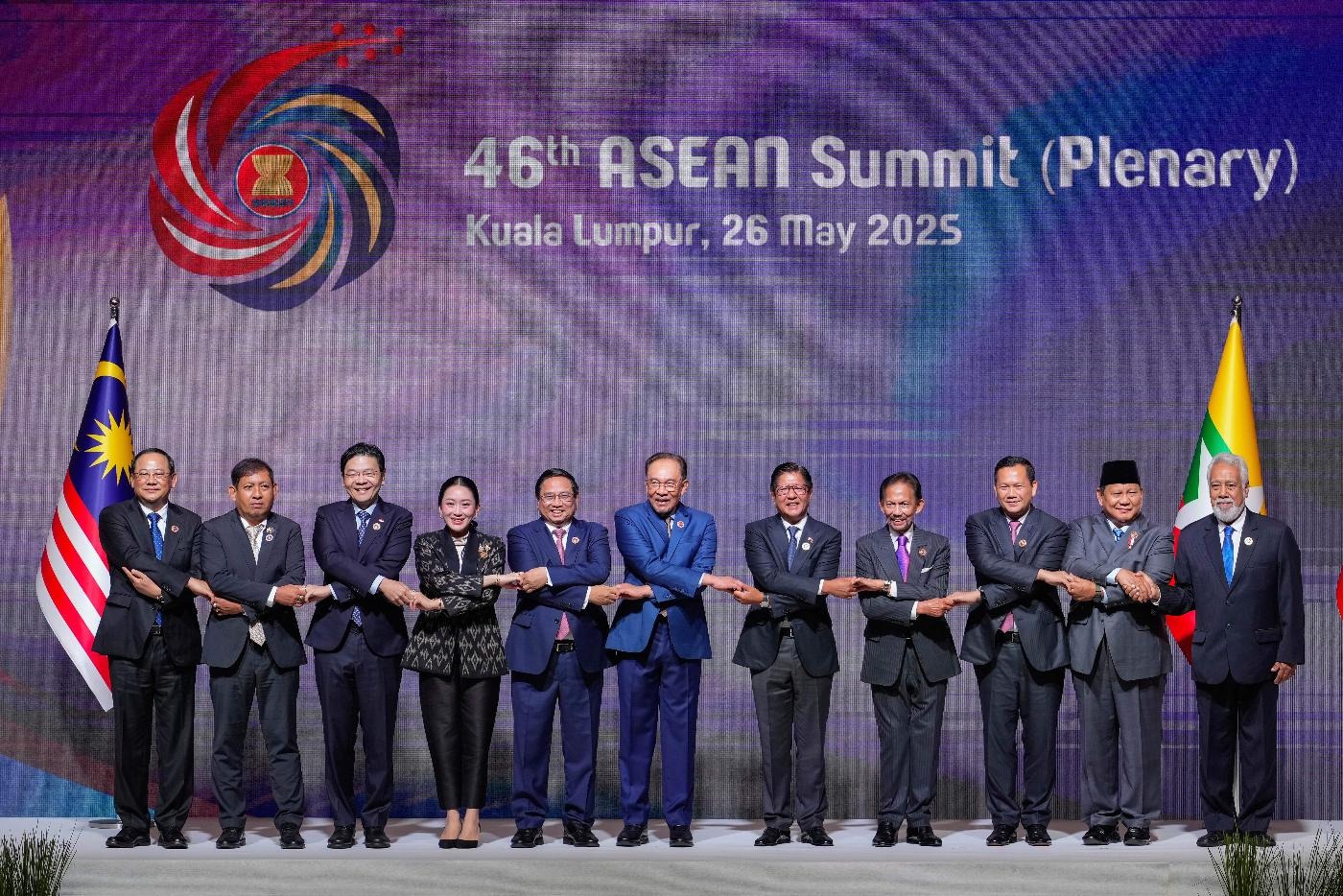
ASEAN Summit in Malaysia: Defying Trump’s Tariffs. Will the Region Break Free or Bow Down?
At the ASEAN Summit in Kuala Lumpur, leaders faced tough choices as Trump’s tariff threats loomed and China expanded its influence. With pressure mounting from both sides, ASEAN pushed for unity and new partnerships, including with the Gulf states. But internal divisions and the unresolved crisis in Myanmar cast a shadow. The summit was a clear reminder: if ASEAN wants to shape its own future, it needs to stand together, now more than ever.

In Kuala Lumpur, the political capital of Malaysia, the leaders of the Association of Southeast Asian Nations (ASEAN) convened for their annual summit. This gathering was particularly significant, as it marked the first major summit since United States President Donald Trump reignited global trade tensions by imposing sweeping tariffs. Although temporarily suspended, these tariffs are set to return in July 2025, potentially affecting countries that fail to negotiate new trade agreements with Washington.
The tariffs have disrupted global supply chains and placed ASEAN, an economic bloc of ten nations, at the centre of a volatile trade war. The summit represented an urgent bid for unity and a coordinated response to unilateral economic disruptions that threaten the region’s stability and long-term prosperity.
ASEAN Summit Context and US–China Trade Tensions
Trump’s tariffs, targeting both rivals and allies, have created uncertainty throughout ASEAN’s export-driven economies. Though temporarily suspended, they remain a looming threat, with July 2025 set as a critical deadline for renewed enforcement if bilateral agreements are not reached.
Melissa Chan, reporting from Taipei, aptly described ASEAN’s dilemma: “The region is caught between the United States and China, its two largest trading partners. It is being forced to play a balancing act under increasing pressure.” Notably, if treated as a unified bloc, China, not the United States or the European Union, is ASEAN’s largest trading partner.
In response, Malaysian Prime Minister Anwar Ibrahim, chair of the summit, extended invitations not only to the United States but also to Gulf countries such as the United Arab Emirates (UAE). This signalled ASEAN’s intention to multilateralise its economic diplomacy and reduce reliance on unstable bilateral ties.
Economic Growth and Shifting Manufacturing Patterns
Southeast Asia’s economies are expanding steadily. Vietnam, for example, recorded 6.1 per cent GDP growth in 2024, reflecting post-pandemic resilience and strategic integration into global value chains. However, the World Bank projects Vietnam’s GDP growth to moderate to 5.8 per cent in 2025, citing increased uncertainty around trade policy.
ASEAN countries such as Malaysia, Indonesia and the Philippines continue to attract foreign investment, particularly in technology and manufacturing sectors.
United States tariffs on Chinese goods have inadvertently accelerated the shift of manufacturing bases from China to ASEAN states, with Vietnam emerging as a preferred destination. However, the potential re-implementation of these tariffs could disrupt this transition and reduce investor confidence across the region.
China’s Strategic Engagement in the Region
President Xi Jinping’s state visits to Vietnam, Cambodia and Malaysia in April 2025 underscored Beijing’s commitment to consolidating regional ties. Offering long-term infrastructure investment, digital economy collaboration and stable trade partnerships, China is positioning itself as a dependable and predictable alternative to the United States.
Premier Li Qiang’s presence at the Kuala Lumpur summit alongside Gulf counterparts further highlighted Beijing’s strategic push. China’s message is clear. While the United States imposes tariffs and withdraws from multilateral forums, China remains engaged, consistent and geographically embedded in the region.
Territorial Disputes and Regional Security
Despite Beijing’s charm offensive, long-standing tensions in the South China Sea remain unresolved. China’s expansive maritime claims directly conflict with those of Vietnam, the Philippines and Malaysia. Recent confrontations, including Chinese naval aggression against Filipino vessels, have raised regional concern.
Nevertheless, ASEAN has remained largely silent in its response, constrained by China’s economic leverage. The question is whether ASEAN can continue to deepen economic ties with Beijing while also safeguarding its territorial sovereignty.
ASEAN’s Delicate Balancing Act
ASEAN’s economic architecture is deeply interwoven with both superpowers. China is a source of raw materials and industrial components, while the United States is a key export destination for semiconductors, electronics, apparel and more. Many ASEAN countries heavily depend on these export flows to sustain their economies.
Journalist David Grunab, reporting from Manila, explained that the bloc’s leaders are striving to “stay in conversation, not allow this to descend into confrontation.” ASEAN’s greatest diplomatic strength may lie in its capacity to navigate this difficult intermediary space without being forced into binary alignment.
Internal Divisions and Structural Challenges
ASEAN aspires to act as a unified entity, but the reality reveals a more fragmented picture. While Prime Minister Anwar Ibrahim calls for collective negotiations with the United States, member states such as Malaysia, Vietnam, Indonesia and Thailand continue to pursue bilateral trade talks independently.
This fragmentation weakens ASEAN’s bargaining power. It also exposes deeper limitations, such as the failure to resolve the civil war in Myanmar. Despite years of diplomacy, ASEAN has made little progress. Meanwhile, China continues to exert significant influence over Myanmar’s ruling junta, leaving ASEAN marginalised within its own region.
The Role of Gulf States and Millilateralism
A major innovation of this year’s summit was the inclusion of Gulf states, most notably the UAE. This reflects a growing trend in international diplomacy. The rise of millilateralism refers to compact groupings of like-minded nations that pursue targeted trade and investment deals.
With summits already convened among China, India and the UAE, ASEAN’s engagement with these emerging networks is timely. Gulf countries, especially the UAE, see themselves as logistical and financial hubs, aligning well with ASEAN’s aspirations to diversify trade routes and bypass protectionist barriers.
ASEAN’s Trade Significance to the United States
Trade with the United States remains crucial. ASEAN countries export a wide array of goods, from high-tech components to consumer products. For nations such as Vietnam and Malaysia, the United States is not just a trading partner but a pillar of economic survival.
Given this interdependence, ASEAN leaders are lobbying not only policymakers but also major American corporations with regional supply chains. The goal is to ensure continued trade flows, regardless of political changes in Washington.
China’s Offer and ASEAN’s Resistance to Polarisation
Beijing continues to position itself as Southeast Asia’s natural, long-term partner. Unlike the United States, it is a neighbour rather than a distant and often unpredictable foreign power. China’s consistency, however authoritarian, is contrasted with America’s shifting policies, sudden trade barriers and retreat from global institutions.
Still, ASEAN remains committed to neutrality. Its leaders seek strategic autonomy through engagement with both China and the United States without having to choose sides. This balancing act, while challenging, is vital to ASEAN’s long-term interests.
The Myanmar Crisis and Regional Security Credibility
Myanmar’s civil war, now in its fourth year, has displaced millions and created a haven for transnational crime. Scam centres, human trafficking networks and illegal trade hubs are flourishing amid the power vacuum.
Despite Malaysia’s efforts to broker dialogue between the junta and opposition forces, ASEAN has failed to exert meaningful influence. Its limited leverage in Myanmar has raised questions about its capacity to ensure regional security and has undermined its credibility as a diplomatic bloc.
Political Stability and Evolution in Southeast Asia
Compared to the turbulent 1990s, most ASEAN states now enjoy relatively stable governance. Though still semi-democratic in many cases, current regimes offer more continuity and accountability than those of previous decades.
Michael Vatikiotis, senior adviser at the Centre for Humanitarian Dialogue, observed, “ASEAN is better positioned today, with settled semi-democratic governments and fewer instances of political upheaval.” In a world dominated by uncertainty, Southeast Asia’s internal stability is a rare and valuable asset.
Future Outlook: Between Giants, Towards Resilience
ASEAN’s future depends on its ability to diversify strategic partnerships while maintaining independence. Relations with the United States and China must be complemented by deeper engagement with the Gulf states, India and the European Union.
Global trade architecture is evolving. Millilateral agreements will become increasingly important, especially as the World Trade Organization’s dispute resolution mechanisms struggle to keep pace with economic change. ASEAN’s cohesion and institutional capacity will determine its success in navigating this complex landscape.
Conclusion: A Call for Unity in a Fractured World
The ASEAN Summit in Kuala Lumpur highlighted not only the pressures confronting the region but also its potential to redefine its role in a multipolar world. The Trump-era tariffs exposed systemic vulnerabilities, but they also prompted a reassessment.
ASEAN must now emerge not as a passive observer, but as a diplomatic force capable of transcending dependency and asserting a principled, people-first regional vision. The challenges such as US–China rivalry, the Myanmar crisis and tariff wars require more than resilience. They demand resolve.
ASEAN’s citizens deserve more than mere economic survival. They deserve leadership that is bold, unified and globally proactive. The region’s destiny must not be dictated by foreign powers, but by its capacity to lead with dignity, unity and vision.
Let ASEAN not simply withstand the crosswinds of geopolitics but chart its own course.
Aric Jabari is the Editorial Director of the Sixteenth Council.


Existing Indian Economic and Strategic Interests in Cuba: Challenges and Prospects