
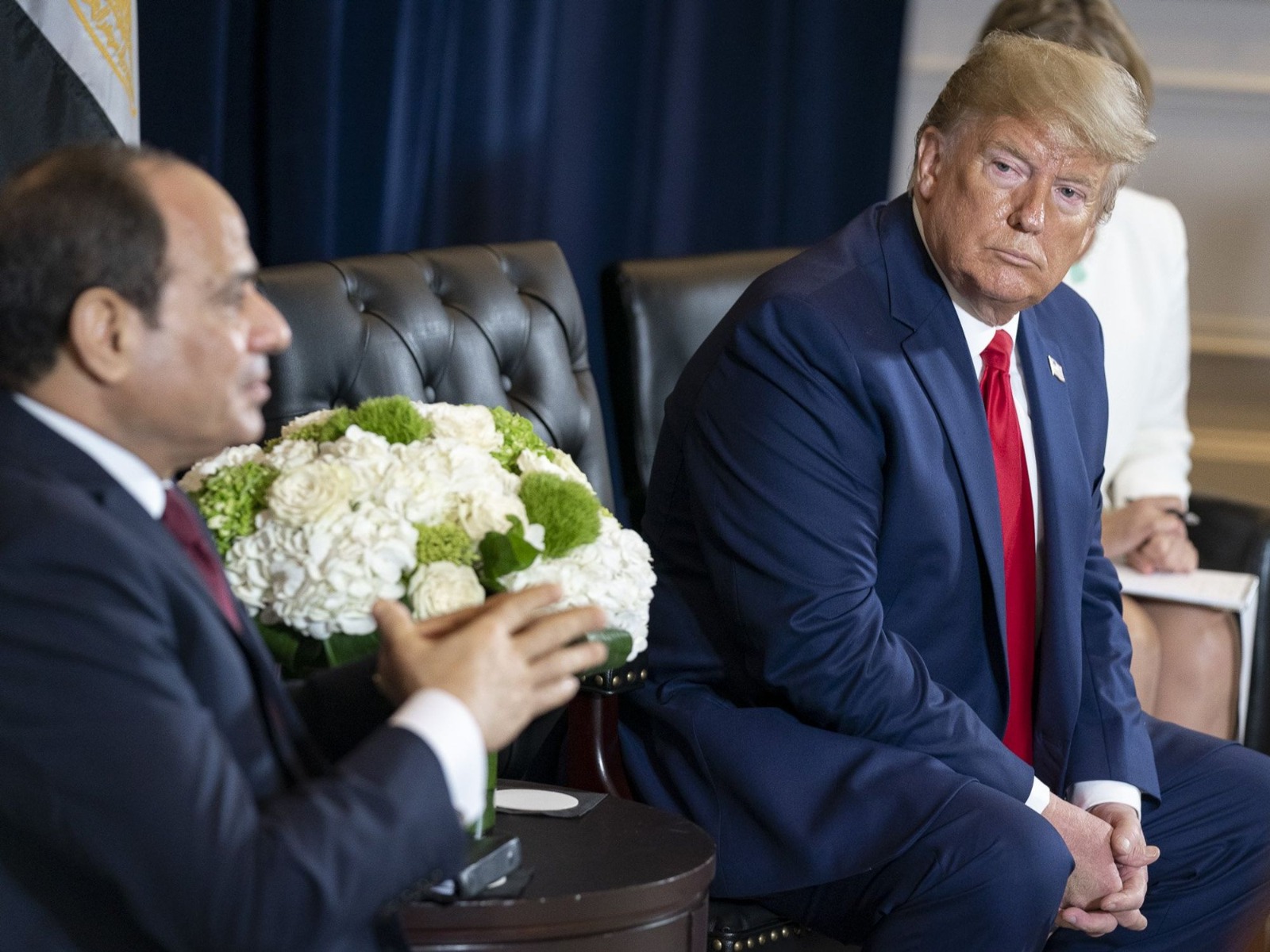
A Cold Partnership- An Analysis of US-Egypt Relations Under Trump 2.0
Under Trump’s second term, U.S.-Egypt relations have cooled further due to controversial positions on the Suez Canal and Gaza diplomacy. Trump’s call for free U.S. passage through the Suez Canal and his Gaza displacement plan, both seen as affronts to Egyptian sovereignty, have strained ties. Egypt’s rejection signals a desire for autonomy and increasing openness to alternative global partners like Russia and China amid growing U.S. unpredictability.

The United States’ partnership with Egypt has been one of strategic and economic importance since Egypt agreed to normalise relations with Israel as a condition of the Camp David Accords in the late 1970s. During the presidency of Hosni Mubarak, the US-Egypt economic and geostrategic relationship only grew stronger as Egypt was viewed as the US’ eyes and ears in the MENA region and played an important role in the US’ War on Terror. However, following the Arab Spring in 2011, there has been a chill in the US-Egypt relationship and even more so under the leadership of current President Abdelfattah El-Sisi following his removal of President Mohamed Morsi, the first democratically elected leader in Egypt’s history and Muslim Brotherhood member. Since this event, Egypt has diversified its relationships with other major powers such as Russia and China, engaging in military and economic trade with the aforementioned countries. Under the presidency of Donald Trump, it was envisioned that the US-Egypt relationship would be under a revival of sorts, however, Trump’s unpredictable nature further strained the US-Egypt relationship. The purpose of this analysis is to take a look at the current state of US-Egyptian relations and understand how the partnership between the US and Egypt further chilled under Trump 2.0. The chilling of the US-Egypt partnership under Trump 2.0 will be analysed through the following key points:
- Trump’s Suez Canal Comments
- Egypt and Gaza Diplomacy
Trump’s Comments on the Suez Canal
The Suez Canal is not only considered important for geopolitical and economic reasons, but also for symbolic reasons. The Suez Canal is seen as a symbol of Egyptian sovereignty as former Egyptian President Gamal Abdel Nasser “…declared its nationalization—an assertive act of independence that challenged three dominant colonial powers of the era” (Abu-Ghazaleh, 2025). Since then, Egypt has used the Suez Canal to establish itself as a geostrategic trading partner that connects the East to the West and has full discretion on who can pass through it. Recently, Trump made comments regarding the Suez Canal in a post to Truth Social, where he stated “ American ships, both military and commercial, should be allowed to travel free of charge through the Panama and Suez Canals” (Amin, 2025). On the surface this comment may seem like another exaggerated statement made by Trump to stir the pot, however it may have ramifications on the US-Egypt relationship.
The Trump Suez Canal comment further chilled US-Egypt relations, as it was viewed as an irrational request and also can be seen as the US forcing Egypt to cater to its wants and needs. According to Hamza Hendawi of The National, the US already has priority in terms of warships passing through the canal, while government-backed news outlets and talk show hosts have criticised Trump’s request as “…preposterous…” (Hendawi, 2025). Furthermore, one can argue Trump’s demands can be considered an attack on Egyptian sovereignty, as US Affairs Specialist Ibrahim Al-Darawi, states that “…the Suez Canal is “an entirely Egyptian waterway,” stressing, “The United States neither helped us in digging it, nor in its nationalisation.” On the contrary, during the nationalisation crisis, the United States sided against Egypt” (Al-Darawi, 2025 cited in Qandil, 2025). As the Suez Canal is considered a symbol of Egyptian sovereignty and a rejection of the foreign control of Egypt’s sources, it is only natural that Egyptians feel that Trump is attacking them by making such comments.
Overall, the demands made by Trump regarding the free passage of US trading and military ships can put heavy strain on the US-Egypt relationship. Trump’s demand could potentially push Egypt to revise its relationship with the US, while also causing Egypt to diversify its trade relations with different nations. It is vital to the US’ geostrategic and economic interests in the MENA region that it maintains warm relations with Egypt and therefore it would be recommended that Trump does more not to alienate the US’ MENA partners. A potential consequence is that the US alienation could force Egypt to align itself with the US’ competitors, which can result in these competitors gaining economic influence over the MENA region through the Suez Canal.
Egypt and Gaza Diplomacy
Beyond the demands made by Trump regarding the Suez Canal, it can also be argued that the US-Egypt relationship is chilled further due to the crisis in Gaza. Since October 2023, Egypt alongside Qatar have been collaborating together to reach a sustainable ceasefire to end the crisis. Egypt’s diplomatic efforts include a plan that involves raising “…$53 billion over five years to rebuild Gaza, establishing a transitional administration led by non-partisan figures and technocrats and creating an international fund to ensure transparency in resource allocation” (Boussel, 2025). This plan shows Egypt’s willingness to engage in diplomatic efforts to bring the Gaza crisis to an end, while showcasing its diplomatic relevance as a means to regain influence in the MENA region. However, since Trump returned to the Oval Office, he had his own plan, which involved the displacement of Palestinians living in Gaza into Egypt and Jordan, which both countries rejected. As a result of these rejections, Trump threatened both countries with cuts in much needed economic and military aid, which further strained the relationship between the US and Egypt (Liga, 2025).
The rejection of Trump’s plan to displace Palestinians and threats by Trump to cut economic and military aid resulted in a strain on US-Egypt relations as Egypt believes that the Trump plan will pose a national security threat. The displacement of Palestinians of Gaza will be a threat to Egyptian national security as there is a fear that some armed elements of Hamas could slip through and continue attacks on Israel on Egyptian soil, which could escalate and force Egypt into the crisis and result in retaliation from both the US and Israel (Mabrouk, 2025). Beyond the national security threat posed by the Trump plan, the Egyptian populace and elements of the government share a strong rejection of Trump’s Gaza policy, as Egypt is against the infringement of Palestinian rights. According to AFP, El-Sisi believed that a Palestinian state is the key to lasting peace in the MENA region, while Egyptian civilians have voiced their outrage towards the Trump plan by pledging support to the reconstruction of Gaza without the displacement of the Palestinian people (AFP, 2025). It is through this rejection of the Trump plan and defiant attitude towards Trump’s threats that Egypt’s relationship with the US has cooled.
It is understandable as to why Trump’s Gaza plan and threats to cut economic and military aid due to Egypt’s rejection can lead to a chilling of US-Egypt relations. Once again, these threats from Trump can be perceived as a complete disregard for Egyptian sovereignty and autonomy, as Trump believes that Egypt is a pawn for US interests in the MENA region. However, Egypt is steadfast in its support for a diplomatic solution that is sustainable and does not result in the Palestinians being displaced into Egypt. A recommendation is that Trump should work with the Egyptians and other nations in the MENA region in order to avert a humanitarian catastrophe that can result from the mass displacement of Palestinian, as opposed to bullying the MENA states into being party to the ethnic cleansing occurring in Gaza.
Conclusion
Conclusively, it can be argued that the US and Egypt’s ties are at a cooling point, as Trump has made clear that he has no regard for Egyptian interests or sovereignty. By demanding that the US gets a free ride through the Suez Canal, Trump alienates Egypt as a trading partner, as Egypt derives much of its trade from the canal, while also ignoring that the canal serves as a symbol of resistance against colonialism and foreign interference. Furthermore, the Trump Gaza plan and his threats to cut off aid to Egypt serve as a national security threat to Egypt, while also showing how Trump attempts to blackmail Egypt to carry out the US’ bidding in regional affairs.
Overall, Trump’s disregard for Egypt’s sovereignty and autonomy may not cost the US its relationship with Egypt, however, it can encourage Egypt to seek out different partners such as Russia and China as an alternative. Already Russia provides Egypt with military aid, while China is seeking to expand its influence into MENA through Egypt, whether it be through military aid or the development of economic relations. It is advisable that if the US were to desire to maintain a strong relationship with Egypt, it must do what it can to not alienate Egypt. This can be done by treating Egypt as a partner and working with Egypt on economic and diplomatic issues that can be beneficial to US-Egypt relations in the future.
Sherif Amin is a non-resident research fellow at the American Program of the Sixteenth Council


Trump Can’t Take Greenland – and the World Knows Why