Forced Relocation and Civil Commitment: Trumps’ Executive Order to Ban Rough Sleeping
President Trump’s executive order banning rough sleeping marks a sharp policy shift from the housing-first approach toward punitive enforcement. Backed by the Supreme Court’s Grants Pass v. Johnson ruling, the order deploys federal agents in Washington, DC to forcibly relocate and civilly commit homeless individuals. While framed as restoring public order, the policy risks worsening homelessness by criminalising poverty, straining shelters, and displacing individuals without alternatives. Critics warn it deepens marginalisation, fuels migration to other cities, and undermines long-term solutions.

Executive Summary
Recent orders from President Trump have resulted in the deployment of federal agents into Washinton, DC to enforce a ban on street homelessness. In June 2024, the US Supreme Council ruled for cities to be able to enforce new laws banning rough sleeping. Many cities, including California, Washington, and New York City, have implemented aggressive policies to address street homelessness in an effort to make streets more presentable and combat a perceived crime risk. These efforts have been ineffective in tackling homelessness rates or addressing the root causes of the issue, instead having a negative impact on homeless people and increasing liability for the US capital city.
Strategic Overview
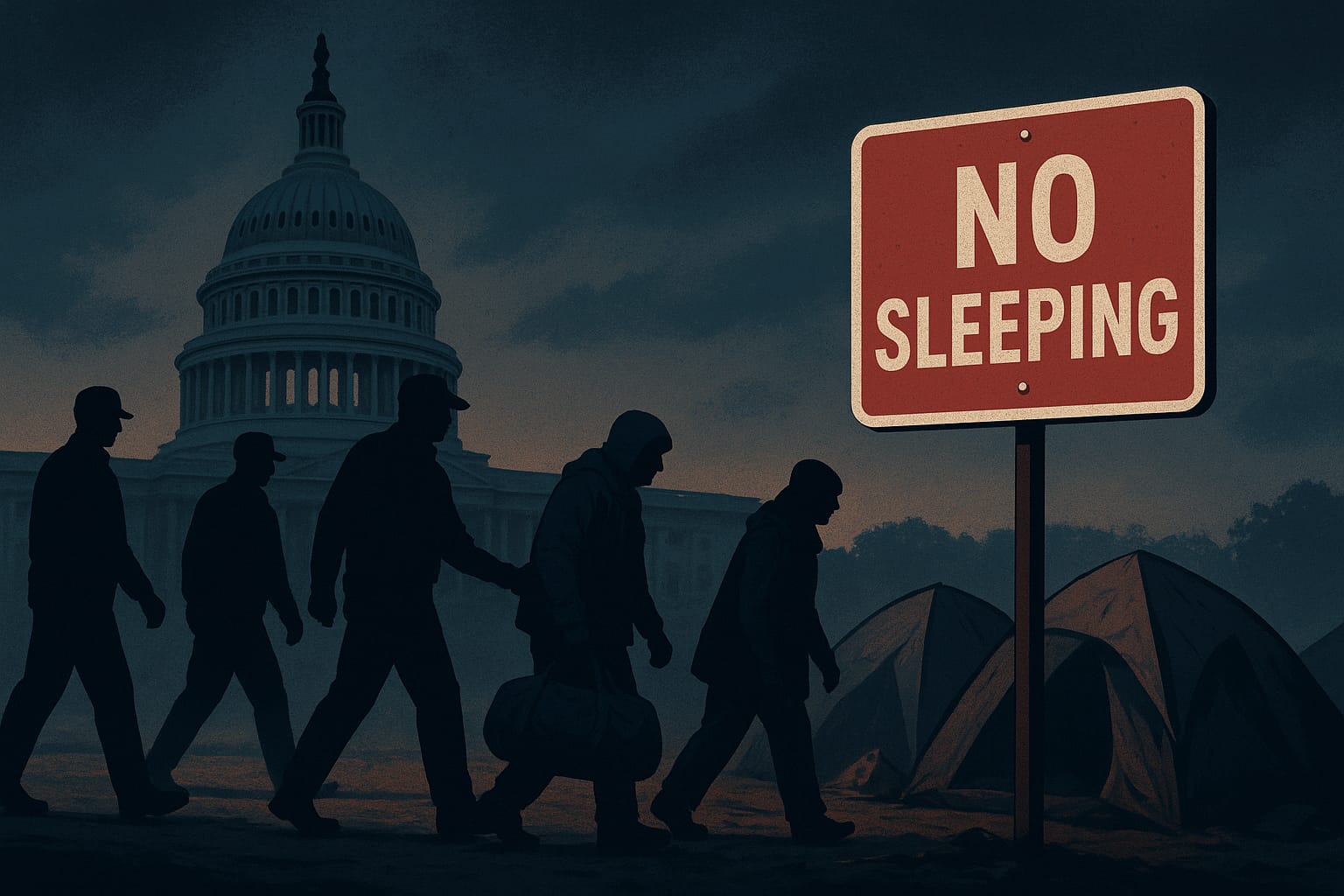
Last month, Republican US President Donald Trump stated that homeless people must “move out” of Washington DC as a representation of his administration’s effort to tackle city crime rates, with plans to make the city safer and more presentable, to ‘restore public order’.
President Trump has signed an order making it easier to arrest homeless individuals and commit them to hospitals (through ‘civil commitment’, a legal tool that allows involuntary institutionalisation of the mentally impaired). It instructs federal housing agency to link homelessness assistance with treatment programmes for mental health and substance abuse, changing the longstanding federal ‘housing-first’ policy approach which prioritised accommodation before addressing other concerns.
This was followed by further instruction for federal law enforcement to take to the streets of Washington, DC. On the 9th of August, 450 federal agents (including the FBI, US Marshals Service, US Park Police, and DEA) were deployed in the city to enforce immediate forceful relocation of homeless individuals found sleeping rough or existing as part of tent encampments.
Operational Context
Homelessness in the US: Since the 1980s the US has faced a growing homelessness crisis, and in 2024 it reached record highs after a significant 18% increase in the recorded number of homelessness individuals according to a January 2024 report by the US Department of Housing and Urban Development (HUD). High housing costs combined with a housing shortage, rising inflation and declining incomes for lower and middle-class households, systemic racism, and forced migration due to natural disasters are the main causes cited.
Grants Pass v. Johnson: Trumps recent orders arrive in the wake of a shift in homelessness policy strategy in the US. In June 2024, the US Supreme Court ruled in a 6-3 vote along ideological lines (for the Grants Pass v. Johnson legal case) that cities have the power to enforce laws prohibiting homeless individuals from sleeping rough or camping in public places, including the right to punish failure to adhere to new restrictions, such as citations, fines, and jail sentences.
US cities that have chosen to implement policies to criminalise street homelessness include:
- Lancaster
- California
- Manchester
- New Hampshire
- Fresno
- California
- Washington
- New York City
Geopolitical Tensions
Washinton Mayor Response: Washington’s Democratic Mayor Muriel Bowser conflicts with Trump’s policy approach and justification, denying any current crime spike. Bowser spoke that there was a spike in crime in 2023, but successful efforts to address this over the past two years have resulted in a 30-year low in violent crime in the city. He reacted to White House description of Washinton as “more violent than Baghdad” as a false exaggeration.
Reverses Prior Ruling: A previous lower court ruling by a San Francisco-based appeals court established that an Oregon Cities laws prohibiting sleeping and camping in public spaces were ‘unconstitutional’ (referring to violation of the eight amendment, on the grounds that it was wrong to punish rough sleeping when no public shelters were available). The Supreme Court overturned this ruling, allowing local governments to enforce existing laws against rough sleeping.
Political Motivations: In response to the growing crisis, recent political election cycles along the West Coast have given greater focus to tackling homelessness, pouring money into increasing the number of homelessness shelters and affordable housing.
Strategic Outlook
Effectiveness: As cities across the US are emboldened to adopt harsher measures against rough sleeping, there is little indication of any success in reducing homelessness rates. Advocates, including HUD, argue that banning street homelessness and tent encampments only serves to remove a choice of last resort for those who lack any better alternatives and fail to solve the issue.
Policy Challenges:
- Overreliance on state and local cooperation; despite significant authority within DC, Trump has limited influence outside of federal properties, meaning implementation falls to state officials.
- Trumps recent orders present increased liability for Washington city, including the forced relocation or arrest and imprisonment of homeless people.
- Logistical challenges regarding where forcibly relocated individuals would be housed and potential impacts on existing state laws raise questions about Trumps long-term plan.
- At current, homeless individuals are forced to move to a new location, only to be confronted with the same restrictions; the policy only ‘moves the problem around’.
- The policy depends on the existence of shelters; however, their presence and capacity have limits which vary between regions.
Implications for the US
Impact on the Homeless: The US Supreme Court’s decision to allow cities to enforce punitive laws against public sleeping and camping will lead to more jurisdictions passing laws that ticket, fine, and jail homeless individuals. This permissive enforcement of a ‘ban’ on rough sleeping will have a negative impact on homelessness, worsening living conditions and making it harder for people to escape extreme poverty.
- It isolates and marginalises the homeless further, making it harder to connect people with housing and social services.
- Imprisonment is likely to worsen conditions, as people leaving prison face increased barriers in finding stable housing due to criminal record exclusions from public housing and landlords’ ability to deny private renting, creating a cycle of instability.
National Migration: Discussion around the forced relocation of homeless people suggest movement to locations outside of DC, which will result in an increased homelessness population in these areas. There is also potential that individuals will be drawn to locations that offer better accommodations and less risk when faced with a choice between prison time and forced relocation, driving up homelessness rates in other urban areas.
Conclusion
Homelessness is increasingly being perceived as a policy choice, but its existence isn’t in question. The causes of homelessness are deeply rooted structural and systematic societal ills that facilitate extreme poverty in the US. Policy offers potential solutions, but their effectiveness varies. Evidence shows that the ‘housing-first approach’ is most effective in addressing the root causes of homelessness, and that a punitive approach to homelessness only exacerbates the issue. As such the new homelessness policy will not see success without concentrated efforts to provide public shelter and homelessness assistance.
Niamh Allen is a Global Policy Intelligence Fellow at the Sixteenth Council