Trump in the DRC: Blood Deals, Justice Dreams, and the Price of Sovereignty
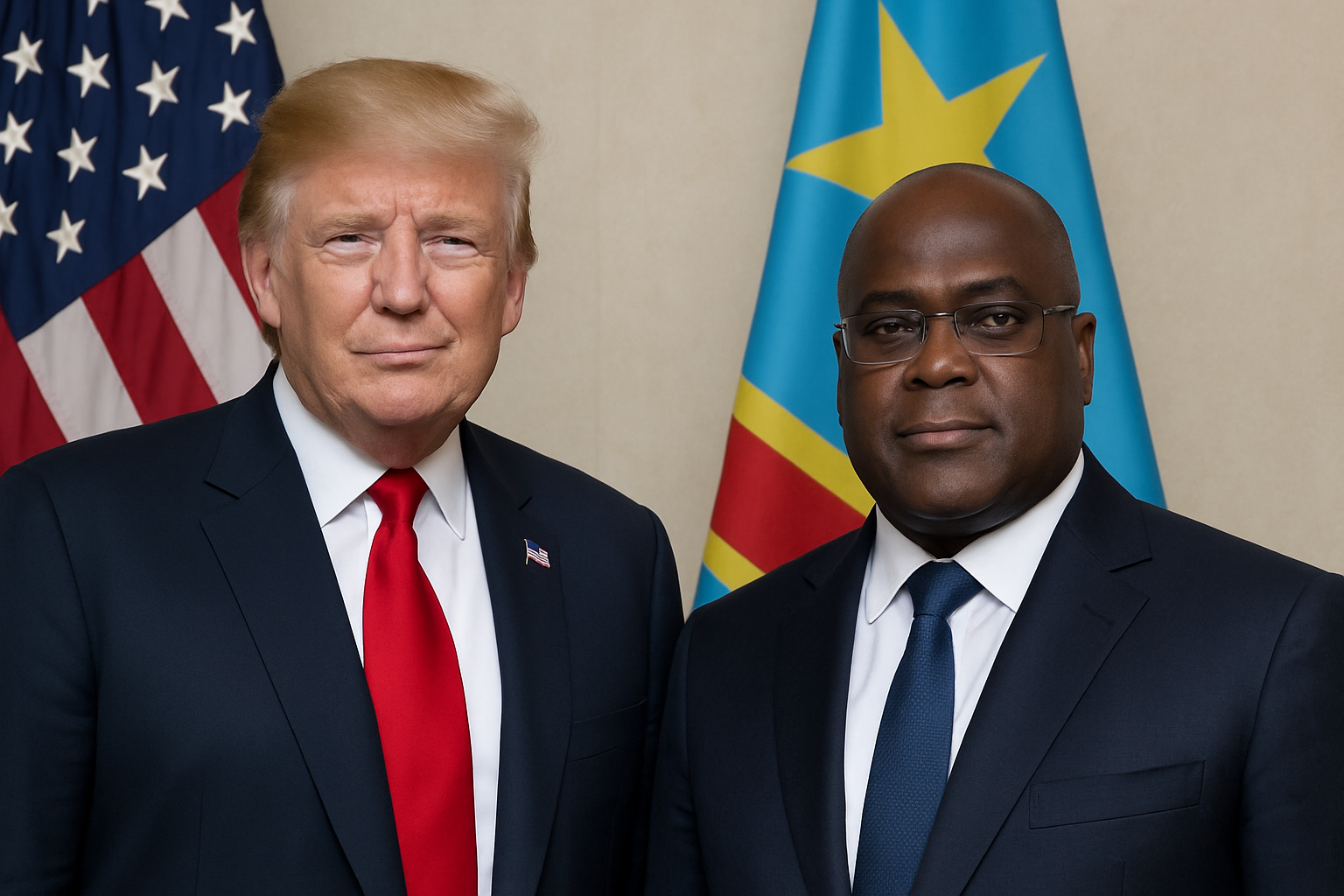
In a bold, high-risk move, President Félix Tshisekedi has signed a mineral-for-security agreement with the United States—an audacious pivot that may either ignite a new chapter of sovereignty or deepen the nation’s postcolonial wounds.

In the mineral heartland of Central Africa, a seismic realignment is underway. The Democratic Republic of the Congo (DRC), a nation brutalised by centuries of extraction and betrayal, now stands at another historic crossroads. In a bold, high-risk move, President Félix Tshisekedi has signed a mineral-for-security agreement with the United States—an audacious pivot that may either ignite a new chapter of sovereignty or deepen the nation’s postcolonial wounds.
Behind the ink lies a desperate bid for peace, a struggle against impunity, and a gamble to tilt power away from China’s suffocating grip. But this deal—backed by Trump, operationalised by private military contractors, and quietly resented by global powers—has reopened old scars, exposed forgotten crimes, and forced a reckoning with Congo’s past, present, and uncertain future.
Why Tshisekedi Took the Deal: War, Weakness, and a Will to Save
President Félix Tshisekedi assumed office in 2019, inheriting not just a presidency, but a battlefield. By 2023, more than one million Congolese had been displaced by the resurgence of M23 rebels in North Kivu, with over 7,000 civilians killed . The Congolese army was losing ground fast. The United Nations peacekeeping force, MONUSCO, had overstayed its welcome and underperformed for decades. China, while heavily invested in Congo’s minerals, refused to intervene militarily. Tshisekedi’s hand was forced.
In a February 2024 letter to Donald Trump, Tshisekedi proposed a strategic partnership: access to critical Congolese minerals in exchange for American security assistance and support for the creation of an International Criminal Tribunal for the Congo . The goal was clear—to stabilise the region, defeat M23, and dismantle the impunity structure that had allowed rebel groups, state actors, and foreign regimes to slaughter with no consequence.
Critics call it a betrayal. But for Tshisekedi, it is a calculated act of survival—and one rooted in law. Under Article 69 of the Congolese Constitution, the President of the Republic is the Head of State. He represents the Nation and serves as the symbol of national unity. He ensures respect for the Constitution and, through his arbitration, guarantees the regular functioning of public powers and institutions, as well as the continuity of the State. He is the guarantor of national independence, territorial integrity, national sovereignty, and the observance of international treaties and agreements. President Tshisekedi invoked this constitutional mandate to seek external support when all internal and regional avenues for stabilising the country had failed.
The Deal’s Terms and the Risk of History Repeating
The deal involves American access to DRC’s cobalt, copper, and coltan reserves—minerals vital to the global green energy transition and U.S. defence systems. In exchange, the U.S. will provide logistical and security support, reportedly through private military contractors affiliated with Erik Prince, the former CEO of Blackwater .
Blackwater, rebranded multiple times, was disbanded after its contractors massacred 17 civilians in Baghdad’s Nisour Square in 2007. Prince was pardoned by Trump in 2020. His involvement in Congo has raised alarms, especially given that contractors will operate in North and South Kivu—regions plagued by conflict and mineral smuggling.
There is no official parliamentary oversight of the agreement. Nor is there clarity on revenue-sharing mechanisms, local employment mandates, or Congolese ownership stakes. These are glaring gaps that echo previous colonial-era deals, including the 2008 Sino-Congolese infrastructure-for-resources pact, which promised $6 billion in roads and hospitals but delivered less than $1 billion .
The CIA, Lumumba, and the Curse of Foreign Partnership
To understand why this deal triggers deep suspicion, one must revisit January 17, 1961—when Congo’s first democratically elected Prime Minister, Patrice Émery Lumumba, was assassinated. The CIA, under direct orders from President Dwight D. Eisenhower and orchestrated by CIA Chief of Station in Léopoldville (Kinshasa), Larry Devlin, coordinated Lumumba’s capture, torture, and execution in Katanga .
The operation’s purpose was geopolitical. Lumumba was seen as a Soviet sympathiser. The United States, desperate to secure uranium from Shinkolobwe (used in the Hiroshima bomb), plotted his removal to install a pro-Western puppet. That puppet was Mobutu Sese Seko—a CIA-funded officer who seized power in a 1965 coup and ruled for 32 years.
Mobutu, while backed by Washington and praised by Ronald Reagan as a “voice of moderation,” oversaw one of Africa’s most kleptocratic regimes. He embezzled an estimated $5 billion, and under his watch, Congo’s infrastructure collapsed.
The CIA’s Operation Dragon Rouge (1964) and continued US logistical and financial backing bolstered Mobutu’s regime, reinforcing his grip on power through Cold War alliances. In 1996, Rwanda and Uganda launched an offensive into eastern Zaire, supporting Laurent-Désiré Kabila, a long-time Marxist and leader of the Alliance of Democratic Forces for the Liberation of Congo (AFDL), in the First Congo War (1996–1997). Backed militarily by both nations, Kabila’s forces advanced westward. On 17 May 1997, the AFDL entered Kinshasa, deposed Mobutu Sese Seko, and Kabila declared himself president—ending Zaire and re-establishing the Democratic Republic of the Congo.
Tshisekedi is aware of this history—and the danger of becoming Mobutu 2.0. His strategy, however, is different: short-term security to stabilise the east, and long-term justice through a tribunal to prosecute crimes committed by AFC/M23, FARDC, Rwandan forces, and even political elites. It is a dangerous tightrope.
China vs. America: Congo Caught in the Middle
China controls over 75% of Congo’s cobalt mining, with 97% of all Congolese cobalt exported to China as of 2023 . This control comes from strategic partnerships with Congolese state firms, particularly through the 2008 Sicomines joint venture, which remains under legal scrutiny for underreporting revenues and failing infrastructure delivery.
But China follows a “non-interference” policy. It will not send troops or mercenaries. It will not push for a war crimes tribunal. It will not protect Tshisekedi from Rwanda-backed rebels. That is why he turned to Washington—a superpower willing to project force in exchange for leverage.
The Trump administration’s objective is not humanitarian. It is geostrategic: displace Chinese control of global critical mineral supply chains. For the U.S., this is Cold War 2.0—played with cobalt instead of nukes.
Rwanda, M23, and the Tribunal That Could Change Everything
The Trump-Tshisekedi deal deliberately avoids criticising Rwanda. Yet evidence is overwhelming. The UN Mapping Report (2010) and repeated Security Council briefings link Rwanda’s military to M23 operations, cross-border smuggling, and atrocities in eastern Congo. Rwanda denies these charges, but the silence of the U.S. deal is deafening.
Tshisekedi’s letter to Trump included a diplomatic exchange: mineral access for U.S. support at the UN Security Council to establish an international tribunal. This tribunal could prosecute war crimes committed by M23, ADF, FARDC, and foreign backers, including Ugandan and Rwandan generals. It would be the first real mechanism for accountability in decades.
If the U.S. follows through, this could be the most transformative aspect of the deal. If they don’t, it will go down as another imperial transaction.
The People, the Institutions, and the Path Forward
So far, there has been no national debate on the deal. No ratification by Parliament. No clear commitment to a Sovereign Wealth Fund or national reinvestment plan. This is a critical failure. Without transparency, the benefits will be captured by elites and the cycle of plunder will continue.
Yet the people of Congo want peace. They want justice. They want to stop dying so that others may drive electric cars. Tshisekedi’s risk—partnering with a historically exploitative power, relying on controversial security actors, and challenging China—may yet pay off if he delivers the tribunal, defeats M23, and builds an economy that serves the Congolese first.
But if he fails, if he chooses silence over accountability, or secrecy over public oversight, then this will be remembered as the moment Congo was sold again.
Conclusion: Courage or Capitulation?
This is not just a deal. It is a defining moment in African geopolitics. Tshisekedi has staked his presidency, and perhaps his legacy, on a gamble that security can buy sovereignty. That America, the same power that killed Lumumba and propped up Mobutu, can be a partner for justice.
He has taken this risk not for vanity, but because his people are dying, his borders are bleeding, and his neighbours are invading. It is a move born of desperation—but also of vision.
To the Congolese: you have every right to question, to resist, to demand answers. But do not dismiss your President’s courage. He has chosen to confront the world’s powers, not hide from them. And if he succeeds—if he delivers justice, jobs, and dignity—then history will not call this a betrayal.
It will call it a resurrection.
Aric Jabari is the Editorial Director of the Sixteenth Council.