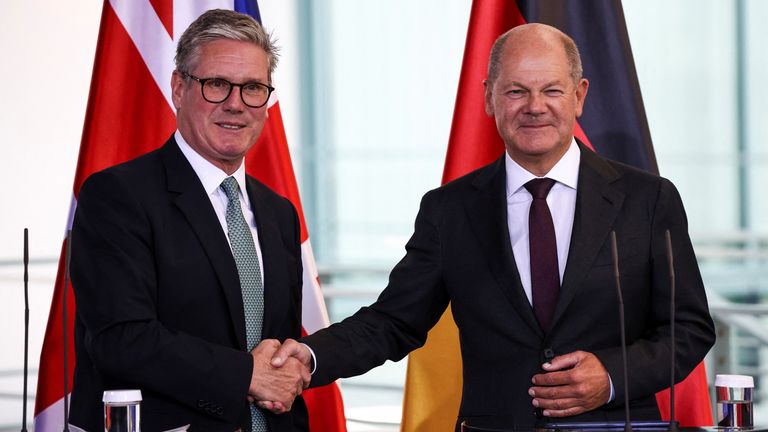
Britain and Germany Cement a New European Defence Order
The UK-Germany defence pact, first signed in 2024, is evolving into a landmark mutual defence treaty with global implications. Anchored in joint missile development, industrial integration, and space cooperation, it signals a new model of European defence leadership. As Britain and Germany deepen their partnership, alongside growing trilateral coordination with France, this agreement reshapes Europe’s strategic landscape—advancing autonomy while reinforcing NATO. The upcoming July 2025 treaty marks a pivotal shift from reactive defence to purposeful, future-driven military architecture.

Executive Summary
The UK-Germany defence pact—formalised in 2024 as the Trinity House Agreement—is now evolving into a full-fledged mutual defence treaty. Set to be signed on July 17, 2025, this treaty marks the most comprehensive bilateral military agreement between the two nations in modern history. It transcends traditional cooperation, embedding joint missile development, defence industrial integration, shared basing, cyber defence, and even space launch capabilities.
The deal not only strengthens NATO’s eastern flank but also positions Britain and Germany—together with France—as the principal architects of a more self-reliant and strategically autonomous European defence posture.
Context: From Framework to Treaty
Signed in October 2024, the Trinity House Agreement emerged in response to intensifying global volatility: Russia’s entrenched war in Ukraine, the US pivot to Asia, and Europe’s need to assume greater responsibility for its own defence.
For Germany, the deal represents the most assertive step in decades toward becoming a credible military power. For the UK, it offers a potent mechanism for shaping European security post-Brexit—particularly in defence, where cooperation remains politically feasible and strategically vital.
Since its inception, the agreement has rapidly progressed from concept to execution. A full mutual assistance clause—akin to NATO’s Article 5—will now be embedded in the forthcoming treaty, ensuring that a strategic threat to one country is treated as a threat to both.
Analysis: Strategic Depth in Five Dimensions
1. Deep Precision Strike Capability
At the heart of the agreement is the co-development of a 2,000-km long-range missile system, a European answer to Russia’s missile dominance and the post-INF Treaty vacuum. The project is officially under way, with feasibility and design coordination progressing under the Trinity House steering group.
2. Defence Industrial Integration
A new Rheinmetall production facility in the UK is manufacturing 120mm and 155mm artillery barrels, with land-systems partnerships expanding to include Boxer armoured vehicles and bridging systems. This underscores a shift toward supply chain sovereignty in Europe’s defence economy.
3. Operational Interoperability
German P‑8A Poseidon aircraft are now operating from RAF Lossiemouth, with British crews also flying German platforms. These joint deployments enhance maritime surveillance in the GIUK gap and represent the most advanced operational integration between the two nations to date.
4. Strategic Governance Infrastructure
A UK-Germany Defence Ministerial Council and Joint Steering Group have been created to align planning, procurement, and doctrine. This has elevated the partnership from tactical cooperation to a standing institutional framework, capable of long-term coordination.
5. Expansion into Space and Cyber
The two countries are collaborating on a rapid-response satellite launch capability based at SaxaVord in Shetland, aimed at reducing dependence on US space assets. Meanwhile, joint cyber defence protocols and digitalisation projects are enhancing resilience against hybrid threats.
Geostrategic Context: A London–Paris–Berlin Triangle Emerges
Beyond bilateralism, this pact is now forming the spine of a wider European defence axis. France and the UK signed the Northwood Declaration in July 2025, deepening nuclear coordination and force integration. Chancellor Friedrich Merz is expected to sign a broader UK-Germany treaty covering migration, innovation, and defence.
Together, these trilateral engagements signal the rise of a new power triangle—not as a substitute for NATO, but as a European-led core for strategic decision-making within the alliance.
Forecast: A Blueprint for Agile Defence Integration
This evolving UK-Germany alliance is likely to set the template for future defence pacts—flexible, deeply integrated, and tailored to 21st-century threats. It may:
- Inspire similar bilateral or trilateral pacts among other mid-sized NATO/EU powers.
- Help harmonise Europe’s fragmented defence procurement landscape.
- Increase the continent’s leverage in transatlantic negotiations, especially on industrial base cooperation.
However, challenges remain:
- Execution risk in joint missile and space projects.
- Budget strain, as NATO calls for defence spending to rise to 5% of GDP—more than double the current 2% target.
- Political friction, particularly in reconciling UK involvement with EU defence frameworks like PESCO and OCCAR.
Conclusion
The UK-Germany defence agreement is no longer a bold post-Brexit gesture—it’s becoming a foundational pillar of Europe’s military future. As the July 17 treaty signing looms, and a new Franco-German-British triangle gains coherence, this pact may prove to be Europe’s most consequential defence initiative since the Cold War.
In a world of renewed great-power rivalry, fragmented alliances, and contested domains, Europe is learning that its security cannot be subcontracted. And Britain and Germany are now at the helm of that reckoning.